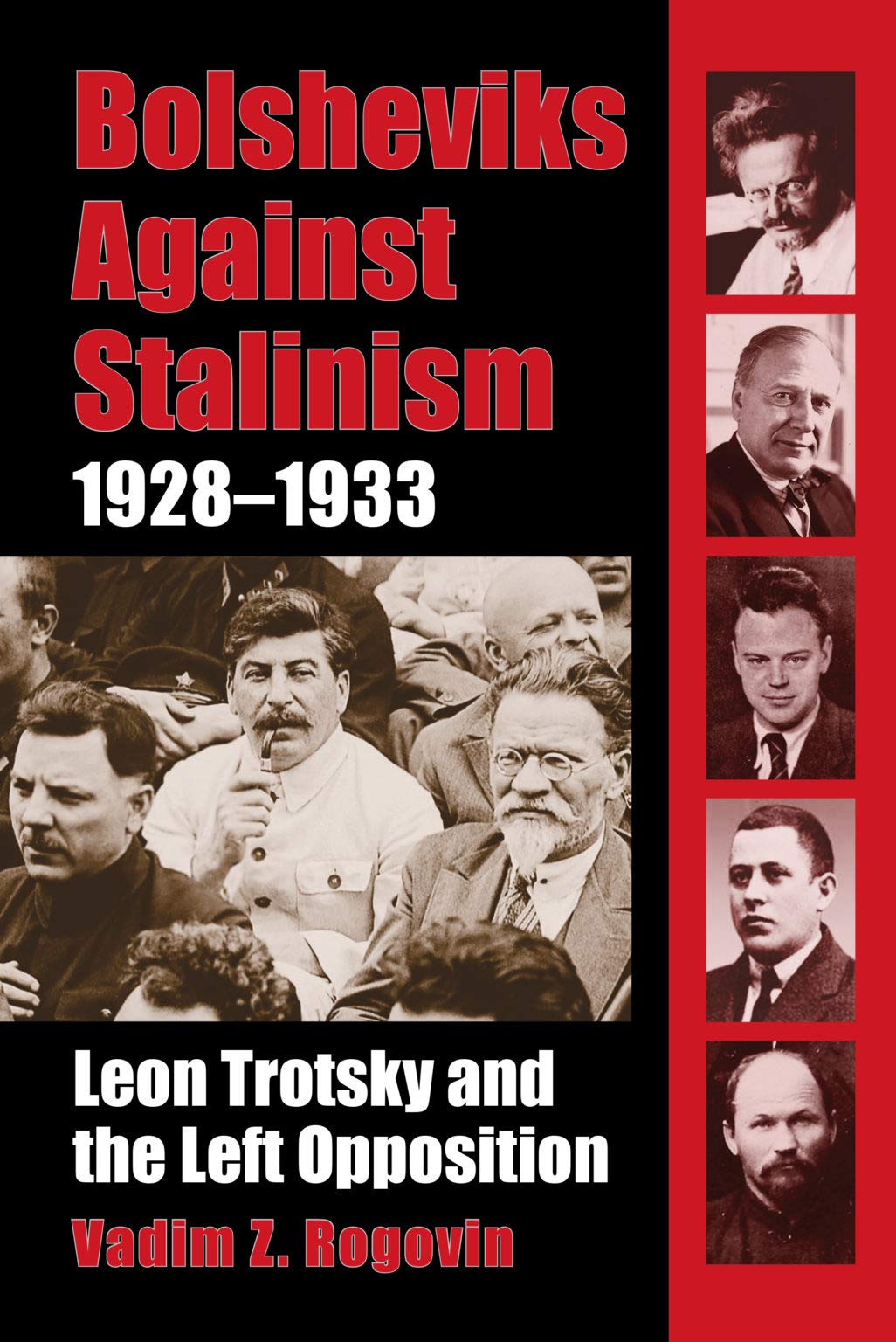



This is the second in a seven-volume series by the Russian Marxist historian, Vadim Rogovin, on the history of the Soviet Union between 1922 and 1940. Rogovin traces the inner-party struggles of 1928-1933, utilizing contemporaneous official documents; speeches and articles; Soviet archival material; memoirs of participants in political life; and documents by oppositionists in groups that were unknown to Soviet readers for many decades. The Left Opposition, led by Leon Trotsky, offered the most principled Marxist opposition to Stalinism, even as its members were being hounded into exile and imprisonment. Less known opposition groups, such as the Riutin group, are systematically presented. Rogovin analyzes the devastating impact of Stalinism on the Comintern. The alternative to Stalinism offered by the Left Opposition is presented chapter by chapter in this richly illustrated work. An appendix includes brief biographies of many oppositionists. The World Socialist Web Site and Mehring Books announce the publication of Bolsheviks Against Stalinism 1928 1933: Leon Trotsky and the Left Opposition by Marxist sociologist and historian Vadim Z. Rogovin (1937-1998). The release of the English-language version of the second volume in Rogovin s seven-volume series, Was There an Alternative to Stalinism?, is a major event in the fight against the falsification of Soviet history. It is part of the struggle to arm the international working class with the knowledge of its own revolutionary past, the necessary foundation for the building of a revolutionary future. In this second volume, Rogovin focuses on five critical years spanning the late 20s and early 30s. Rogovin s work demonstrates that there existed within the Soviet Union and internationally a powerful socialist opposition to Stalinism, led by Leon Trotsky. The expulsion of Leon Trotsky from the Soviet Union in 1929 failed to silence the great revolutionary and his many followers in the USSR. Trotsky s exposure of Stalin s betrayals encouraged the emergence of a broad network of oppositional groups, which the regime met with intensifying political repression. Careening from one economic and political crisis to the next, the Stalin regime continually confronted resistance to its policies from within the party and the working class, to which it responded with savage reprisals. Bolsheviks Against Stalinism begins with an introduction by the author that discusses the political significance of the book at the time it was first published in 1993. Rogovin observes that the restoration of capitalism in the USSR rested on false myths about Soviet history and false promises for the future, all aimed at securing the interests of the privileged by defaming socialism with historical lies. The biggest of all these lies was that Stalinism equaled socialism. To refute this, Rogovin poses, and his book answers, what he describes as the most complex historical riddle of the twentieth century. Why, on the ground prepared by the October Revolution, did there appear a phenomenon such as Stalinism? Bolsheviks Against Stalinism is a masterful account of the economic crises seizing the Soviet Union during this period, the origins, programs, and positions of the left and right oppositions that emerged to the bureaucracy, the recklessness and brutalities of collectivization, the material privileges of the party-state elite, the ideological war waged by the Stalinists against Marxism, the coming to power of Hitler, and Trotsky s relentless defense of revolutionary socialism. --World Socialist Web Site Vadim Rogovin (1937-1998) was a Doctor of Philosophical Sciences at the Institute of Sociology of the Russian Academy of Sciences in Moscow from the late 1970s until his death. Prior to this he had worked in the field of literary and aesthetic criticism. As a researcher at the Institute of Sociology, Rogovin studied and wrote about the existence and growth of social inequality in the USSR and its implications for social justice, labor productivity, and social morality in Soviet society. Rogovin s interest in analyzing the allocation of wealth and privileges in the Soviet Union grew out of political conclusions he drew about the origins of the Soviet bureaucracy. After having quietly gained access to some of the writings of the Left Opposition during the 1960s and 1970s, Rogovin, whose own grandfather had died in the purges, became convinced of the correctness of Leon Trotsky s opposition to Stalin. In the late 1980s, he became an outspoken critic of Mikhail Gorbachev s pro-market economic reforms and their negative impact on the living standards of the broad mass of the population. After writing articles in the popular Soviet press about the positions of the Left Opposition on major questions of politics and policy, Rogovin started publishing what would become a seven-volume series on the rise of Stalinism and the history of the socialist-based opposition to Stalin s rule. Before his untimely d