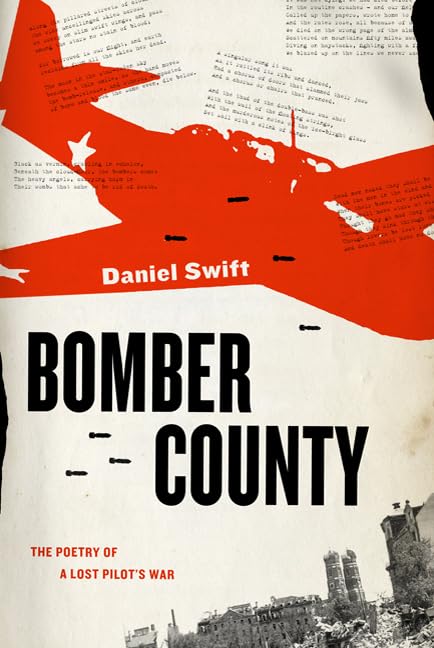



In early June 1943, James Eric Swift, a pilot with the 83rd Squadron of the Royal Air Force, boarded his Lancaster bomber for a night raid on Münster and disappeared. Widespread aerial bombardment was to the Second World War what the trenches were to the First: a shocking and new form of warfare, wretched and unexpected, and carried out at a terrible scale of loss. Just as the trenches produced the most remarkable poetry of the First World War, so too did the bombing campaigns foster a haunting set of poems during the Second. In researching the life of his grandfather, Daniel Swift became engrossed with the connections between air war and poetry. Ostensibly a narrative of the author’s search for his lost grandfather through military and civilian archives and in interviews conducted in the Netherlands, Germany, and England, Bomber County is also an examination of the relationship between the bombing campaigns of World War II and poetry, an investigation into the experience of bombing and being bombed, and a powerful reckoning with the morals and literature of a vanished moment. The literature of World War II has seen countless books covering just about every aspect of war imaginable, though few, if any, explore the poetry of air bombing. Using as his starting point a visit to his grandfather's grave and uncovering the man's story through documents, interviews, and histories, including W. G. Sebald's On the Natural History of Destruction , Swift succeeds in combining memoir, history, literary criticism, and biography--no easy matter. "I think I wanted to tell a story, and [my grandfather] was available" he writes, and he nimbly juggles the two very different parallel story lines. Although the story could have gotten away from him, Swift explains away the sometimes jarring juxtaposition of his grandfather's life and death with the poetry of annihilation. Swift writes well and with great insight, and the poetry becomes a lens through which he views the war's more complicated and poignant legacy. Part memoir, part historical analysis, part literary study, Swift’s book is a unique and moving addition to the literature of World War II. Swift’s grandfather was shot down while returning from a bombing raid on Germany. His body later washed up on the coast of the Netherlands, where he was buried with thousands of other soldiers. Decades later, Swift went in search of his lost grandfather, reconstructing his last years as he moved away from family and into the exciting and dangerous world of aviation. Swift does not dodge the moral questions about Britain’s bombing of Germany and the resultant high civilian death toll, nor does he deny the glamour of his grandfather’s chosen career. To capture that ambivalence and ambiguity, Swift turns to poets ranging from T. S. Eliot, John Ciardi, and Siegfried Sassoon to unpublished pilot poets whose work he found in historical museums. While his effort to understand his grandfather’s experience provides the book’s chronological structure, its heart is the poetry, which captured a war never before seen and rarely imagined. --Patricia Monaghan Daniel Swift has written for Bookforum , The New York Times Book Review , and The Times Literary Supplement . Bomber County Chapter 1. Five Minutes after the Air Raid 12 June 1943 After the air raid, Virginia Woolf went for a walk. 'The greatest pleasure of town life in winter - rambling the streets of London,' she had written, a decade before. She called it 'street haunting', and in the essay of that title she gives instructions on how this should be done. 'The hour should be the evening and the season winter, for in winter the champagne brightness of the air and the sociability of the streets are grateful,' she wrote: 'The evening hour, too, gives us the irresponsibility which darkness and lamplight bestow. We are no longer quite ourselves.' Picture her, then, stepping out into the bombed city. It is perhaps a little earlier in the day than she might have liked, this afternoon in the middle of January 1941, and in less than three months she will be dead, but today she is here to take a quiet pleasure in the ruins. 'I went to London Bridge,' she notes in her diary: I looked at the river; very misty; some tufts of smoke, perhaps from burning houses. There was another fire on Saturday. Then I saw a cliff of wall, eaten out, at one corner; a great corner all smashed; a Bank; the Monument erect; tried to get a Bus; but such a block I dismounted; & the second Bus advised me to walk. A complete jam of traffic; for streets were being blown up. So by tube to the Temple; & there wandered in the desolate ruins of my old squares; gashed; dismantled; the old red bricks all white powder, something like a builders yard. Grey dirt & broken windows; sightseers; all that completeness ravished & demolished. She is watching carefully, making her way north and then west, through traffic jams and rubble, and she pauses for a while in