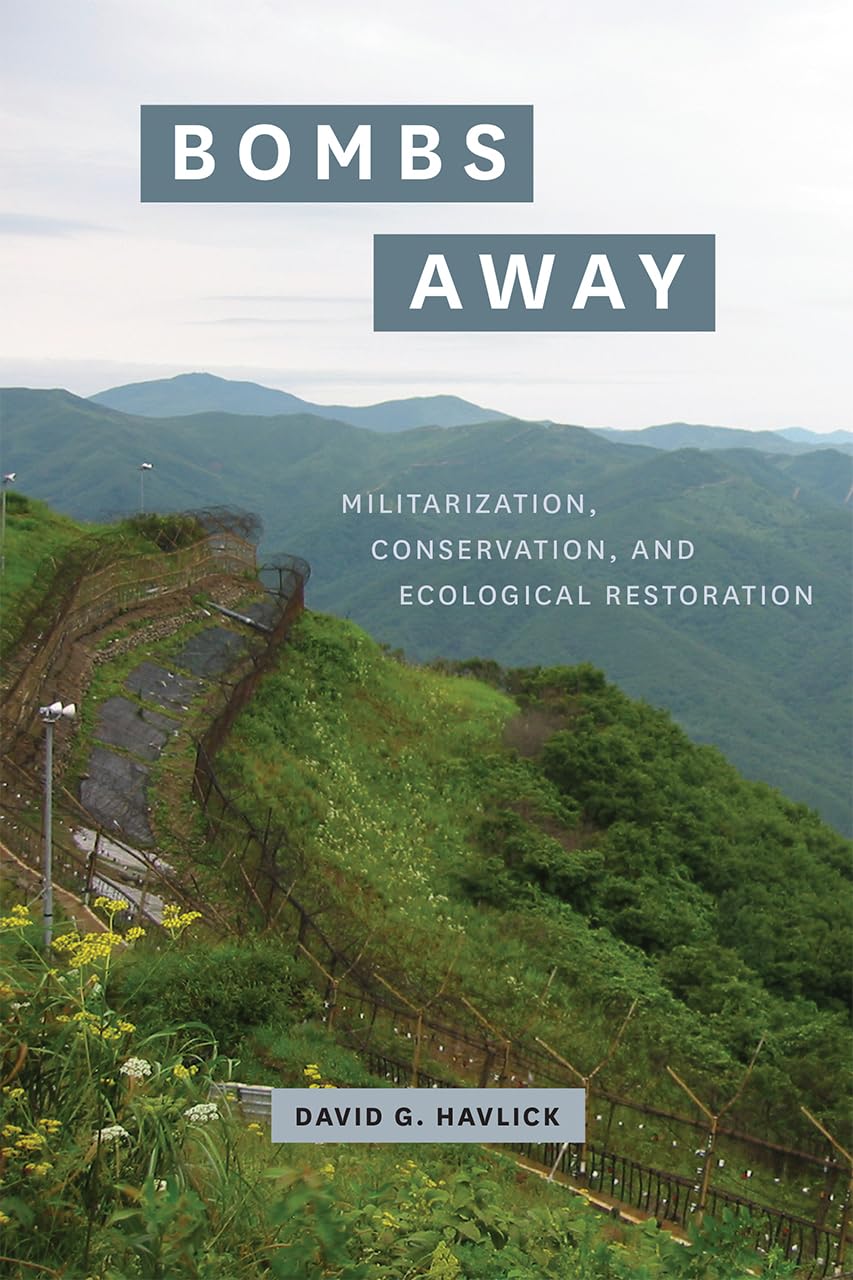
Bombs Away: Militarization, Conservation, and Ecological Restoration
$38.00
by David G. Havlick



When viewed from space, the Korean Peninsula is crossed by a thin green ribbon. On the ground, its mix of dense vegetation and cleared borderlands serves as home to dozens of species that are extinct or endangered elsewhere on the peninsula. This is Korea’s demilitarized zone—one of the most dangerous places on earth for humans, and paradoxically one of the safest for wildlife. Although this zone was not intentionally created for conservation, across the globe hundreds of millions of acres of former military zones and bases are being converted to restoration areas, refuges, and conservation lands. David G. Havlick has traveled the world visiting these spaces of military-to-wildlife transition, and in Bombs Away he explores both the challenges—physical, historical, and cultural—and fascinating ecological possibilities of military site conversions. Looking at particular international sites of transition—from Indiana’s Big Oaks National Wildlife Refuge to Cold War remnants along the former Iron Curtain—Havlick argues that these new frontiers of conservation must accomplish seemingly antithetical aims: rebuilding and protecting ecosystems, or restoring life, while also commemorating the historical and cultural legacies of warfare and militarization. Developing these ideas further, he shows that despite the ecological devastation often wrought by military testing and training, these activities need not be inconsistent with environmental goals, and in some cases can even complement them—a concept he calls ecological militarization. A profound, clear explication of landscapes both fraught and fecund, marked by death but also reservoirs of life, Bombs Away shows us how “military activities, conservation goals, and ecological restoration efforts are made to work together to create new kinds of places and new conceptions of place.” “It is vital to remember other kinds of military legacies, too, as Havlick’s book, Bombs Away , powerfully demonstrates. . . . It is easy to see the conversions as ecological success stories—and in many ways they are. But Havlick is adamant that this coat of green paint mustn’t obscure sites’ uncomfortable histories and legacies, in many cases of unexploded ammunition, toxic chemicals, and human displacement. . . . Havlick’s aim is to nettle us out of an easy complacency about our military history and future. Sadly we may not need that nettling now.” -- Bob Holmes ― New Scientist “The author approaches his topic with the refreshing breadth of a geographer, looking beyond wild-life considerations to include the complex human histories of military landscapes. . . . Havlick’s treatment is even-handed and thought-provoking throughout, enriched by personal travels to many of the places in question. . . . Bombs Away makes a valuable contribution to an emerging field by significantly broadening the discussion of nature conservation on military landscapes. It will be a go-to reference for anyone looking for case studies on the challenges of integrating history, ecological restoration, social justice, biodiversity conservation, and other overlapping issues facing landscapes touched by warfare.” -- Thor Hanson, author of "Buzz" ― Quarterly Review of Biology “Havlick’s treatise on the status quo of militarized landscapes is one of those rare part-academic/part-pop science books that grabs you and does not let go until you find yourself sharing the author’s philosophy. . . . You will find yourself immersed in this geography teacher’s train of thoughts on the history, ethics and politics of militarized landscapes such as barracks, proving grounds and air bases—a ride fueled by his travel and research experience. . . . Havlick’s deep dive into military environmentalism is an important chapter in environmental history.” -- Vijay Shankar Balakrishnan ― SEJ BookShelf “Compact and accessible. . . . Its seven chapters analyze converted military sites from social, political, and environmental perspectives, using evidence from interviews, government documents, and site visits. The author's lucid style of writing and personal experience—he grew up near the highly toxic Rocky Mountain National Arsenal, now a National Wildlife Reserve—will engage readers, both general and specialist. . . . Bombs Away has few weaknesses, being built on a solid theoretical background illustrated by well chosen case studies. . . . In short, scholars should welcome Havlick's fine study as a model for adding missing pieces.” -- Tom J. Arnold, San Diego Mesa College ― Michigan War Studies Review “[A] thoughtful and interdisciplinary study. . . . One of the book’s many strengths is that the author draws on his notes and observations from personal visits to many of these M2W refuges, not only to those in the United States, notably the Rocky Mountain Arsenal National Wildlife Refuge near Denver, Colorado, but also to those elsewhere in the world, such as the Iron Curtain Trail in Central Europe and the Hiroshima Pea