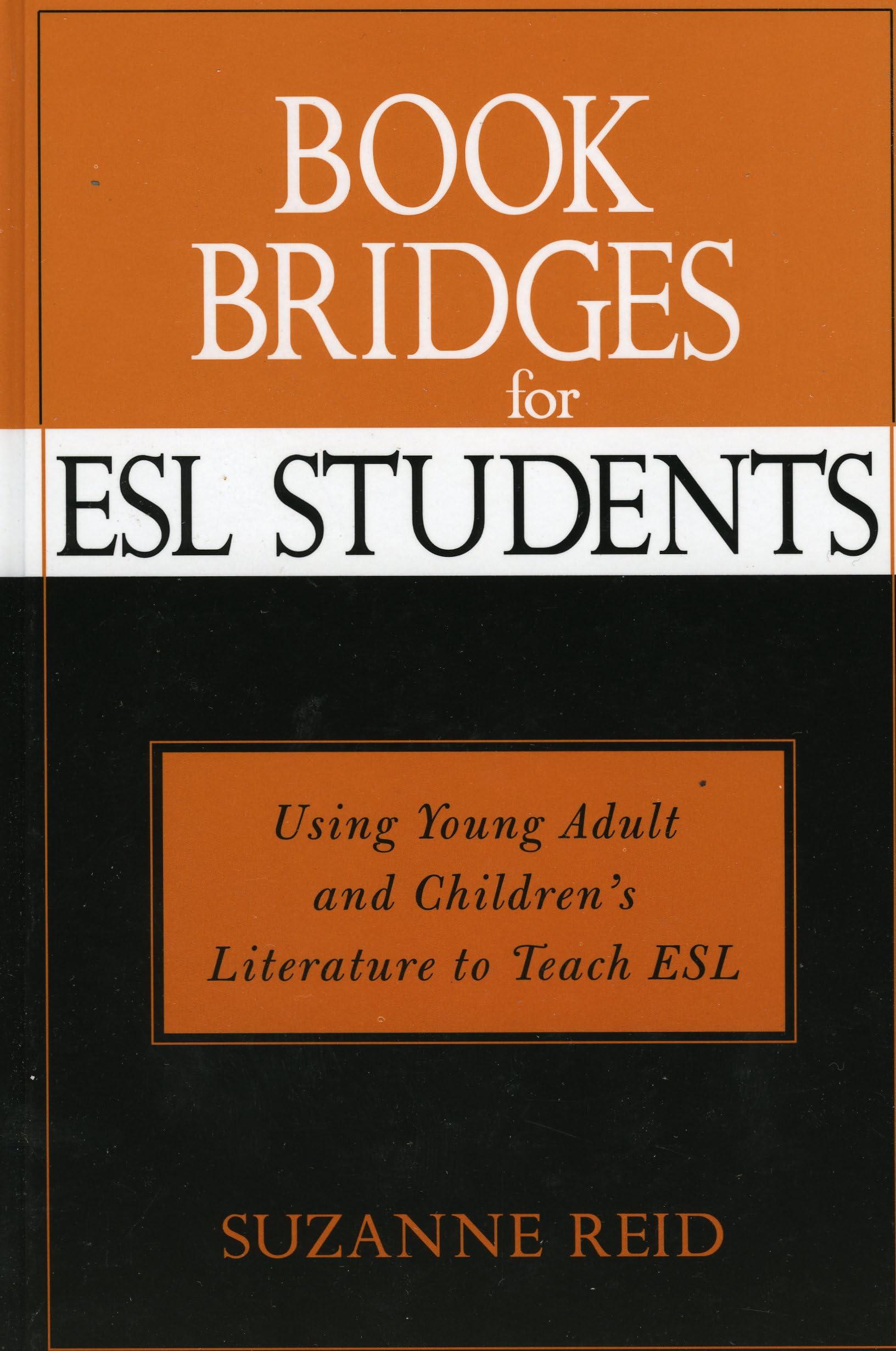
Book Bridges for ESL Students: Using Young Adult and Children's Literature to Teach ESL (Scarecrow Studies in Young Adult Literature)
$64.89
by Suzanne Elizabeth Reid



This easy-to-use handbook will help teachers whose classrooms include students whose first language is not English. The focus is on books written for children or teens, which can serve as a valuable teaching tool for language-attractive illustrations, simple plots, and easy vocabulary deal with familiar situations so that language is acquired easily and the students maintain a high degree of interest. Even picture books, traditionally designed for the very young, now appear with intelligent wit and sophisticated themes that make this literature both accessible for new learners of English and suitable for older students. The more advanced books for intermediate readers have exciting, uncomplicated plots that will motivate teens to develop reading fluency while providing vocabulary and subject matter for participation in class discussions. Book Bridges is a complete teaching resource, replete with activities, suggested materials for classroom use, and lesson plans. In addition, it will serve as a useful reader's advisory tool for public libraries serving teens learning English. This very complete book begins with the basics, the "first steps" that an ESL teacher should take with a new class. Reid makes it clear that English is a complex language, and that it takes from seven to nine years to achieve a "cognitive/academic language proficiency" to be able to understand textbooks, lectures, and other academic materials. From there, she segues into the hows and whys of using literature as a teaching tool, ranging from picture books for beginning speakers to simple novels and nonfiction titles to help teach history, math, and science. One of the approaches that she suggests is the "multiple-pass" technique, where the instructor first reads the book aloud, pausing and discussing words and concepts with students, and then reads it again without interruption. A chapter is aimed at "special" populations, such as children of migrant workers. The book includes a bibliography of titles for children and young adults, a selected annotated bibliography of resources for teachers, and an index, which includes titles recommended throughout the book. A clear and straightforward presentation for both novice and more experienced ESL teachers. Marlyn K. Roberts, City of Long Beach Public Library, CA Copyright 2002 Cahners Business Information, Inc. A college professor who teaches courses in literature for young adults and children and English as a Second Language has produced this resource. It seeks to bring together books of varied styles and subjects and students with different levels of competence in English. Following an introduction to the issues found in teaching ESL students, are chapters that deal with specialized topics such as using picture books and teaching science and math. Each chapter provides concrete techniques and activities for teaching ESL students. The book ends with a bibliography of the books used in various chapters, an annotated list of resources for teachers, and an author-title index. The concepts in this work are clearly presented. While few books are used as examples, the principles of teaching ESL students can be applied to other books selected by teachers. Sharon E. Cohen Copyright © American Library Association. All rights reserved “A clear and straightforward presentation for both novice and more experienced ESL teachers.” ― School Library Journal “Each chapter provides concrete teaching techniques and activities for teaching ESL students.” ― Booklist “This easy-to-use handbook will help teachers whose classrooms include students whose first language is not English.” ― Hispanic Outlook “This text's inspired use of juvenile books will serve as a welcome-and reassuring-guide” ― VOYA “Each chapter provides concrete teaching techniques and activities for teaching ESL students” ― Booklist Suzanne Elizabeth Reid is assistant professor at Emory & Henry College in Emory, Virginia, where she teaches courses in Literature for Young Adults and Children and Teaching English as a Second Language. Used Book in Good Condition