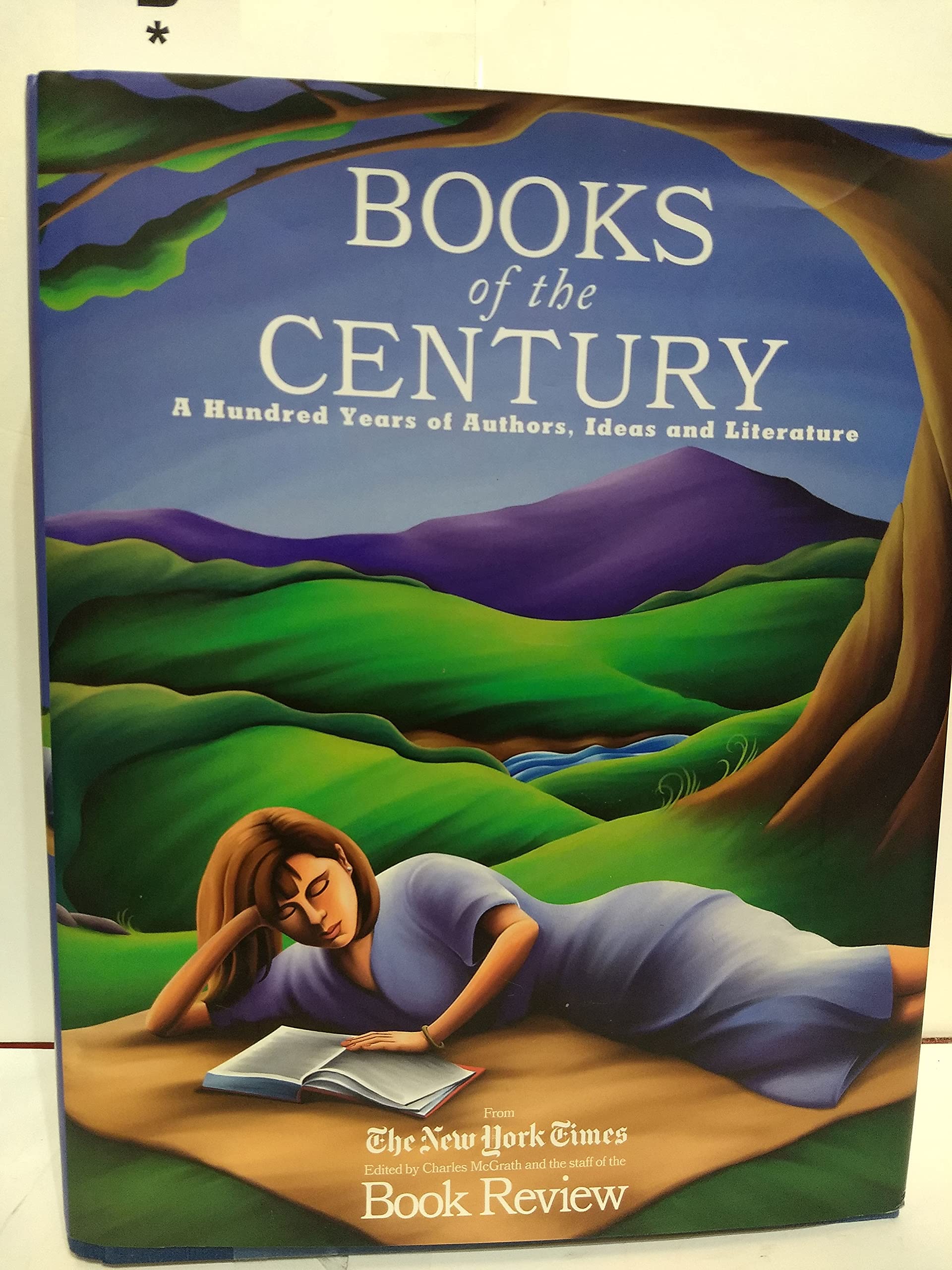
Books of the Century: A Hundred Years of Authors, Ideas, and Literature
$12.97
by New York Times Book Review



Books of the Century is an extraordinary collection of the best writing about books and authors published in The New York Times Book Review , America's most widely read journal of the literary arts. Arranged chronologically from 1896 through 1997, this rich chronicle leads the reader through a century of historic literary achievements, while also providing memorable portraits of the most significant writers and thinkers of the era. Often the critics are as distinguished as the authors and books they review: Eudora Welty's sparkling discussion of E. B. White's Charlotte's Web, John Updike's perceptive review of J. D. Salinger's Franny and Zooey, and W. H. Auden's appreciation of J.R.R. Tolkien's The Fellowship of the Ring are a few of the memorable critiques contained within these pages. In addition to dozens of influential reviews of seminal books, Books of the Century includes several special features that will delight all booklovers. Essays includes such highlights as Alice B. Toklas evoking Jazz Age Paris and Dr. Seuss chuckling over children's sense of humor. First Impressions features the initial reviews of such luminaries as Virginia Woolf, George Orwell, Dashiell Hammett, Saul Bellow, Flannery O'Connor, and Derek Walcott. Interviews offers such unique voices as Willa Cather, Vladimir Nabokov, Milan Kundera, and Norman Mailer, heard with force and clarity. Letters revives some remarkably keen and unexpected insights, like Alan Greenspan's passionate defense of Ayn Rand's legacy and William Manchester's recollection of H. L. Mencken's contribution to the American language. Oops! recalls reviews that panned soon-to-be classics such as Catch-22 and Catcher in the Rye on their first appearance, showing that even The New York Times Book Review errs on occasion. Editors' Choice, an annual feature chartered in 1972, and running here through 1997, reflects our changing literary tastes. YA-To celebrate the publication's 100th anniversary, the editors of the New York Times Book Review selected offerings dating back to 1896 that reflect the trends, styles, interests, and level of writing of each of the 10 decades. As readers browse through the pages and begin to digest the plethora of literary criticism that they contain, it soon becomes apparent that-despite the transitory nature of most of the literary entries-they still provide ample entertainment and education. During the early 1950s, Eudora Welty wrote a short, lyrical, and poignant appraisal of E. B. White's Charlotte's Web that ended with the sentence, "'At-at-at, at risk of repeating myself' as the goose says, Charlotte's Web is an adorable book." In referring to Thomas Keneally's Schindler's List, the editor sums up this unforgettable tale of an imperfect, but noble, human being's successful effort to thwart the Nazi Holocaust. Keneally "tells the true story of a man who saved lives that the sinews of civilization were bent on destroying." Letters, essays, and interviews from the archives add greatly to the value of this anthology. Since students often have to obtain book reviews from an earlier era, this excellent literary compilation can provide them with a potpourri of choices. Peggy Mooney, Pohick Public Library, Burke, VA Copyright 1999 Reed Business Information, Inc. This enhanced version of the centennial issue of the New York Times Book Review offers, in a more permanent form, the pleasures of that retrospective: a broad sampling of pieces drawn from the pages of the section launched in 1897 and thus, given the considerable influence and scope of the weekly journal, a record in microcosm of the evolution of the genre of the book review. The 250 selections include excerpts from essays by influential writers, interviews, and reviews. Some of the reviews seem, inevitably, rather dated. others (such as a review of Thomas Mann's The Magic Mountainin 1927) seem to possess an undimmed freshness and accuracy. As McGrath, the current editor of the Review, points out in his succinct Introduction, reviews remain an ephemeral but necessary form, the first and (sometimes) the best response to new work. Gathering so many of them together offers the browser a rare sense of, in McGrath's words, ``literary immediacyof what it was like, of initial and immediate reaction, when some of the most important or influential books of the century first came into view.'' A lively, often surprising, and entertaining companion for serious readers. (Author tour) -- Copyright ©1998, Kirkus Associates, LP. All rights reserved. A 1924 appreciation of A Passage to India (page 53) "One of the saddest, keenest, most beautifully written ironic novels of the time. Saying so much one is forced to say much more, for Mr. Forster's quality is unique." Dick Schaap's 1969 first impression of Mario Puzo's The Godfather (page 266) "There are strong similarities between Michael Corleone and Alexander Portnoy. Neither . . . wishes to enter his father's line of work