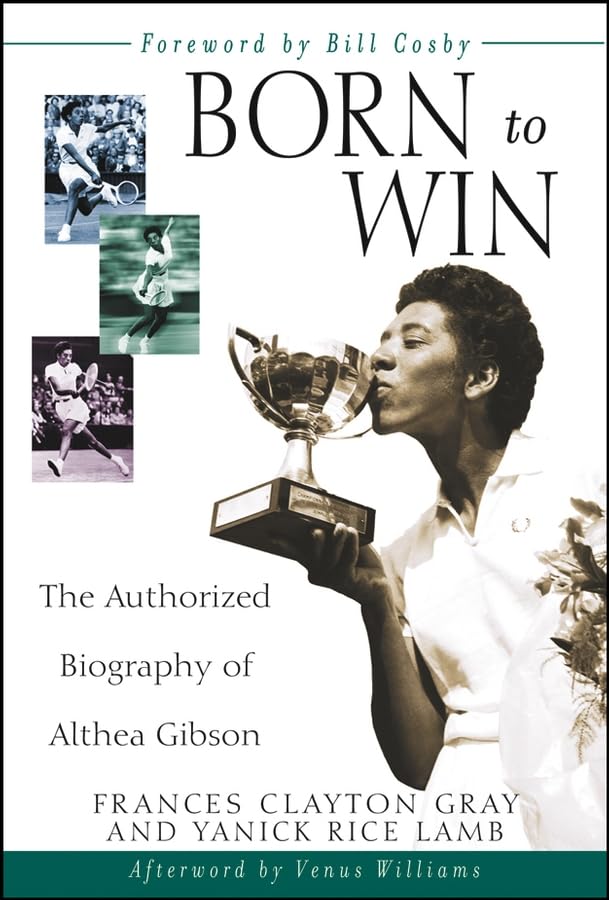



On Althea Gibson, America's first African American tennis champion: "I am grateful to Althea Gibson for having the strength and courage to break through the racial barriers in tennis. She knocked down walls that gave us more freedom to concentrate on the game. . . . Althea's accomplishments set the stage for my success, but she also made a difference for people of all backgrounds in all areas. Through beneficiaries like me, Serena, and many others to come, her legacy will live on." -Venus Williams "She just meant so much to me. I've always felt connected to her and thankful and grateful for what she's done for people of color and me." -Billie Jean King "Althea built many bridges over her seventy-six years on this earth to ease our crossing. . . . She fought the good fight, she finished her course, she kept her faith, and she can rest-game, set, and match." -David Dinkins former mayor of New York City "It was the quiet dignity with which Althea carried herself during the turbulent days of the 1950s that was truly remarkable. . . . When she began playing, less than five percent of tennis newcomers were minorities. Today, some thirty percent are minorities, two-thirds of whom are African American. This is her legacy." -Alan Schwartz President, U.S. Tennis Association Althea Gibson won both Wimbledon and the U.S. Open tennis titles in 1957 and 1958, achievements made all the more significant because, at that time, it was almost unknown for African Americans to compete in the sport. Gray, Gibson's longtime friend, relates a life filled with sporting excellence and personal struggles against racism. The compelling aspect of Gibson's battles as a black woman in a very white sport was the solitary nature of her crusade. Jackie Robinson had Branch Rickey, but none of Gibson's advocates possessed that level of personal clout or institutional leverage. Gray enumerates Gibson's journey through the sporting world, her money struggles, and her lack of endorsements. Gibson seldom took her frustrations public, internalizing them instead. In the years preceding her death in 2003 at 76, she was bitter and virtually penniless. Gray presents a balanced portrait of a life that had its storybook moments but was missing the happily-ever-after ending. Thought-provoking reading, especially for those who think the integration of sport was accomplished solely by Jackie Robinson. Wes Lukowsky Copyright © American Library Association. All rights reserved "I knew that I was an unusual, talented girl through the grace of God. I didnt need to prove that to myself. I only wanted to prove it to my opponents." Althea Gibson Born to Win is the first and only fully authorized biography of the late great Althea Gibson, the first African American to break the color line in tournament tennis. Cowritten by Frances Clayton Gray, who was Gibsons confidante and caretaker and is now executor of her estate, and journalist Yanick Rice Lamb, this authorized biography sheds new light on Gibson, from her childhood in Harlem and her ten-year reign as champion of the all-black American Tennis Association to her historic 1950 debut at Forest Hills and her momentous victories of 1957 and 1958, when she swept both Wimbledon and the U.S. Open. This riveting account reveals how Gibson distinguished herself as a champion in a long and diverse athletic career, helping to pave a path for such modern-day sports phenomena as Tiger Woods and Venus and Serena Williams. A strong-willed child who skipped school frequently and had a reputation for being a tough girl, Gibson nevertheless developed a solid work ethic and a desire for independenceand was a natural athlete to boot. Youll follow her as she picks up a tennis racket for the first time and goes on to compete in her first tournament, setting the stage for a remarkable journey. At 5 feet 11, Gibson had the height, speed, and reach to dazzle a crowd by returning shots that seemed guaranteed to get away, and she devised brilliant strategies to zero in on her opponents weaknesses. She garnered international acclaim, earned numerous titles, and set records that have yet to be broken. Yet, while people of all colors celebrated her triumphs, Althea also battled discrimination, naysayers who questioned her wins, and reporters who wondered whether success was going to her head. Even as she broke barriers, others would fall into place. Youll hear from Gibson herself, as well as her family and supporters, as she faces numerous challenges that sharpen her game, strengthen her confidence, and test her resolve. Youll also see how an ongoing series of personal disappointments, slights, and setbacks stoked an underlying bitterness in Gibsoneven as she continued to make contributions that transcended race and gender and set an example for younger players. And youll discover how she helped revolutionize the entire universe of sports, making strides that have benefited everyone from Billie Jean King t