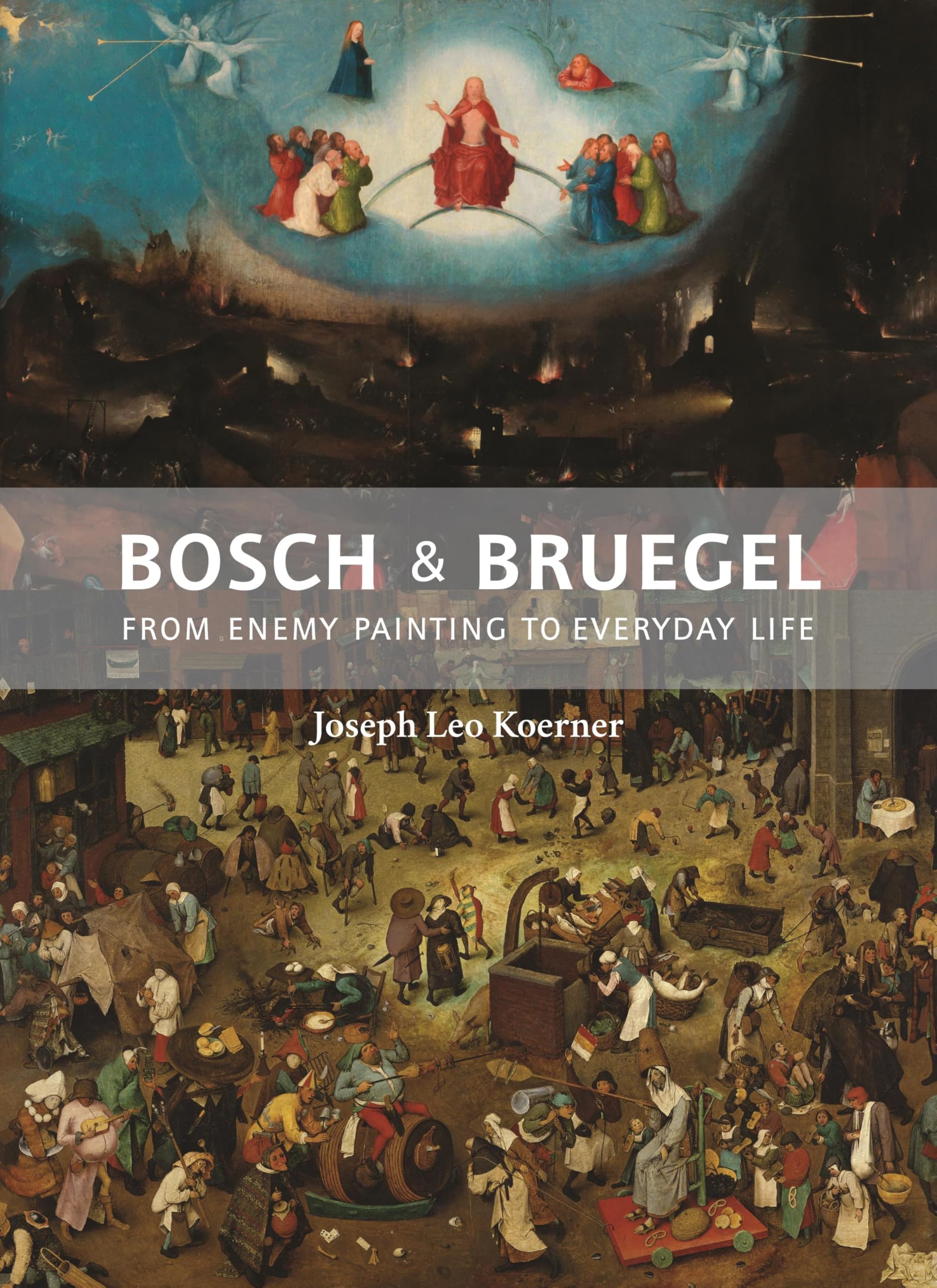
Bosch and Bruegel: From Enemy Painting to Everyday Life (The A. W. Mellon Lectures in the Fine Arts)
$41.99
by Joseph Leo Koerner



A bold new interpretation of two northern Renaissance masters In this visually stunning and much anticipated book, acclaimed art historian Joseph Koerner casts the paintings of Hieronymus Bosch and Pieter Bruegel in a completely new light, revealing how the painting of everyday life was born from what seems its polar opposite: the depiction of an enemy hell-bent on destroying us. Supreme virtuoso of the bizarre, diabolic, and outlandish, Bosch embodies the phantasmagorical force of painting, while Bruegel, through his true-to-life landscapes and frank depictions of peasants, is the artistic avatar of the familiar and ordinary. But despite their differences, the works of these two artists are closely intertwined. Bruegel began his career imitating Bosch's fantasies, and it was Bosch who launched almost the whole repertoire of later genre painting. But Bosch depicts everyday life in order to reveal it as an alluring trap set by a metaphysical enemy at war with God, whereas Bruegel shows this enemy to be nothing but a humanly fabricated mask. Attending closely to the visual cunning of these two towering masters, Koerner uncovers art history’s unexplored underside: the image itself as an enemy. An absorbing study of the dark paradoxes of human creativity, Bosch and Bruegel is also a timely account of how hatred can be converted into tolerance through the agency of art. It takes readers through all the major paintings, drawings, and prints of these two unforgettable artists―including Bosch’s notoriously elusive Garden of Earthly Delights , which forms the core of this historical tour de force. Elegantly written and abundantly illustrated, the book is based on Koerner’s A. W. Mellon Lectures in the Fine Arts, a series given annually at the National Gallery of Art, Washington. Published in association with the Center for Advanced Study in the Visual Arts, National Gallery of Art, Washington, DC "Winner of the 2017 PROSE Award in Art History & Criticism, Association of American Publishers" "One of the Evening Standard Best Art Books of 2017 (chosen by David Ekserdijian)" "More gripping than a thriller. . . . A frightening, fascinating study. . . . It is rare, when reading a work of scholarly criticism, to be so gripped as to feel nervous about turning the page. Be warned: there are chapters here more frightening than a thriller because they allow us to see, with Bosch, infinitely multiplying sin. . . . This is a book to read and reread in any moment of doubt about what critical analysis can achieve. Koerner believes that every painting by Bruegel ‘can sustain a lifetime of looking.' He has written a passionately attentive book that brings all life to bear on these pictures, and makes one feel that a lifetime of looking would be well spent." ---Alexandra Harris, The Guardian "[An] eloquent and rich exploration . . . based on Koerner's A.W. Mellon Lectures in the Fine Arts at the National Gallery of Art in Washington, the series of talks seamlessly form a book of linked essays that discuss individual paintings, with magnifying precisions, while simultaneously advancing a broader theory on art in a Europe emerging from its dark ages. . . . [Koerner's] observations bring Bosch's work into relevance today." ---Nina Siegal, New York Times Book Review "A new book by Joseph Koerner is always an event. Here, as usual, he seems to have read everything and to have thought about everything connected with his chosen subject. . . . But it is his ability to look and to find words for what he is looking at that sets him in the very front rank of art historians. . . . A magnificent achievement, with something to arrest and challenge on every one of its 400-plus pages." ---Gabriel Josipovici, Times Literary Supplement "Among the many publications about art I acquired or received, the most important were Bosch and Bruegel: From Enemy Painting to Everyday Life , a long-awaited, provocative study of these two key painters by Harvard art historian Joseph Leo Koerner." ---Sebastian Smee, Boston Globe "This book is a lucid and rewarding read, and lavishly illustrated with 325 reproductions. . . . [Koerner's] use of illustration details from the paintings is particularly effective. . . . Koerner navigates deftly through fraught attributions and interpretative controversies. . . . [His] discussion of Romanesque grotesque sculpture and Bosch’s compelling organic monsters is illuminating. . . . With Koerner, the reader steps into these scenes. . . . Koerner compares analysing Bosch and Bruegel to 'looking for a watershed in marshland', and he does an admirable job of it."" ---Tracey Warr, Times Higher Education "An extremely thoughtful, wide-ranging examination of Hieronymus Bosch (?1450–1516) and Pieter Bruegel (1525–69), who have been considered together almost from their own time, this volume attests to the layers of meaning invested in these artists and to Koerner's erudition." ― Choice "At the intellectual he