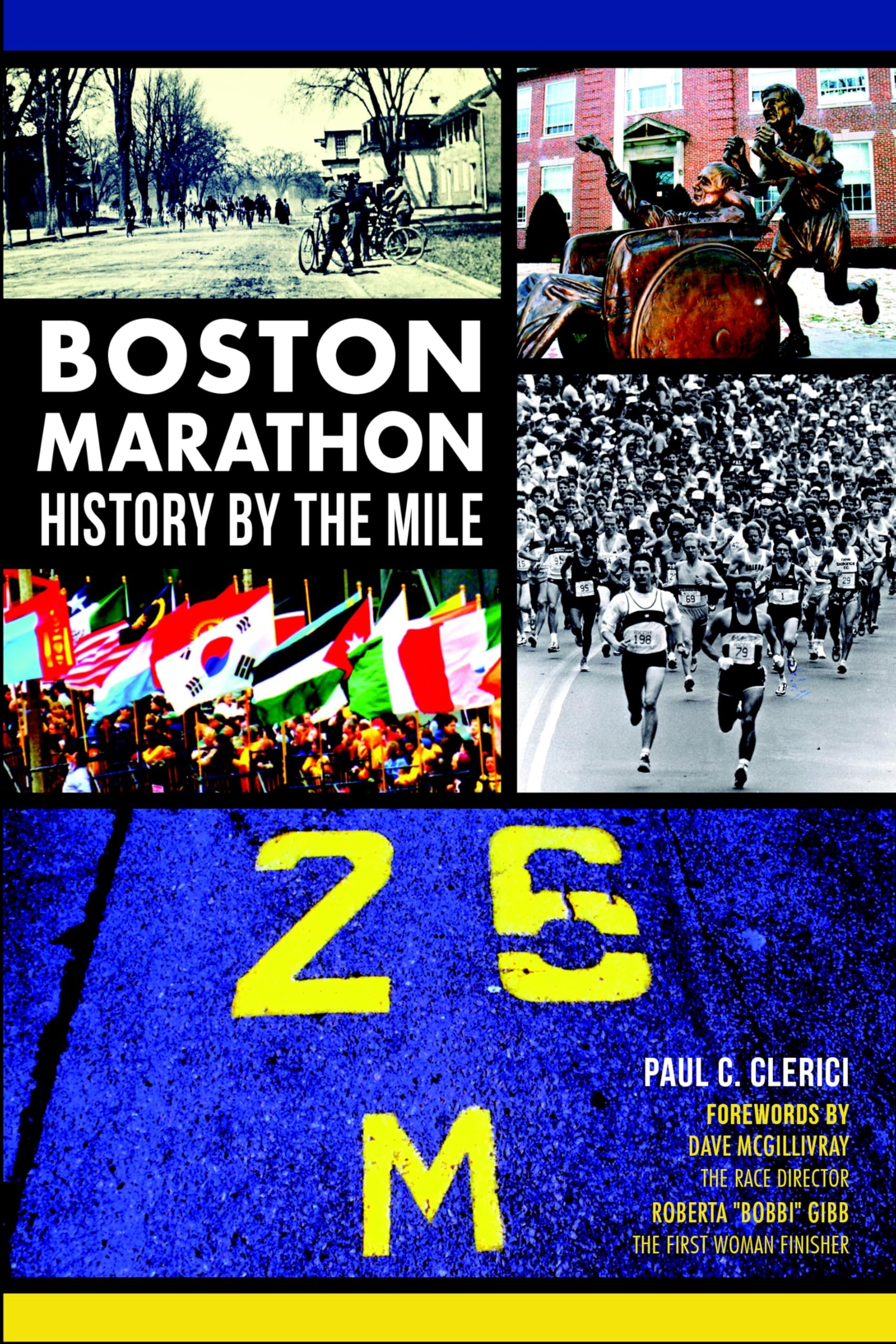



Author and marathon veteran Paul C. Clerici's inside look of the Boston Marathon route and the history it holds. From Hopkinton to Boylston Street, the beloved 26.2 miles of the Boston Marathon mark historic moments and memories dating back to 1897. Town by town and step by step, follow author, journalist, and runner Paul C. Clerici as he goes deeper into each town and city along the route with firsthand descriptions of the course from the uphill climbs to the spirited sprints. Insightful anecdotes, from the naming of Heartbreak Hill to the incorporation of women runners, reveal meaningful racing heritage along the route. This comprehensive and unique journey also explores the stories behind notable landmarks, statues, and mile markers throughout the course. Woven into the course history is expert advice on how to run each leg of the race from renowned running coach Bill Squires. Whether you're a runner, spectator, or fan, Boston Marathon History by the Mile has it all. Paul C. Clerici is a freelance journalist, writer, photographer and former newspaper editor and sports editor. A dedicated runner, Clerici has competed in nearly every distance from the mile to the marathon, including 2 triathlons, more than 40 marathons, and the Boston Marathon more than 20 years in a row. First woman to run the BAA Boston Marathon Boston Marathon History by the Mile By Paul C. Clerici The History Press Copyright © 2014 Paul C. Clerici All rights reserved. ISBN: 978-1-62619-475-5 Contents Foreword, by Dave McGillivray, Foreword, by Roberta "Bobbi" Gibb, Acknowledgements, Introduction, 1. The Boston Marathon, 2. Hopkinton: Miles 0.00 to 1.90, 3. Ashland: Miles 1.90 to 4.95, 4. Framingham: Miles 4.95 to 7.52, 5. Natick: Miles 7.52 to 11.72, 6. Wellesley: Miles 11.72 to 15.93, 7. Newton: Miles 15.93 to 21.35, 8. Brighton/Brookline: Miles 21.35 to 24.70, 9. Boston: Miles 24.70 to 26.20, 10. Memorial, Bibliography, About the Author, CHAPTER 1 THE BOSTON MARATHON Like most great things in life, the Boston Marathon in its current form of nearly thirty thousand participants began humbly enough, with but fifteen men. Thanks to a handful of members of the nine-year-old Boston Athletic Association (BAA) who competed in and witnessed the beautiful and otherworldly 1896 Modern Olympic Games in Athens, Greece, a spark was kindled that remained burning on their return home to America. Of the dozen men-only events at the Games, the marathon, in particular, so struck John Graham, the club's coach/manager, that the seed was planted for what would become the grand dame of marathons. The marathon is modeled after the accepted mythological story of ancient Greek soldier and messenger Pheidippides, who after a twenty-four-mile run from the battlegrounds of Marathon to the city of Athens in 490 BC to report the Athenian victory over the superior Persian forces, proclaimed, "Nenikekamen!" ("We have won!") and instantly succumbed to a heroic death. Despite the historically and factually combined legend, the amalgamation survived to inspire millions. So much so that the word itself — marathon — has become known as more than a town in Greece; it is the pinnacle of duration, a far cry from its root origin as that of the flowered plant marathos (known as fennel) from that region of the world. The first marathon footrace was held on March 10, 1896, in Greece and served as an ancient "qualifier" for the Modern Olympic Games marathon one month later, on April 10, 1896. Fittingly, the hometown Greeks won both races — Kharilaos Vasilakos in its debut and Spyridon Louis in the Olympics. At the time in the United States, the BAA held its own multi-event competition called, simply enough, the BAA Games. From the Olympics, Graham had brought with him the embryonic idea and plans that would become the closing event of the BAA Games on April 19, 1897. According to the BAA, it was known in its infancy by several names, including the American Marathon, the BAA Road Race, and the BAA Marathon. And much like the 1896 Olympic Marathon was the second one held, so, too, was Boston's in the United States. About six months prior to the BAA's race, there had been a marathon that ran from Stamford, Connecticut, to the Knickerbocker Athletic Club at the Columbia Circle Oval in New York City. Interestingly, the victor of both U.S. marathons was John J. McDermott of New York. To create the new course that approximated the Greek distance of about forty kilometers (24.85 miles), it was initially thought to follow in reverse order the route of Paul Revere's famous Midnight Ride of April 18–19, 1775, to warn of the British soldiers who were on their way to arrest soon-to-be president of the Continental Congress John Hancock and future Massachusetts governor Samuel Adams. Revere's ride, which took him from Charlestown to Boston (via the Charles River by boat) and then through Somerville (part of Charlestown back then), Medford (Mist