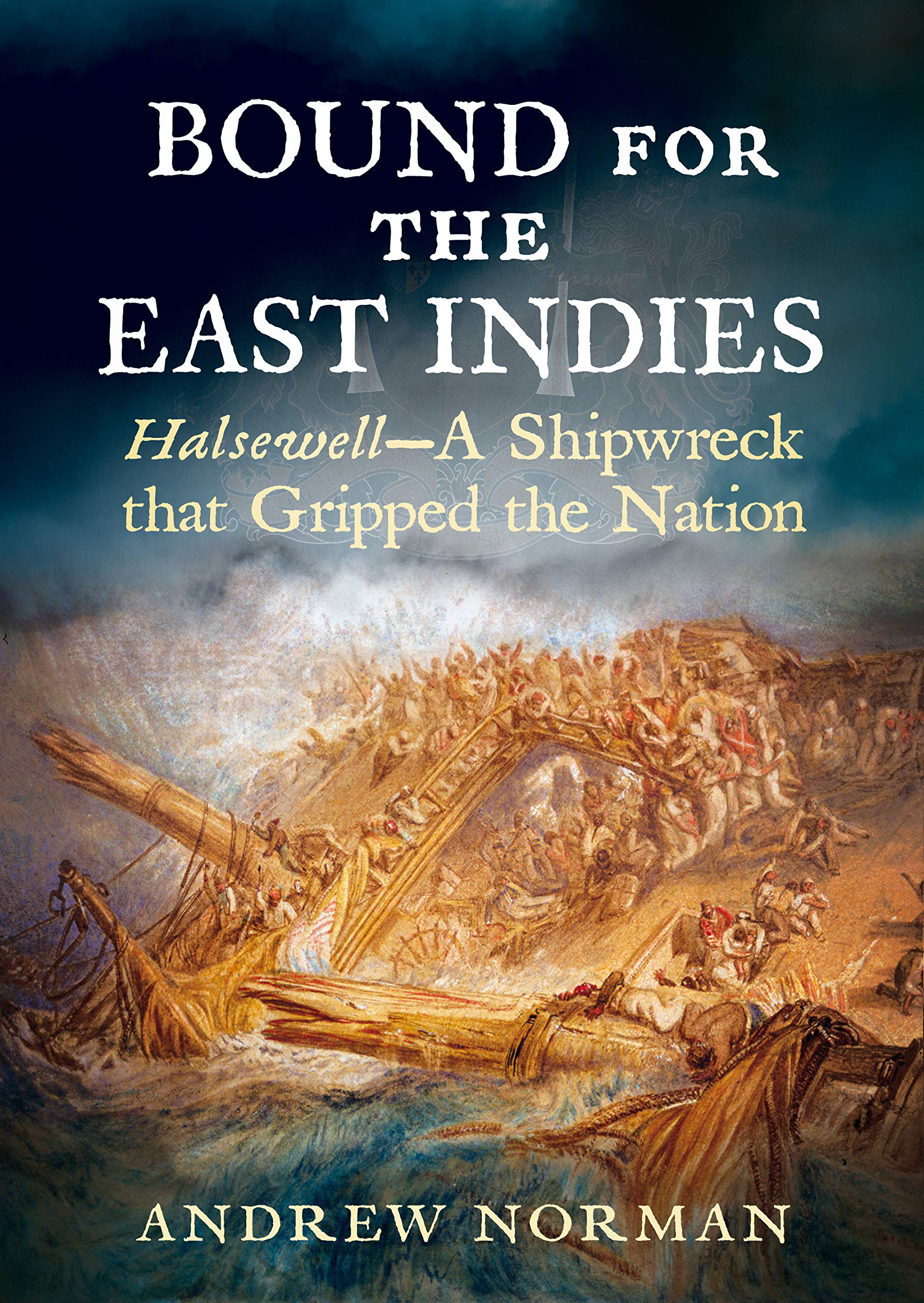
Bound for the East Indies: Halsewell―A Shipwreck that Gripped the Nation
$16.62
by Andre Norman



"Two centuries later, the wreck still appeals to divers, treasure hunters, and Andrew Norman, who has written a gripping story." ―The Northern Mariner It was late December 1785, the twenty-fifth year of the reign of King George III, King of Great Britain and King of Ireland. For the past six weeks the Honorable Company Ship (HCS) Halsewell, employed in the service of the Honorable East India Company, had been berthed at Gravesend in Kent (a town situated on the River Thames) as she prepared to embark on her third voyage to the East Indies (the whole of South-East Asia to the east of, and including, India). When she set sail, on 1 January 1786, no one could have guessed that her dramatic demise would touch the very heart of the nation: an event of such pathos as to inspire the greatest writer of the age, Charles Dickens, to put pen to paper, the greatest painter of the age J. M. W. Turner to apply brush to canvas, and the King and Queen to pay homage at the very place where the catastrophe occurred. Artifacts continue to be recovered from the seabed, shedding further light both on ‘Halsewell’ herself, and on the extraordinary lives of those who sailed in her. Table of Contents Preface 1 The Honourable East India Company 2 The Honourable Company Ship (HCS) Halsewell 3 The Allure of the East 4 Captain Richard Peirce, Commander of Halsewell 5 Halsewell’s First Voyage (1778-1781): An Unpleasant Encounter with Horatio Nelson 6 Halsewell’s Second Voyage (1782-1784): An Important Passenger 7 Halsewell’s Third Voyage (1786- ): Her Officers, Crew, and Passengers 8 Halsewell’s Third Voyage (1786- ); 9 The Voyage Begins 10 Shipwreck 11 A Glimmer of Hope 12 Aftermath: Halsewell’s Grim Legacy 13 Analysis of the Disaster: Was Captain Peirce in Any Way to Blame? 14 ‘Halsewell’: From Whence Did the Ship Derive her Name? 15 The 1960s: Renewed Interest in the Wreck: Intriguing Artefacts 16 The Halsewell Disaster is Captured in Poetry 17 A Re-enactment of the Drama: the King and Queen Pay their Respects: Charles Dickens Commemorates the Tragedy 18 Halsewell is Immortalized by Artists 19 Sequel Epilogue Appendices: 1 Peirce Family Tree 2 Halsewell/Tynte Family Tree 3 Greenland Dock and the Wells Family of Shipbuilders 4 Uniforms 5 Required Qualifications for Commanders and Officers (‘Mates’) 6 Required Inventory of Equipment etc. Necessary for Commanders and Officers 7 Required Inventory of Equipment etc. Necessary for a Midshipman 8 Indulgences 9 Wages 10 List of Officers [and crew, excluding ordinary seamen—‘foremastmen’] on board the Halsewell, at the time she sailed 11 Soldiers of the 42nd Foot, transported by Halsewell on her 3rd voyage 12 The Three Voyages of HCS Halsewell 13 Halsewell’s Logbook: an Explanation 14 Ships’ Stores 15 List of Officers, Seamen, and Soldiers saved 16 The History of Walnut Tree House. "Two centuries later, the wreck still appeals to divers, treasure hunters, and Andrew Norman, who has written a gripping story." The Northern Mariner Andrew Norman was born in Newbury, Berkshire, UK in 1943. Educated at Thornhill High School, Gwelo, Southern Rhodesia (now Zimbabwe), Midsomer Norton Grammar School, and St Edmund Hall, Oxford, he qualified in medicine at the Radcliffe Infirmary. He has two children Bridget and Thomas, by his first wife. From 1972-83, Andrew was a general practitioner in Poole, Dorset, before a spinal injury cut short his career. His published works include biographies of Charles Darwin, Winston Churchill, Thomas Hardy, T. E. Lawrence, Adolf Hitler, Agatha Christie, Enid Blyton, Beatrix Potter, Marilyn Monroe. Andrew married his second wife Rachel, in 2005.