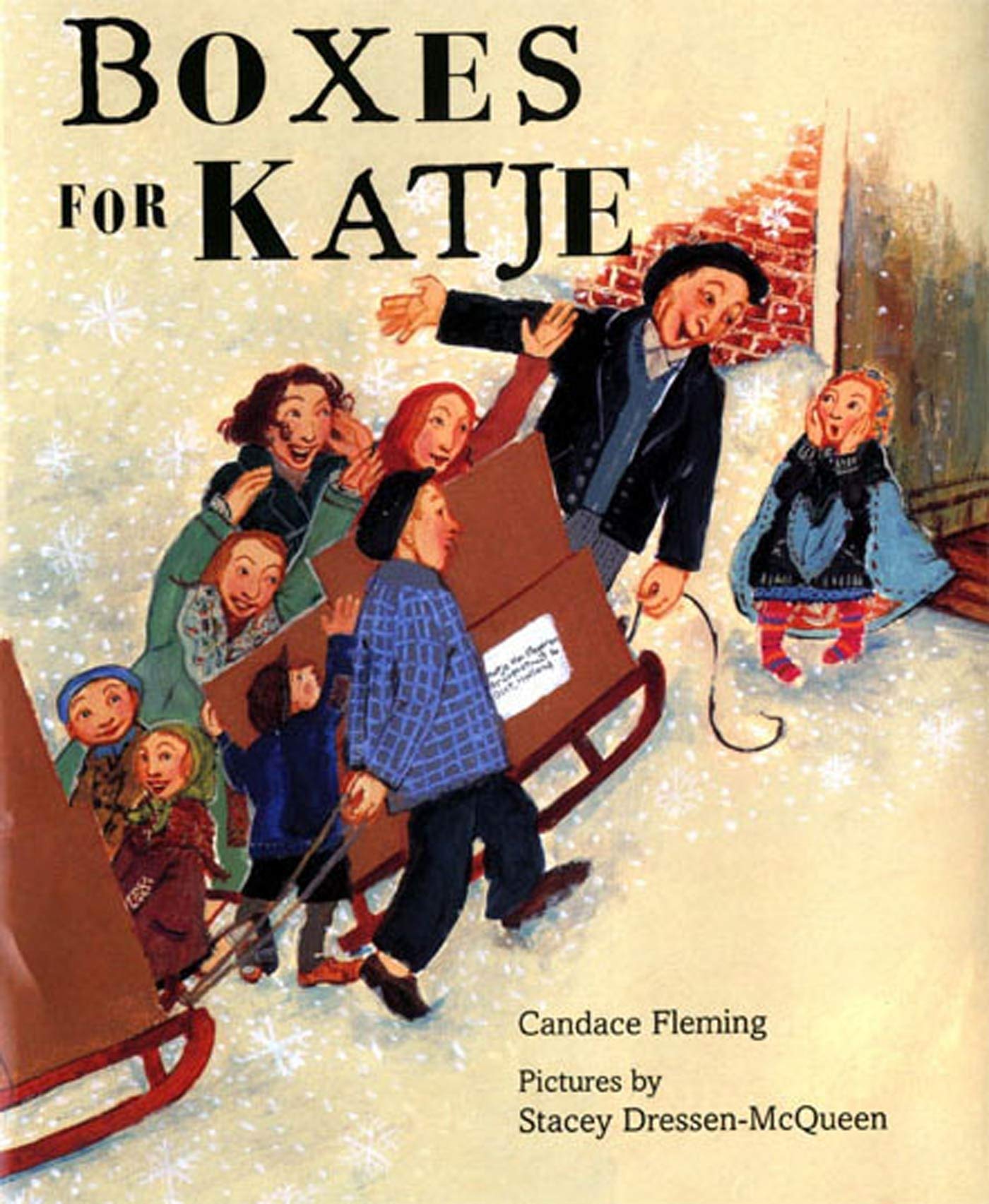



Simple seeds of friendship grow into something extraordinary After World War II there is little left in Katje's town of Olst in Holland. Her family, like most Dutch families, must patch their old worn clothing and go without everyday things like soap and milk. Then one spring morning when the tulips bloom "thick and bright," Postman Kleinhoonte pedals his bicycle down Katje's street to deliver a mysterious box – a box from America! Full of soap, socks, and chocolate, the box has been sent by Rosie, an American girl from Mayfield, Indiana. Her package is part of a goodwill effort to help the people of Europe. What's inside so delights Katje that she sends off a letter of thanks – beginning an exchange that swells with so many surprises that the girls, as well as their townspeople, will never be the same. This inspiring story, with strikingly original art, is based on the author's mother's childhood and will show young readers that they, too, can make a difference. Boxes for Katje is a 2004 Bank Street - Best Children's Book of the Year and a 2006 California Young Readers Medal for Picture Books for Older Readers winner K-Gr. 3. In May 1945, a Dutch girl named Katje is thrilled to receive a letter and a package of socks, soap, and chocolate from Rosie, a girl she doesn't know who lives in Mayfield, Indiana. The kids start to exchange letters, and when Rosie's family members learn of Holland's severe post-war deprivations, they enlist Mayfield residents to send food and clothes to Katje, who generously shares the gifts with others in her community. The sense of suffering isn't strong here, in part because the Dutch townspeople are almost always depicted as smiling about the packages. But the story is still moving, and Dressen-McQueen's lively illustrations, in colored pencil, oil pastel, and acrylic, pack lots of color, pattern, and historical details onto every expansive page. Fleming based the book on her mother's experience, which she describes in an author's note; in the real-life story, however, adults, not children, orchestrated the events, a finding that may be a little disappointing to kids who took the book, with its specific dates, town names, and heroic, generous children, as straight fact. Kathleen Odean Copyright © American Library Association. All rights reserved “Fleming 's engaging story of post-WWII Holland serves as a potent and merry lesson in generosity. . .Dressen-McQueen immerses readers in post-war Holland, crafting an entirely credible world of cobblestone streets, Dutch architecture and vintage clothing.” ― Starred, Publishers Weekly “As heartwarming and uplifting as a bouquet of tulips.” ― Kirkus Reviews Candace Fleming is the author of Giant Squid , an ALA Notable Book and Charlotte Zolotow Honor Book, and numerous other books for children. She lives in Oak Park, Illinois. From the Author : I have always been a storyteller. Even before I could write my name, I could tell a good tale. And I told them all the time. As a preschooler, I told my neighbors all about my three-legged cat named Spot. In kindergarten, I told my classmates about the ghost that lived in my attic. And in first grade, I told my teacher, Miss Harbart, all about my family’s trip to Paris, France. I told such a good story that people always thought I was telling the truth. But I wasn’t. I didn’t have a three-legged cat or a ghost in my attic, and I’d certainly never been to Paris, France. I simply enjoyed telling a good story . . . and seeing my listener’s reaction. Sure, some people might have said I was a seven-year-old fibber. But not my parents. Instead of calling my stories "fibs" they called them "imaginative." They encouraged me to put my stories down on paper. I did. And amazingly, once I began writing, I couldn’t stop. I filled notebook after notebook with stories, poems, plays. I still have many of those notebooks. They’re precious to me because they are a record of my writing life from elementary school on. In second grade, I discovered a passion for language. I can still remember the day my teacher, Ms. Johnson, held up a horn-shaped basket filled with papier-mâché pumpkins and asked the class to repeat the word "cornucopia." I said it again and again. I tasted the word on my lips. I tested it on my ears. That afternoon, I skipped all the way home from school chanting "Cornucopia! Cornucopia!" From then on, I really began listening to words -- to the sounds they made, and the way they were used, and how they made me feel. I longed to put them together in ways that were beautiful and yet told a story. As I grew, I continued to write stories. But I never really thought of becoming an author. Instead, I went to college, where I discovered yet another passion -- history. I didn’t realize it then, but studying history was really just an extension of my love of stories. After all, some of the best stories are true ones -- tales of heroism and villainy made more incredible by the fact they r