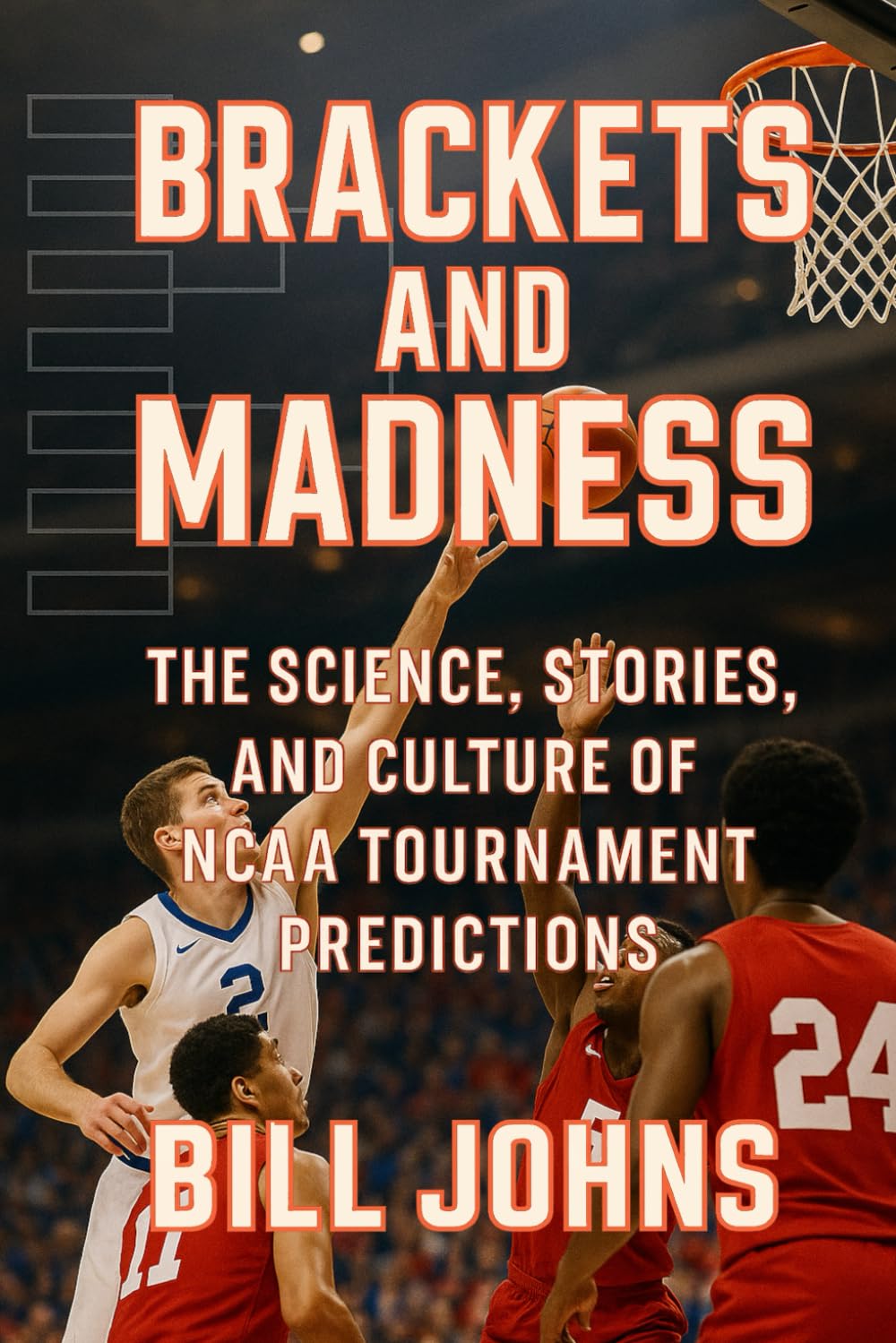
Brackets and Madness: The Science, Stories, and Culture of NCAA Tournament Predictions (Above the Rim)
$19.99
by Bill Johns



March Madness is more than a tournament—it is America’s spring ritual, where college basketball, bracketology, and the hope of the impossible collide. Every March, millions of fans fill out NCAA brackets, chasing the dream of perfection, knowing the odds are astronomical and the collapse inevitable. Yet the madness endures, binding classrooms, office pools, living rooms, and entire towns in a shared liturgy of play, hope, and memory. Brackets and Madness: The Science, Stories, and Culture of NCAA Tournament Predictions is the first book to treat bracketology not as a hobby but as a cultural history. Bill Johns examines why the NCAA Tournament has become the most compelling event in American sport, exploring the science of prediction, the thrill of upsets, and the meaning of the busted bracket. He shows how the act of filling out brackets is at once mathematical and mythic, a democratic exercise in which children, experts, and casual fans participate equally. In its failures, the bracket creates solidarity; in its stories, it preserves memory. This book brings together the analytics of college basketball with the narratives that have defined March Madness. Johns traces how statistics, efficiency ratings, and probability models transformed the science of prediction, yet were continually undone by buzzer-beaters, miracle runs, and Cinderellas that defied logic. From North Carolina State’s miracle in 1983 to UMBC’s historic upset in 2018, from Villanova’s perfection in 1985 to Virginia’s redemption in 2019, these stories became parables of democracy, faith, and chance. The perfect bracket may be impossible, but the imperfect bracket is what endures, binding fans together across generations. Johns also situates bracketology within the larger fabric of American life. The NCAA Tournament reflects democracy in its structure, capitalism in its wagers, faith in its improbable outcomes, and memory in the stories retold each spring. Office pools dramatize risk and reward; betting markets mirror volatility; children’s picks by mascot or color often outperform statistical models. In this unpredictability lies the bracket’s power: it is a ritual that thrives on futility, teaching humility, hope, and laughter in equal measure. Through sustained narrative and cultural insight, Brackets and Madness reveals why America cannot stop filling out brackets, even as perfection remains out of reach. It explores how television, gambling, media hype, and statistical revolution all expanded the tournament’s grip, but also how the real meaning of March lies in the moments we remember long after the games have ended. A bracket is not just a chart of seeds but a canvas of collective hope; a buzzer-beater is not just a shot but a parable retold across decades. Johns writes with conviction that March Madness is not only about who wins, but about why people believe, why they gather, and why they keep playing despite inevitable collapse. He places bracketology alongside the great rituals of American culture, showing how futility itself becomes belonging, how imperfection creates solidarity, and how memory outlasts accuracy. For readers who love college basketball, who study bracketology, who remember the thrill of every Cinderella run and the despair of every busted sheet, this book offers both story and meaning. It captures why March Madness is the most democratic of spectacles, a ritual that sustains itself not in perfection but in its refusal to be solved. To read Brackets and Madness is to enter a memory larger than the game itself—a legacy of banners, chants, failures, and miracles that turned prediction into story and play into belonging. It is an invitation to live with the madness, to embrace its futility as gift, and to remember that in brackets, as in life, imperfection is the most enduring form of hope.