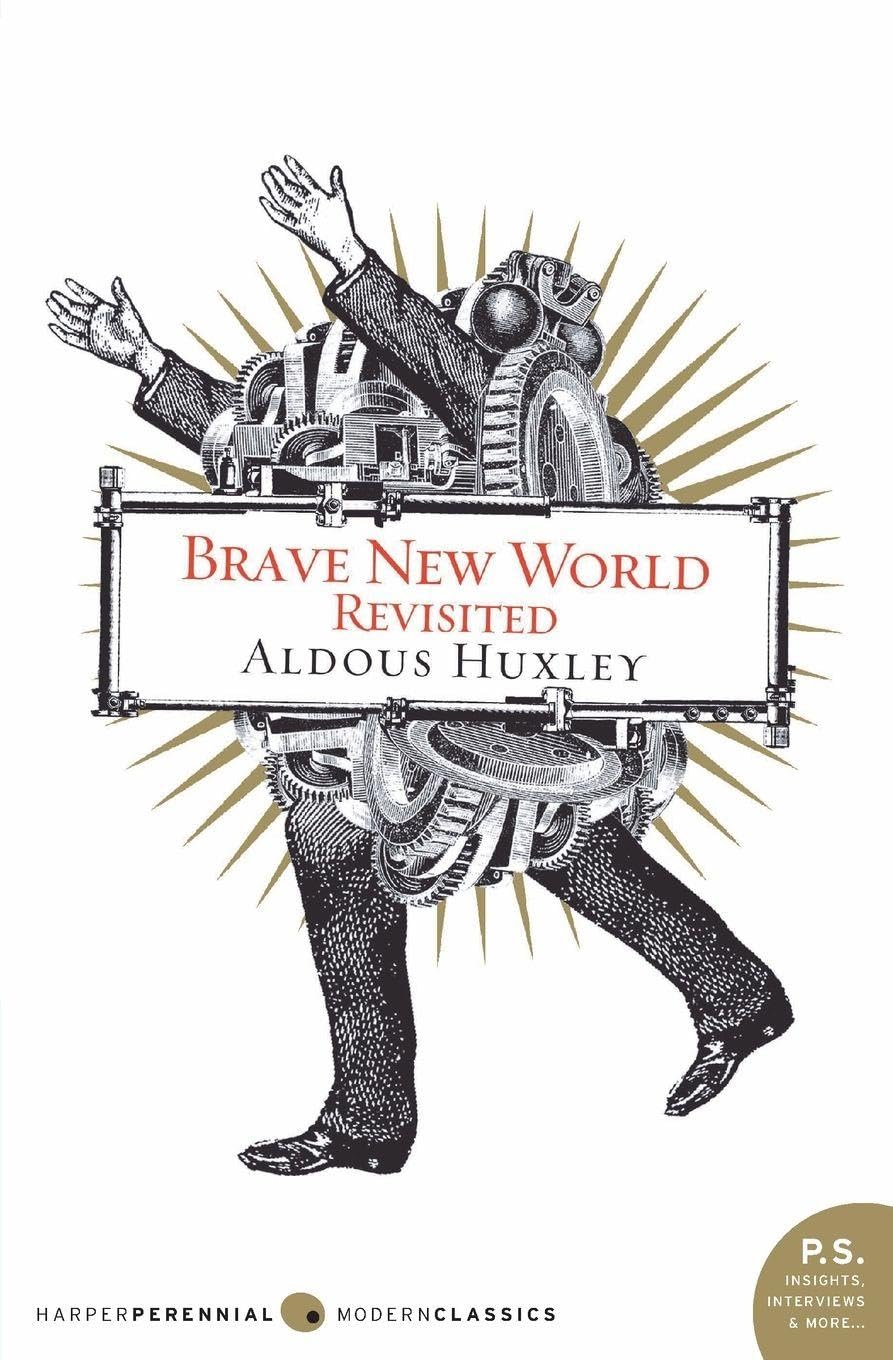



"Huxley uses his erudite knowledge of human relations to compare our actual world with his prophetic fantasy of 1931. It is a frightening experience, indeed, to discover how much of his satirical prediction of a distant future became reality in so short a time." ― New York Times Book Review When Aldous Huxley wrote his famous novel Brave New World , he did so with the belief that the dystopian world he created was a true possibility given the direction of the social, political and economic world order. Written more than twenty-five years later, Brave New World Revisited is a re-evaluation of his predictions based on the changes he witnessed over that time. In this twelve-part work of social philosophy, one of the most important and fascinating books of his career, Huxley uses his tremendous knowledge of human relations to compare the modern-day world with his prophetic fantasy. He scrutinizes threats to humanity, such as overpopulation, propaganda, and chemical persuasion, and explains why we have found it virtually impossible to avoid them. Brave New World Revisited is a trenchant plea that humankind should educate itself for freedom before it is too late. In this landmark analysis, Huxley explores the chilling accuracy of his vision: Propaganda in a Democracy: An analysis of the methods used by commercial and political propagandists to manipulate the masses in a supposedly free society. - Chemical Persuasion: A prescient warning about the use of drugs―both recreational and pharmaceutical―to create an artificial happiness that stifles dissent and critical thought. - Overpopulation as a Threat: A clear-eyed look at how excessive human numbers, a problem Huxley once thought centuries away, now strains our resources and personal liberties. - Education for Freedom: A powerful argument for an education rooted in critical thinking and the values of liberty as the only true antidote to creeping totalitarian control. "Huxley uses his erudite knowledge of human relations to compare our actual world with his prophetic fantasy of 1931. It is a frightening experience, indeed, to discover how much of his satirical prediction of a distant future became reality in so short a time." - New York Times Book Review "A message which, enforced by Mr. Huxley's seriousness and clear dialectic on dealing with social problems, we cannot ignore. . . . The last pages carry a somewhat tragic node about his misgivings whether man himself wishes to be saved." - Time and Tide (London) "A thought jabbing, terrifying book." - Chicago Tribune When the novel Brave New World first appeared in 1932, its shocking analysis of a scientific dictatorship seemed a projection into the remote future. Here, in one of the most important and fascinating books of his career, Aldous Huxley uses his tremendous knowledge of human relations to compare the modern-day world with his prophetic fantasy. He scrutinizes threats to humanity, such as overpopulation, propaganda, and chemical persuasion, and explains why we have found it virtually impossible to avoid them. Brave New World Revisited is a trenchant plea that humankind should educate itself for freedom before it is too late. Aldous Huxley (1894–1963) is the author of the classic novels Brave New World , Island , Eyeless in Gaza , and The Genius and the Goddess , as well as such critically acclaimed nonfiction works as The Perennial Philosophy and The Doors of Perception . Born in Surrey, England, and educated at Oxford, he died in Los Angeles, California. Brave New World Revisited By Aldous Huxley HarperCollins Publishers, Inc. Copyright © 2006 Aldous Huxley All right reserved. ISBN: 0060898526 Chapter One A squat grey building of only thirty-four stories. Over the main entrancethe words, Central London Hatchery and ConditioningCentre, and, in a shield, the World State's motto,Community, Identity, Stability. The enormous room on the ground floor faced towards thenorth. Cold for all the summer beyond the panes, for all the tropicalheat of the room itself, a harsh thin light glared through the windows,hungrily seeking some draped lay figure, some pallid shape ofacademic goose-flesh, but finding only the glass and nickel andbleakly shining porcelain of a laboratory. Wintriness responded towintriness. The overalls of the workers were white, their handsgloved with a pale corpse-coloured rubber. The light was frozen,dead, a ghost. Only from the yellow barrels of the microscopes did itborrow a certain rich and living substance, lying along the polishedtubes like butter, streak after luscious streak in long recession downthe work tables. "And this," said the Director opening the door, "is the FertilizingRoom." Bent over their instruments, three hundred Fertilizers wereplunged, as the Director of Hatcheries and Conditioning enteredthe room, in the scarcely breathing silence, the absent-minded, so-liloquizing hum or whistle, of absorbed concentration. A troop ofnew