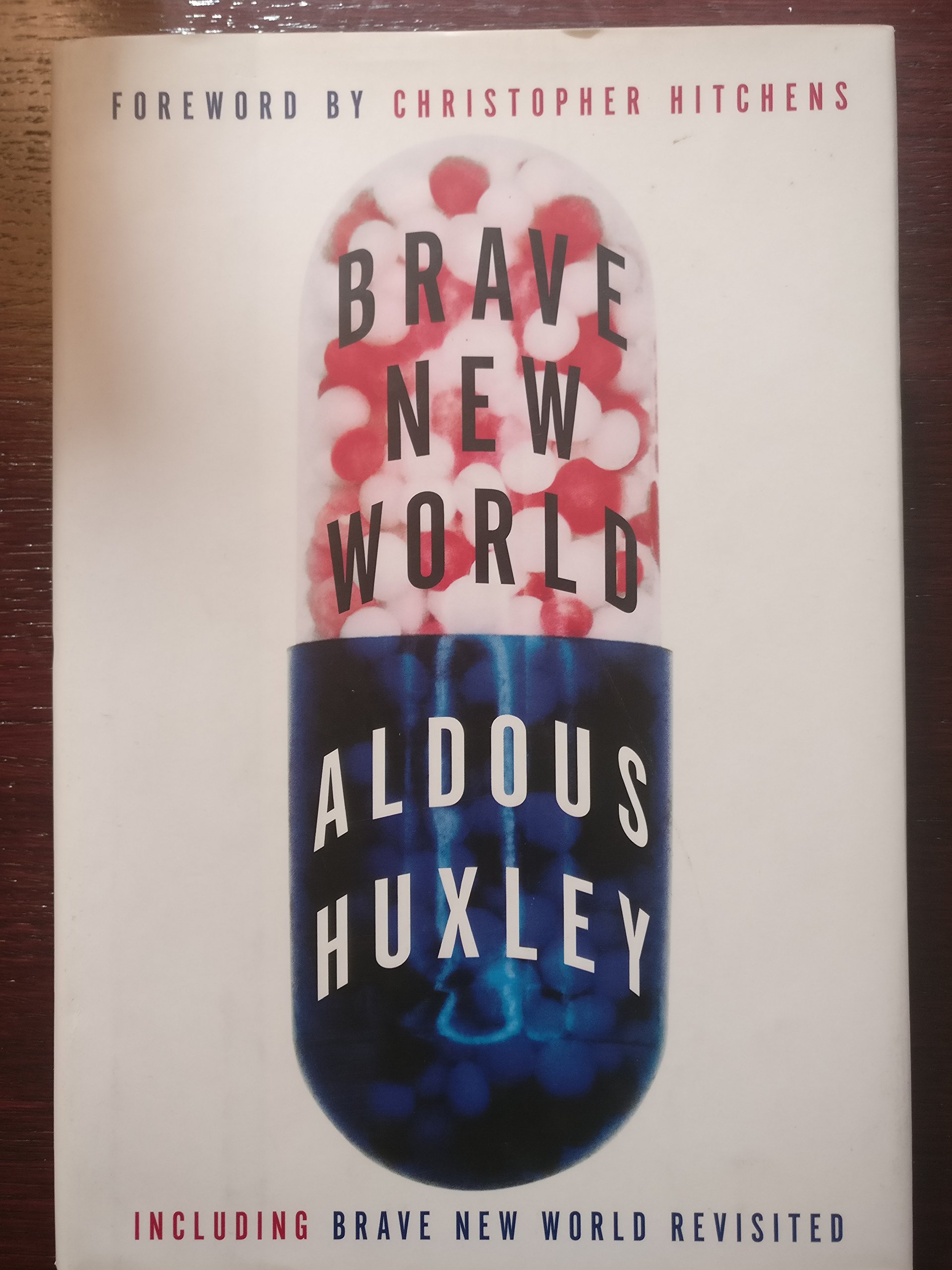



Now more than ever: Aldous Huxley's enduring "masterpiece ... one of the most prophetic dystopian works of the 20th century" ( Wall Street Journal ) must be read and understood by anyone concerned with preserving the human spirit in the face of our "brave new world" Aldous Huxley's profoundly important classic of world literature, Brave New World is a searching vision of an unequal, technologically-advanced future where humans are genetically bred, socially indoctrinated, and pharmaceutically anesthetized to passively uphold an authoritarian ruling order--all at the cost of our freedom, full humanity, and perhaps also our souls. A genius [who] who spent his life decrying the onward march of the Machine ( The New Yorker ), Huxley was a man of incomparable talents: equally an artist, a spiritual seeker, and one of historys keenest observers of human nature and civilization. Brave New World, his masterpiece, has enthralled and terrified millions of readers, and retains its urgent relevance to this day as both a warning to be heeded as we head into tomorrow and as thought-provoking, satisfying work of literature. Written in the shadow of the rise of fascism during the 1930s, Brave New World likewise speaks to a 21st-century world dominated by mass-entertainment, technology, medicine and pharmaceuticals, the arts of persuasion, and the hidden influence of elites. "Aldous Huxley is the greatest 20th century writer in English." C hicago Tribune This book also includes the full text of Brave New World Revisited , Huxley's 1958 nonfiction followup to Brave New World . “Aldous Huxley is the greatest 20th century writer in English.” - Chicago Tribune “One of the 20th century’s greatest writers.” - Washington Post “A genius . . . a writer who spent his life decrying the onward march of the Machine.” - The New Yorker “Huxley uses his erudite knowledge of human relations to compare our actual world with his prophetic fantasy of 1931. It is a frightening experience, indeed, to discover how much of his satirical prediction of a distant future became reality in so short a time.” - New York Times Book Review “Chilling. . . . That he gave us the dark side of genetic engineering in 1932 is amazing.” - Providence Journal-Bulletin “A sometimes appallingly accurate view of today’s world.” - St. Louis Post-Dispatch “It’s time for everyone to read or reread Brave New World.” - Raleigh News & Observer “[A] masterpiece. ... One of the most prophetic dystopian works of the 20th century.” - Wall Street Journal The astonishing novel Brave New World , originally published in 1932, presents Aldous Huxley's vision of the future -- of a world utterly transformed. Through the most efficient scientific and psychological engineering, people are genetically designed to be passive and therefore consistently useful to the ruling class. This powerful work of speculative fiction sheds a blazing critical light on the present and is considered to be Aldous Huxley's most enduring masterpiece. The nonfiction work Brave New World Revisited , first published in 1958, is a fascinating work in which Huxley uses his tremendous knowledge of human relations to compare the modern-day world with his prophetic fantasy envisioned in Brave New World , including the threats to humanity, such as overpopulation, propaganda, and chemical persuasion. Aldous Huxley (1894–1963) is the author of the classic novels Brave New World , Island , Eyeless in Gaza , and The Genius and the Goddess , as well as such critically acclaimed nonfiction works as The Perennial Philosophy and The Doors of Perception . Born in Surrey, England, and educated at Oxford, he died in Los Angeles, California. Brave New World and Brave New World Revisited By Huxley, Aldous HarperCollins Publishers ISBN: 0060535261 Chapter One A squat grey building of only thirty-four stories. Over the main entrancethe words, Central London Hatchery and ConditioningCentre, and, in a shield, the World State's motto,Community, Identity, Stability. The enormous room on the ground floor faced towards thenorth. Cold for all the summer beyond the panes, for all the tropicalheat of the room itself, a harsh thin light glared through the windows,hungrily seeking some draped lay figure, some pallid shape ofacademic goose-flesh, but finding only the glass and nickel andbleakly shining porcelain of a laboratory. Wintriness responded towintriness. The overalls of the workers were white, their handsgloved with a pale corpse-coloured rubber. The light was frozen,dead, a ghost. Only from the yellow barrels of the microscopes did itborrow a certain rich and living substance, lying along the polishedtubes like butter, streak after luscious streak in long recession downthe work tables. "And this," said the Director opening the door, "is the FertilizingRoom." Bent over their instruments, three hundred Fertilizers wereplunged, as the Director of Hatcheries and Conditioning enteredthe room,