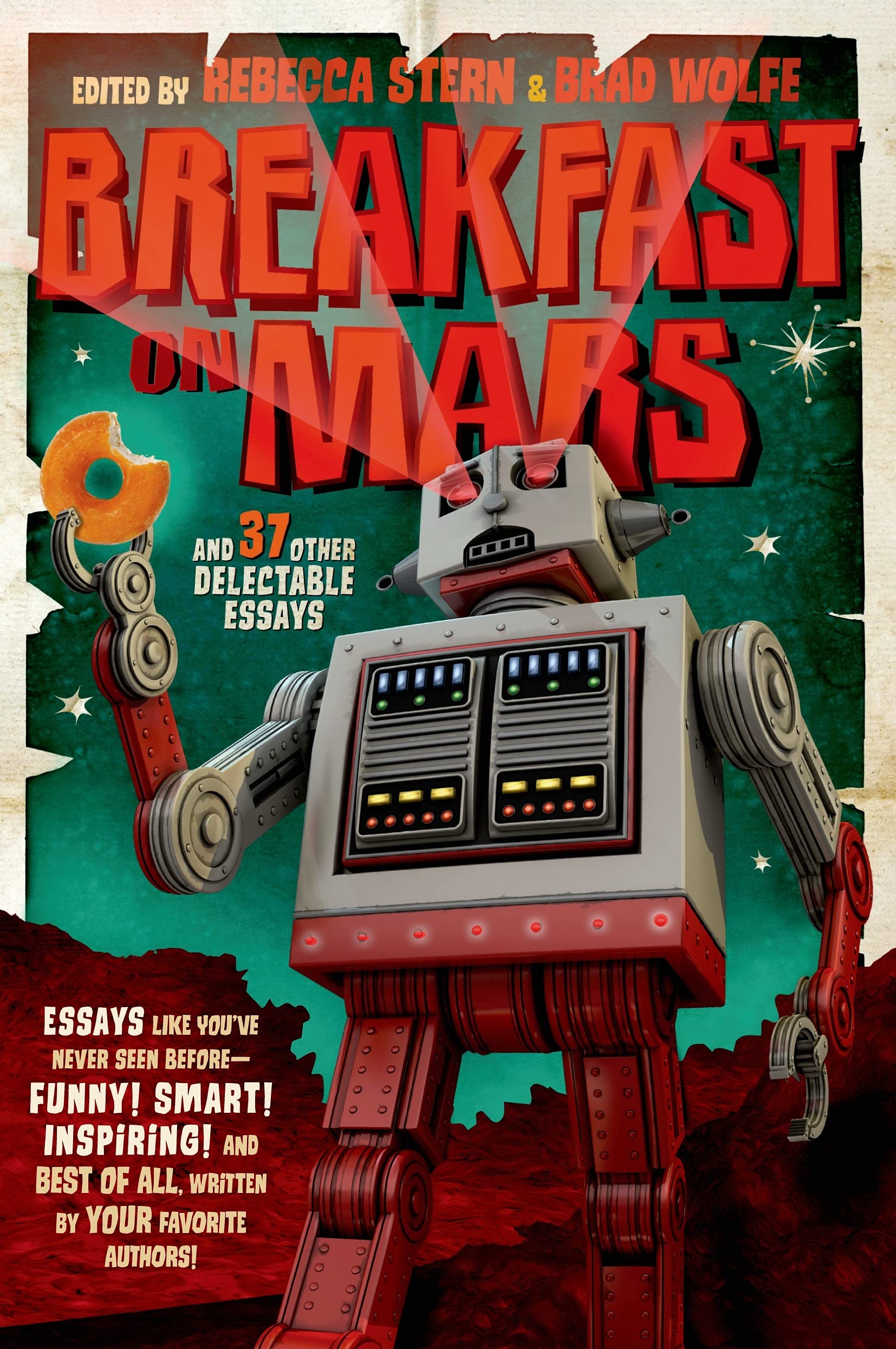
Breakfast on Mars and 37 Other Delectable Essays: Your Favorite Authors Take A Stab at the Dreaded Essay Assignment
$12.23
by Brad Wolfe



Breakfast on Mars and 37 Other Delectable Essays will inspire students to think differently about the much-feared assignment in elementary and middle schools around the country: essay writing. Rebecca Stern's fifth-grade students were bored to death with essay writing, and the one thing Rebecca needed to inspire them―great examples appropriate for kids―was nowhere to be found. Inspired by a challenge, Rebecca joined forces with her friend, social entrepreneur Brad Wolfe, and the two came up with a terrific proposal―to gather together a collection of unconventional essays by some of the best writers around. They have compiled and edited a collection of imaginative, rule-breaking, and untraditional essays that is sure to change the way you think about the essay. Contributors include: Ransom Riggs, Kirsten Miller, Scott Westerfeld, Alan Gratz, Steve Almond, Jennifer Lou, Chris Higgins, Rita Williams-Garcia, Elizabeth Winthrop, Chris Epting, Sloane Crosley, April Sinclair, Maile Meloy, Daisy Whitney, Khalid Birdsong, Sarah Prineas, Ned Vizzini, Alane Ferguson, Lise Clavel, Mary-Ann Ochota, Steve Brezenoff, Casey Scieszka, Steven Weinberg, Michael Hearst, Clay McLeod Chapman, Gigi Amateau, Laurel Snyder, Wendy Mass, Marie Rutkoski, Sarah Darer Littman, Nick Abadzis, Michael David Lukas, Léna Roy, Craig Kielburger, Joshua Mohr, Cecil Castellucci, Joe Craig, and Ellen Sussman. “* An important collection that ought to become a staple in writing classes.” ― Kirkus Reviews, starred review “* A refreshing and useful tool for every middle- and high-school writing teacher to keep handy.” ― Publishers Weekly, starred review “In this valuable resource, the authors include research in their essays and sometimes make convincing arguments for something totally impossible. Best of all, they even bring humor back to this old, musty format.” ― Booklist “A unique volume, well worth the read.” ― School Library Journal Rebecca Jackson Stern worked for National Novel Writing Month (NaNoWriMo), a nonprofit that believes stories matter and works to empower and encourage writing and vibrant creativity around the world. Prior to joining NaNoWriMo's staff, she was an elementary and middle school teacher for a decade, as well as a Senior Digital Editor at Pearson Education. A Bay Area native, Brad Wolfe helps rising high school seniors craft their college admissions essays. He enjoys the breakthrough moments when his students begin to see their lives as empowering personal narratives, using the essay writing process to uncover their truest passions and aspirations. PERSONAL ESSAY Describe a time you had to do something you really didn’t want to do. Camp Dread or How to Survive a Shockingly Awful Summer by RANSOM RIGGS It took me about a week to realize I’d been suckered. The ad in the church bulletin had called it a “horseback riding” camp, but by the end of week one, the only thing I’d learned about horses was how to scrape their stalls clean, and the only thing I’d ridden was an electric fence, which I had backed into in what was probably a subconscious escape attempt. But there was no escaping. I was stuck in the swampy middle of nowhere. Cell phones hadn’t been invented yet, and neither I nor the other campers had the guts to complain to the swaggering, dip-spitting cowboys who served as both our camp counselors and de facto prison guards. As that fence launched me into the air, arms flailing like a rodeo clown, butt tingling with residual electricity, I made a solemn pledge to myself: never again. I ended up at horse camp because my mother had decided it was important for me to try new things—her definition of which apparently did not extend to watching new movies at the multiplex or playing new Nintendo 64 games in various friends’ basements, which had previously comprised my entire plan for the summer. She had never objected to my lazy summers before, and after nine months of the exceptional torment that was sixth grade, I thought I deserved one more than ever. So naturally I felt a little betrayed when, a mere week after school had ended, she announced that I was off to camp in a few days. And not just any camp— horse camp. I was baffled too and Mom was short on answers to my many questions. Was I being punished for something? What imaginary crime had I supposedly committed? Did she think I’d actually have fun ? I couldn’t imagine why, as I’d never expressed even the slightest interest in horses, or horse-related camps, or camps in general. Then, after remembering how the few girls’ rooms I’d seen the inside of had been veritable shrines to horses, an admittedly unlikely explanation occurred to me: My mother thinks I’m a girl. I tried explaining to her that I wasn’t a girl, that I didn’t know the first thing about horses and didn’t care to, and that living in an un-air-conditioned cabin with strangers in the sweltering summer heat of Central Florida made little sense when I had air-conditioning and video