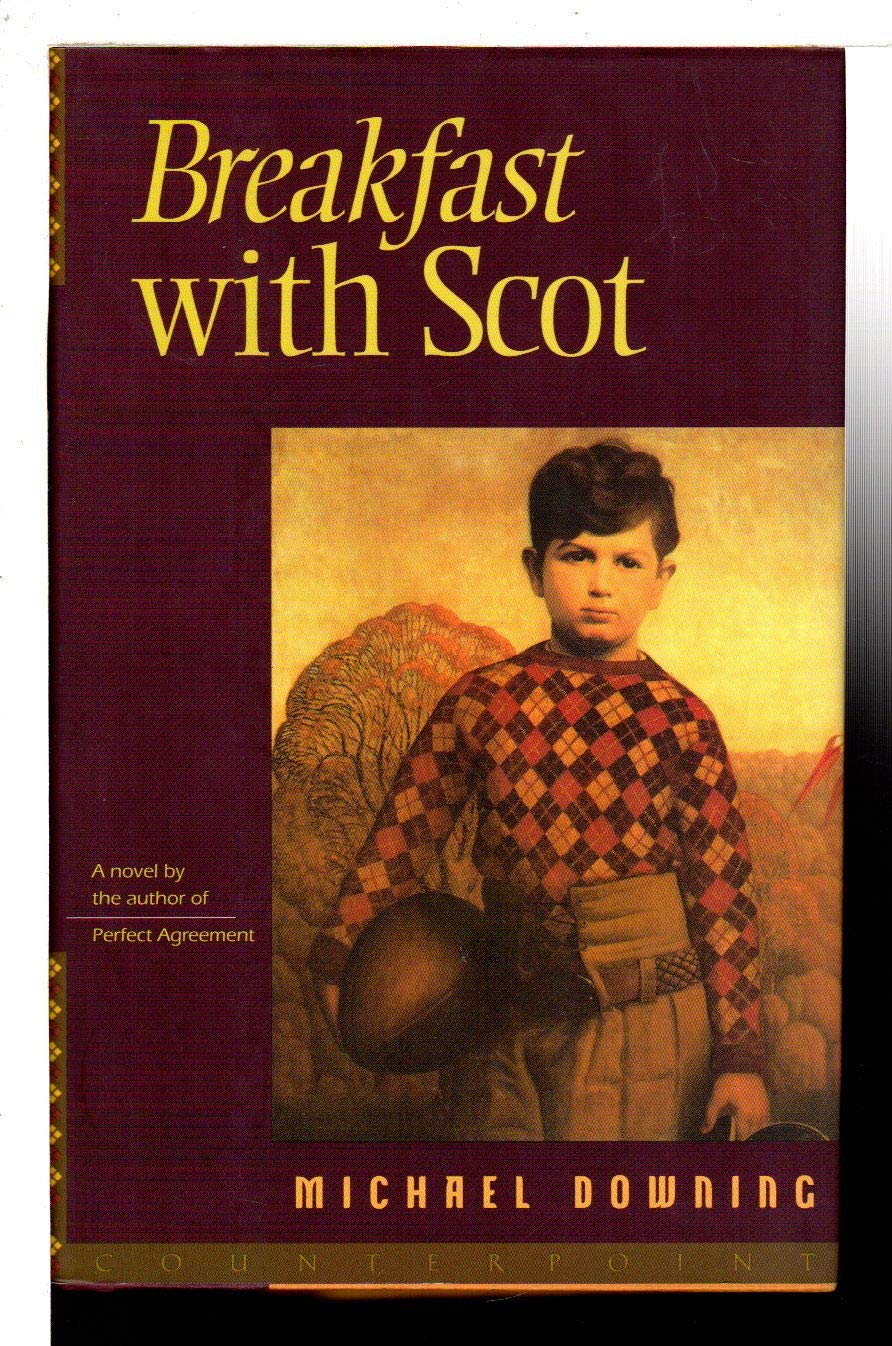



When Scot's mother dies, Sam and Ed, although childless and enjoying it, decide to take him in, only to get more than they bargained for when Scot reveals his love of feather boas and expresses his dissatisfaction with the house's drapes. What happens when your very own mincing, makeup-sporting Mini Me comes to stay--forever? In Michael Downing's highly amusing and hugely touching Breakfast with Scot , a couple takes on an 11-year-old with a difference. Sam's a prosperous chiropractor and Ed, the novel's narrator, works for the English-language edition of the highly pretentious magazine Figura . Almost 40, Ed hasn't followed through with much of anything, save his relationship. But now swishy Scot could be putting that at risk: I never wanted a kid. Sam never wanted a kid. We were getting a kid because Sam believed a man is meant to make good on his word, and because I hadn't seeded and watered and weeded my garden, and now, when I needed it, I had no abundant supply of garlic to ward off the little vampire. Let's just say that though the boy isn't even remotely a bloodsucker, when he utters that familiar complaint "Nobody understands me," he really means it--and he's right. Well, almost. Within days of his arrival in Cambridge, Massachusetts, Scot's new guardians are "drowning in make-up policies and other moral imperatives," for he is an accessorizor par excellence, prone to wearing pantyhose, nail polish, and various other affronts to things masculine. He's also a catalyst for disaster, pointing up the shame and social booby traps that Sam and Ed have done their best to ignore. Nevertheless, their days slowly begin to take on a familial rhythm, and Downing effortlessly displays the depth and feeling that can come up in the most casual moments and conversations. He's equally good at overt disaster, and even as he never lets us forget the mortifications that may be just around the corner, the author makes us believe in his triumvirate. Downing can snap a line with the best of them, as those lucky enough to read his fine third novel will know. Breakfast with Scot , too, is a veritable garden of verbal delights--and a strong look at the apparent weaknesses and hidden treasures of family life. --Kerry Fried Witty and poignant, Breakfast with Scot is a hilariously sweet take on the woes and joys of parenthood as seen through the eyes of a gay couple. When Sam's sister-in-law dies, he and Ed agree to raise her 11-year-old son. An unusual boy in an even more unusual situation, Scot throws Sam and Ed's life into complete disarray. And when Scot begins to show his more flamboyant side--wearing makeup and lacy socks to school--Sam and Ed begin to question their own relationship, their abilities as parents, and the compromises they have made in order to live quietly within a predominantly straight society. Downing's prose is lively, quick, and vivid, yet his characters do not suffer from his humorous treatment of their lives. Sam, Ed, and Scot each contain an emotional depth normally absent in the characters of farcical comedy. Through the relationship of Scot, Sam, and Ed, Downing explores what it truly means to be a family, compassionately contrasting familial stereotypes with the realities of family life and showing how it feels to be a boy who doesn't quite fit into the role society has prepared for him. Bonnie Johnston A middle-aged gay couple's misadventure in parenting is the subject of this wisecrack-laden fourth novel by the author of Mother of God (1990), etc. Life is moving along in an agreeable rut in Cambridge, Mass., for Sam, a busy chiropractor, and his partner Ed, who works for a tony art magazine (Figura) owned by a jet-setting cheapskate. But then unmarried Julie, Sam's brother Billy's former girlfriend, dies, andthanks to a solemn promise made during a convivial drunken evening outSam and Ed inherit, if you will, guardianship of Julie's 11-year-old son Scot. This kid isn't your typical troublesome preadolescent. Scot owns a musical hairbrush and two make-up kits, uses Pink Gardenia hand lotion and won't go anywhere without his Chapstick, plus his interest in school sports is limited to baton twirling and an ambition to become a cheerleader. Downing tries to work up a perfunctory plot from Sam's vow to put ``more strut and less swish'' into their charge and from the complications that ensue when it's discovered that Scot isn't the only issue Julie and Billy created. But Downing doesn't seem to have decided whether to write a serious comic study of how Sam's and Ed's relationship is both tested and clarified by the changes Scot brings or a TV movie script festooned with one-liners. Some of the latter are pretty good (gay-couple friends own a ``feral poodle; Ed repeatedly asks himself ``What do you say to a boy in a neckerchief?). The best moments here depict Scots effect on his guardians' extended family of varyingly deranged friends and on his ``normal'' schoolmates (who hassle him me