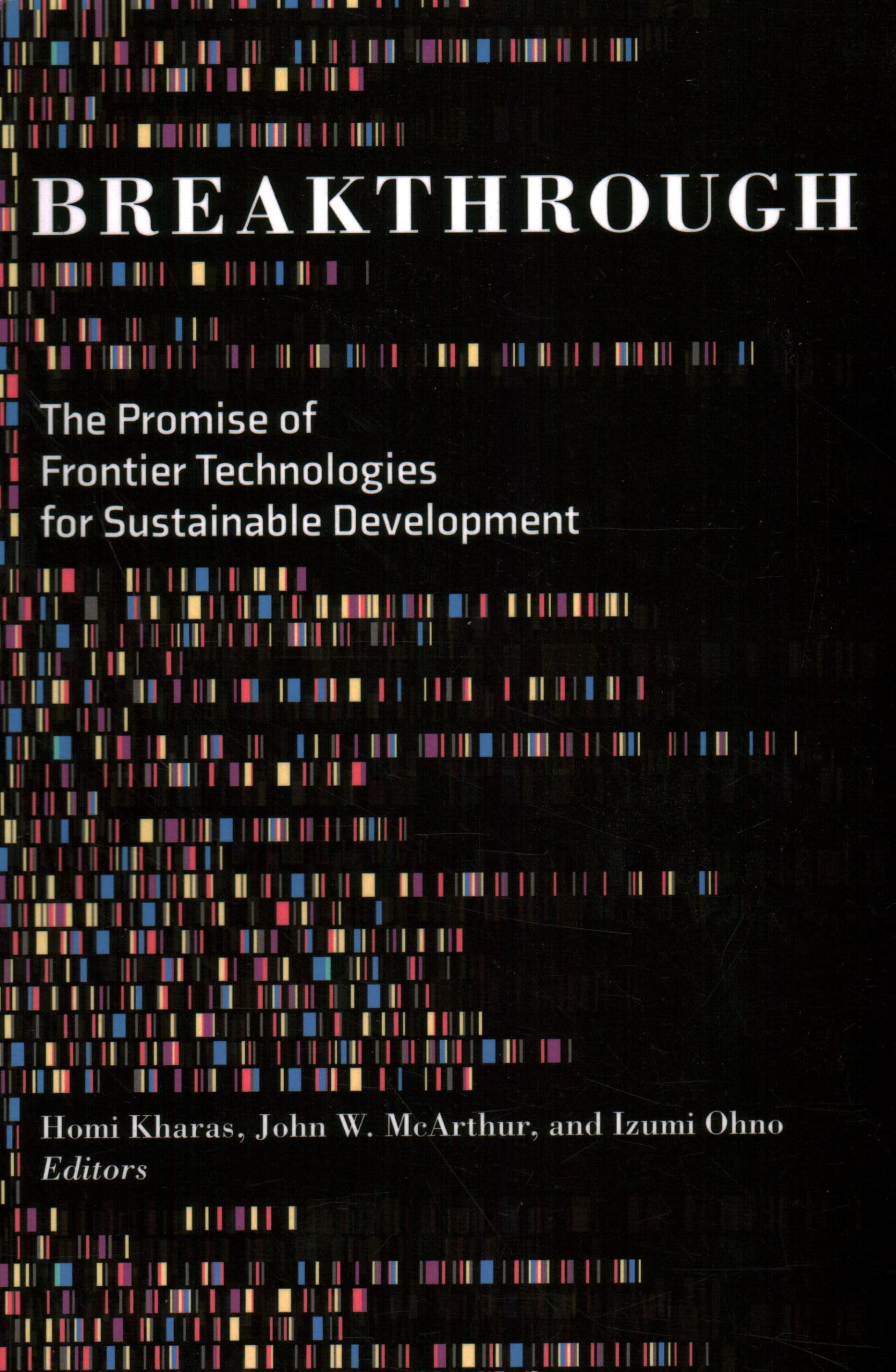
Breakthrough: The Promise of Frontier Technologies for Sustainable Development (The Thornton Center Chinese Thinkers Series)
$40.87
by Homi Kharas



One overall takeaway is that gradualist approaches will not achieve those goals by 2030. Breakthroughs will be necessary in science, in the development of new products and services, and in institutional systems. Each of the experts responded with stories that reflect big ambitions for what the future may bring. Their stories are not projections or forecasts as to what will happen; they are reasoned and reasonable conjectures about what could happen. The editors’ intent is to provide a glimpse into the possibilities for the future of sustainable development. At a time when many people worry about stalled progress on the economic, social, and environmental challenges of sustainable development, Breakthrough is a reminder that the promise of a better future is within our grasp, across a range of domains. It will interest anyone who wonders about the world’s economic, social, and environmental future. “Focusing on UN Sustainable Development Goals (SDGs)―ending poverty, malnutrition, deforestation, and climate change―Kharas, McArthur, and Ohno ask what key ingredients produce nonlinear breakthroughs. They argue that a gradualist approach will fail and that exponential progress comes only with better policy and politics as well as technology. The book's 12 chapters draw on more than a dozen authors with expertise in science, business, civil society, and policy making. Overall, they find that best practices for innovation include user-centered design, understanding the context and concerns of affected communities, smart risk-taking, designing for scale and sustainability from the start, and collaboration. Chapter 4 examines utility-scale solar power, finding it nearly free as costs lie with battery storage and metering rather than with the electrical power itself. Chapter 7 targets smallholder agriculture with the maxim "think big, act fast, start small" to help improve agronomic decisions regarding activities such as fertilizing, watering, and harvesting. Chapter 9 explores "smart cities" as more than just a venue for showcasing new technology, from transportation to utilizing sensors for collecting large data sets for AI analysis. Throughout, contributing authors rightly recognize that new breakthrough technologies risk primarily benefiting the world's wealthiest, further exacerbating inequities borne by poor and rural populations. Highly recommended.” ― Choice Reviews The COVID-19 pandemic offered many lessons for the world, one of the most important of which is the role of technology in solving seemingly intractable problems. A breakthrough technology led to the development of vaccines against COVID-19 in record time, helping slow a pandemic that has led to at least 5 million premature deaths and caused untold misery worldwide. In Breakthrough , more than a dozen distinguished international experts examine the potential for similar technological breakthroughs to affect the human condition and natural world within the next ten years. Their stories reflect major ambitions for what the future could bring and offer a glimpse into the possibilities for achieving the UN’s Sustainable Development Goals. The authors were asked to envision future success in their respective fields, given the current state of technology and potential progress over the next decade. Each examined technological advances that could contribute directly to achieving the Sustainable Development Goals and affect the lives of hundreds of millions of people or a substantial segment of the planet. The book’s chapters cover a wide range of problems and potential technological solutions in such fields as medicine, agriculture, energy, finance, and nature conservation. Each chapter in the book reflects major opportunities for humanity. These are not predictions for what will happen but are informed conjectures about what could happen if leaders make the right choices to promote the right circumstances. Technological advances will not solve all of the world’s problems; better public policies and more community-minded politics are vital in every society. But technology must play a crucial role in smoothing the path toward better sustainable development outcomes. Breakthrough is a major contribution to public understanding of how that can happen. Homi Kharas is a senior fellow in the Center for Sustainable Development at The Brookings Institution. He studies politics and trends influencing developing countries, including aid to poor countries, the emergence of the middle class, and global governance and the G20. John W. McArthur is a senior fellow and director of the Center for Sustainable Development at the Brookings Institution. He co-founded and co-chairs the 17 Rooms initiative, an innovative approach to catalyzing ideas and action for the Sustainable Development Goals.