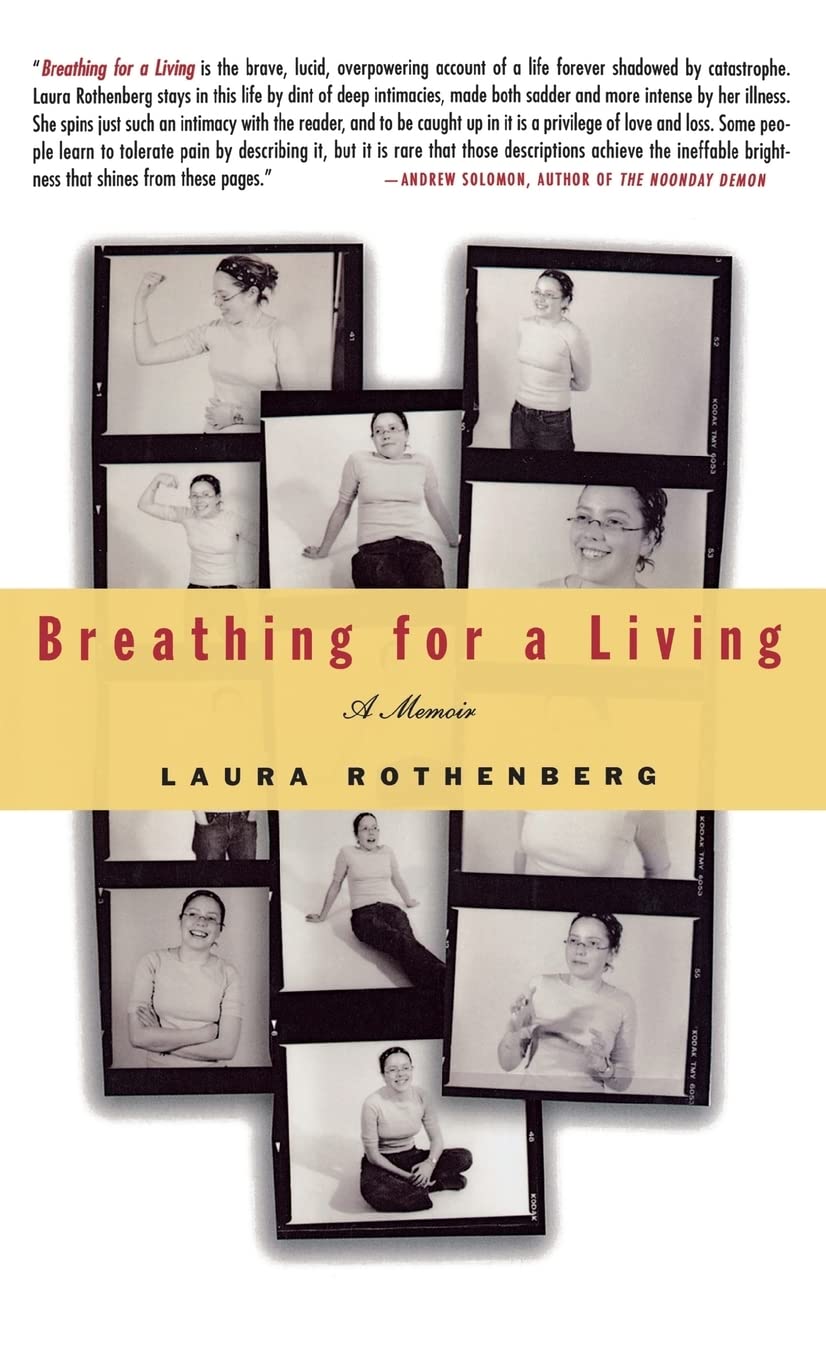



A moving account by an extraordinary young woman who mounts a daily struggle with cystic fibrosis in an effort to lead an ordinary life. Twenty-one-year-old Laura Rothenberg has always tried to live a normal life--even with lungs that betray her, and a sober awareness that she may not live to see her next birthday. Like most people born with cystic fibrosis, the chronic disease that affects lungs and other organs, Rothenberg struggles to come to grips with a life that has already been compromised in many ways. Sometimes healthy and able to go to school, other times hospitalized for months on end, Rothenberg finds solace in keeping a diary. In her writing, she can be open, honest, and irreverent, like the young person she is. Yet mixed in with this voice is an incredible maturity about her mortality. The memoir opens with Rothenberg's decision to accept a lung transplant. From the waiting--and all it implies to the surgery, recovery, and her new life, Rothenberg muses on mortality in journal entries and poetry. Through it all, she reveals a will and temperament that is strong and wise despite her years. Laura Rothenberg's story, recorded and shared on NPR's Radio Diaries , was awarded the prestigious Third Coast Audio Festival Award, it also received an unprecedented listener response and generated more e-mail than any other story the producers could recall. Rothenberg's story was also featured in the New York Times and U.S. News & World Report . It would be easy to assume that the story of Laura Rothenberg's battle with cystic fibrosis is one of a brave young woman staying constantly positive in the face of tremendous adversity. But situations such as hers are rarely that simple. Thankfully, the portrait that emerges in her memoir, Breathing for a Living , is that of a complex and very real human being who experiences joy, anger, despair, and hopefulness while struggling to live the kind of normal life most of her fellow college students take for granted. And while her candor is admirable, what makes Rothenberg a remarkable author is her dedication to just getting words written down on the page at times when many would simply retreat from the world. Through an agonized process of waiting for a lung transplant, she writes down exactly what she's feeling. She writes extensively as her body fights the disease and struggles to accept the new lungs. And as she is shuttled back and forth between her New York home, her academic career at Brown, and numerous emergency hospital stays, she keeps on writing. Diagnosed with cystic fibrosis at three days old, Rothenberg spent much of her life in and out of hospital rooms so her medical knowledge is extensive and well documented. One gets the impression that staying on top of this information helped her feel at least somewhat in control of her own situation and it lends a steady gravity to her emotionally charged memoir. The book is a pastiche of e-mails to friends, journal entries, and the occasional snapshot. It looks very much like a college kid's scrapbook, which, in many ways, it is. Rothenberg’s energetic prose is highly informal and probably more guileless than one would see from a more seasoned writer. But that intimacy and simplicity adds to the charm and, as Rothenberg's health deteriorates, the heartbreak as well. By the end of Breathing for a Living , the reader loses a friend but gains a greater appreciation of what it means to live. --John Moe "What kept me going was, I think, that writing for me is a way of understanding what is happening to me, of thinking hard things out," the poet May Sarton wrote. ". . . Perhaps it is the need to remake order out of chaos over and over again. For art is order, but it is made out of the chaos of life" (At Seventy: A Journal. New York: W.W. Norton, 1984). This quotation from one of Sarton's journals might well serve as an introduction to the genre of modern memoir, and it is a particularly apt description of Laura Rothenberg's Breathing for a Living. The most obvious difference between the books of the two women is that the excerpt above was written when Sarton was in her 70s and still deeply engaged in a life of creativity and observation, whereas Rothenberg died of cystic fibrosis when she was 22. And yet the two women had similar impulses: to probe, to find out "what is happening to me," and in so doing, to forge literary vessels that make sense of the lives they lived. There are many reasons to read a memoir, but ultimately it is the voice of the memoirist that makes the experience valuable. He or she may write of a simple, prosaic life or of a life of privilege or historical significance. But how well the author uses written language to allow others to inhabit his or her life is what elevates a memoir beyond the commonplace. Rothenberg's voice is strong and honest. The reader moves quickly through the stages of curiosity and empathy and within the first few pages has made a commitment to the author; he