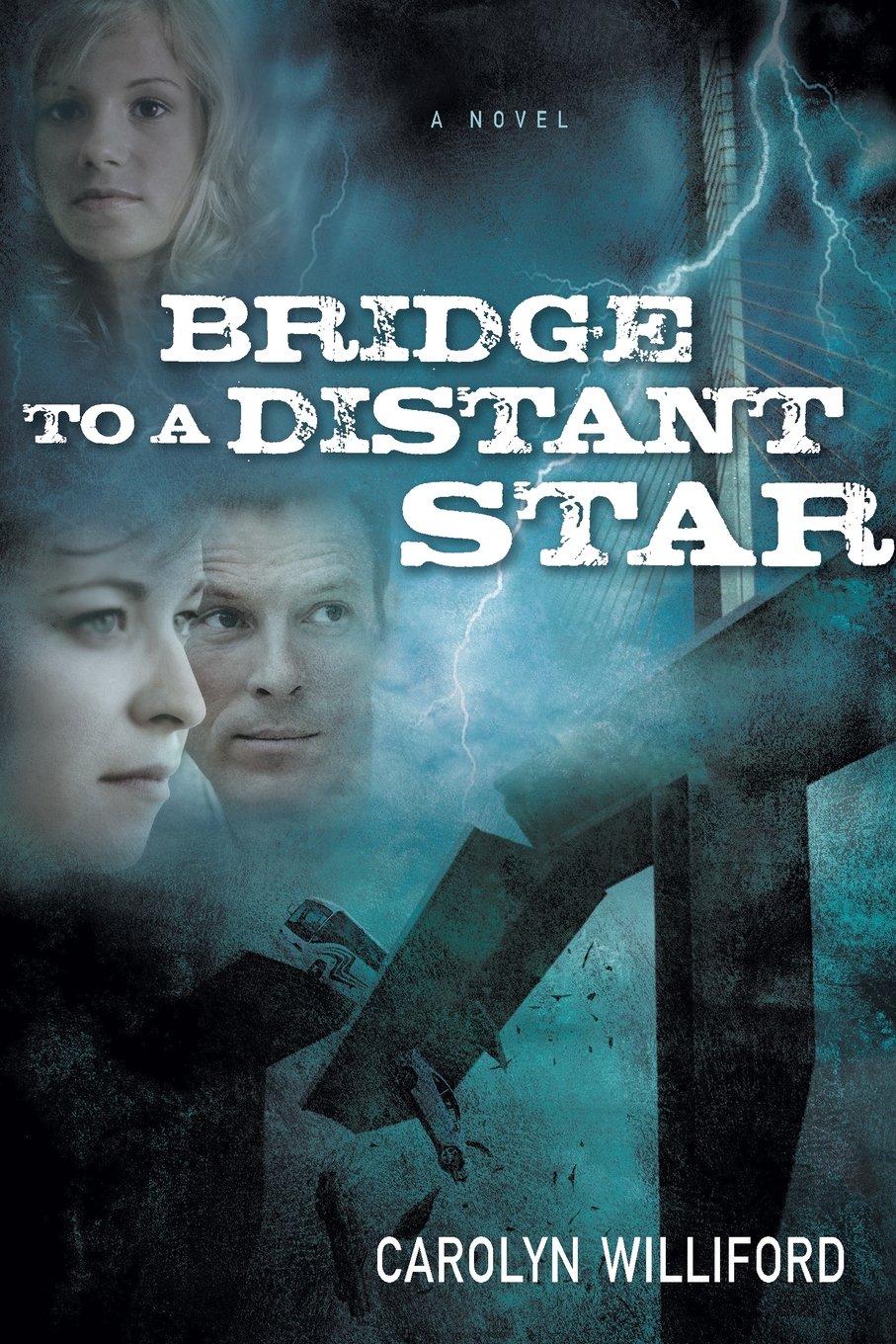



It All Comes Tumbling Down As a storm rages in the night, unwary drivers venture onto Tampa Bay’s most renowned bridge. No one sees the danger ahead. No one notices the jagged gap hidden by the darkness and rain. Yet when the bridge collapses vehicles careen into the churning waters of the bay below. In that one catastrophic moment, three powerful stories converge: a family ravaged by their child’s heartbreaking news, a marriage threatened by its own facade, and a college student burdened by self doubt. As each story unfolds, the characters move steadily closer to that fateful moment on the bridge. And while each character searches for grace, the storms in their lives loom as large as the storm that awaits them above the bay. When these characters intersect in Carolyn Williford’s gripping and moving volume of three novellas, they also collide with the transforming truth of Christ: Deny yourself, take up your cross, and follow me. Carolyn Williford has authored seven books, including Jordan’s Bend, Devotions for Families That Can’t Sit Still , and Faith Tango, as well as numerous articles . She and her husband, Craig, live in Deerfield, Illinois, where he serves as president of Trinity International University. They have two children and four grandchildren. BRIDGE TO A DISTANT STAR By CAROLYN WILLIFORD David C. Cook Copyright © 2011 Carolyn Williford All rights reserved. ISBN: 978-1-4347-6703-5 Contents Acknowledgments, Beginnings, Deny Yourself, Pick Up Your Cross, Follow Me, Endings, Afterwords, A Conversation with Carolyn Williford, CHAPTER 1 Beginnings A Friday morning in May 2009 The heavy fog moved toward him like fists pushing against the window. Using a frayed handkerchief, the solitary man reached up to wipe a mist-covered spot. Large, heavily muscled, he was an imposing figure accustomed to giving orders, commanding men and ships at will. But as he leaned forward, squinting jet-black eyes to peer out into the gloom of that dawn, he was aware that there would be no submission from the fickle weather, no acquiescence to his hope for an easier route ahead. The toothpick he absentmindedly chewed switched from one side of his bushy-mustached mouth to the other. And then he slumped backward in frustration, sighing heavily. Captain Ray Luis was a great believer in signs and omens. In his estimation, this beastly morning was a harbinger of nothing good. Though inside the pilothouse and out of the wretched weather, Captain Luis felt the dampness envelop him like a soggy blanket. Usually the view out the window toward the waves filled him with a sense of pride; holding the well-worn, smooth wheel of the ship in his calloused hands could still produce a thrill. But on that particular morning, none of the familiar pleasures would lift his spirits. In good weather, he would trust no other crew member to be at the helm for the formidable journey up the Tampa Bay channel; in this weather, the responsibility of the job weighed on him—and him alone—even more. Intently peering through the fogged windows, Luis tried to estimate the visibility ahead, shaking his head at his infernal bad luck. Reaching up to rub tired eyes and then scratch his chin, he felt the stubble of a three-day growth of beard. He'd taken all the necessary precautions before heading up the bay. Even so he reminded himself that his freighter, the Wilder Wanderer , was now without cargo and therefore significantly lighter; as a result, she would ride higher in the water, more at the mercy of wind and waves. The bridge that worried him just ahead was the over five-mile-long Sunshine Skyway, a marvel of engineering—and beauty—that spanned the bay from St. Petersburg to Bradenton. The golden cables, designed to gently arch upward, proclaimed the elegance of her design, beckoning all who passed over or beneath to savor the symmetry. But wise captains weren't naive to her siren's song; they knew her spell was merely a facade, and a dangerous one at that. Beneath the beauty lay treachery for the unwary. The stark reality was this: Every ship's captain faced a critical test of his skills by maneuvering through the passage, which measured 864 feet wide and 150 feet tall. On each side of the channel stood bridge piers made of steel and concrete; these structures supported the roadway above, providing a safe journey for people in the cars, trucks, and buses that crossed the bridge, going about their daily lives. All of them traveled blind to any potential emergency or danger from below. Unknowingly, they placed their trust not only in the worthiness of the superstructure itself, but also in the hands of every pilot who steered his ship under the bridge. Today their lives rested in the hands of Captain Luis. Clutching the wheel of the Wild One —as he affectionately called the ship—Luis continued his search for the all-important buoys that marked the safe channel under the bridge. Any divergen