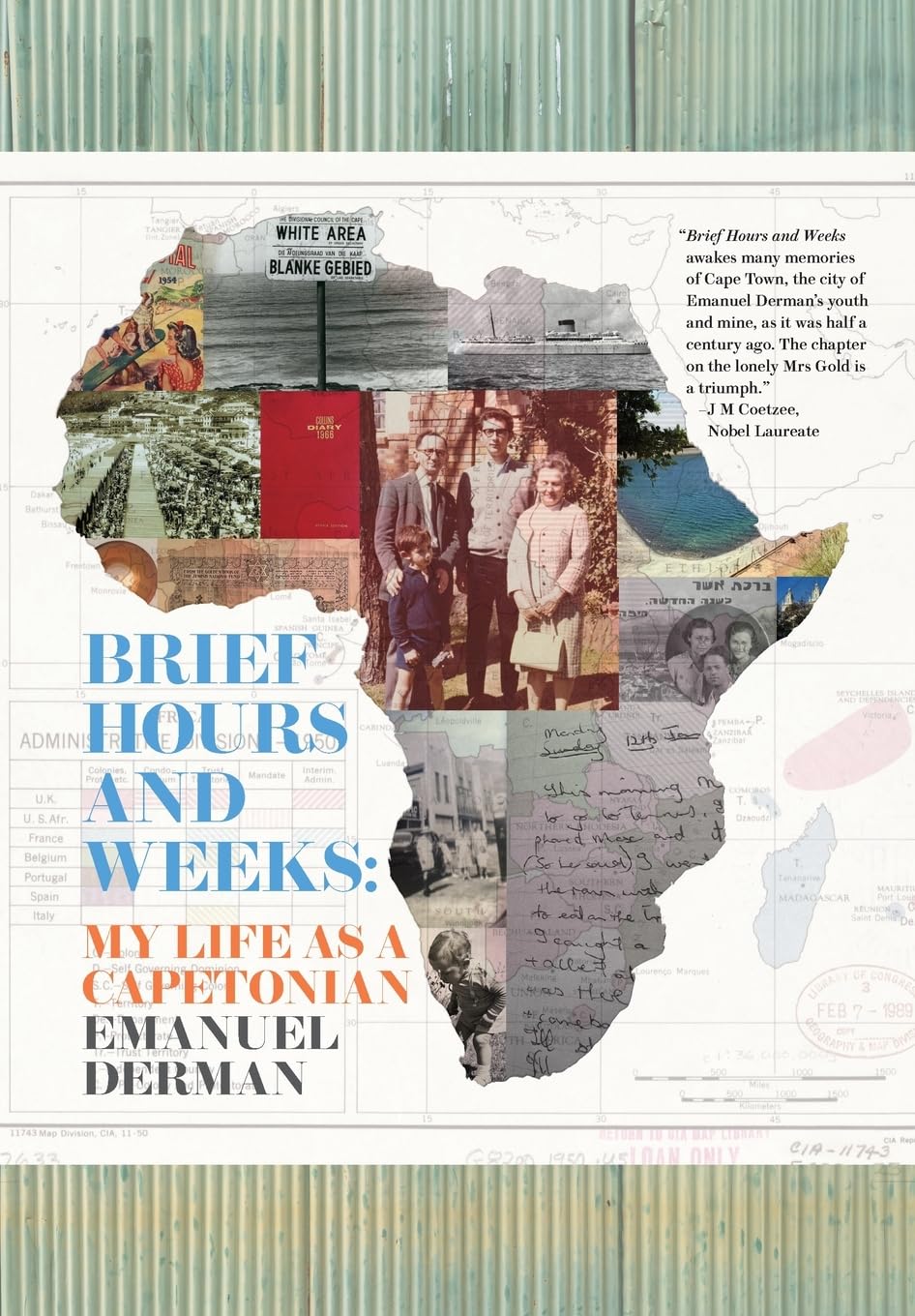



Brief Hours and Weeks is the author's account of growing up in a small, tightly knit, first-generation Polish-Jewish community in Cape Town in the 1940s, 50s, and 60s. Observing through at first naive and then later more sophisticated eyes, he describes his childhood and youth in a protective off-the-boat immigrant Jewish family in very British-Commonwealth South Africa as apartheid becomes increasingly coercive. Through vivid and candid personal stories, he brings to life a time, place, culture, people, and set of mores that no longer exist. At 21, he leaves Africa to study in America. "Brief Hours and Weeks awakes many memories of Cape Town, the city of Emanuel Derman's youth and mine, as it was half a century ago. The chapter on the lonely Mrs Gold is a triumph." - J M Coetzee, Nobel Laureate Why did they invent reading? "Brief Hours and Weeks: My Life as a Capetonian" would almost be reason enough. It's the story of a Jewish boy's coming-of-age in the South Africa of the 1950s and '60s. Emanuel Derman is the remarkable author and subject: a Bell Labs-caliber physicist turned Wall Street quant turned professor of financial engineering turned autobiographer. One charm of this gorgeously illustrated book is the absence of a clear delineation between what happened and what Mr. Derman allows himself to imagine happened. "The author likes the observation by Sheila Heti," an endnote reveals: " The self's report on itself is surely a great fiction.' " So we don't really know whether the pimply young Emanuel bedded the lonely Mrs. Gold, though we can be quite certain that somehow, somewhere, the student of electromagnetic theory and quantum mechanics learned how to write like an angel. -Wall Street Journal, James Grant, author of Bagehot: The Life and Times of the Greatest Victorian "Written with laconic candour, this book is proof of why you had to leave this city that corralled you while it nurtured you." - Albie Sachs, writer and anti-apartheid activist "This is a touching, evocative (and beautifully illustrated) memoir, a vibrant portrayal of a vanished yet not wholly distant world. Emanuel Derman paints a convincing picture with great skill, candour and humanity. These are precious memories, which you will enjoy reading." -Stefan Stern, former Financial Times columnist and author "Professor Derman writes with such honesty, openness and detail that I feel I may have developed false memories. 'But, Paul, you aren't Jewish and you've never been to Cape Town.' Now I'm not so sure." -Paul Wilmott, mathematician, author and semi-professional controversialist Emanuel Derman is the author of My Life as a Quant, the 2004 memoir that first introduced the quant world to a wide audience. He is also the author of Models.Behaving.Badly, a meditation on the critical difference between models in the physical sciences and those in the social sciences. He is a frequent contributor to X/twitter at @EmanuelDerman. Brief Hours and Weeks is a memoir of childhood and youth in Cape Town. The author likes the remark by Sheila Heti: "The self's report on itself is surely a great fiction." Derman was born in South Africa but has spent most of his professional years in Manhattan in New York City, where he made contributions to several fields. He started out as a theoretical physicist, doing research on unified theories of elementary particle interactions. At AT&T Bell Laboratories in the 1980s he developed programming languages for business modeling. From 1985 to 2002 he worked on Wall Street, running quantitative strategies research groups in fixed income, equities, and risk management at Goldman Sachs, where he was appointed a managing director in 1997. The two financial models he developed with colleagues there, the Black-Derman-Toy interest rate model and the local volatility model, have become widely used industry standards. From 2003 to 2023 he was head of the Master's Program in Financial Engineering at Columbia, where he is now Professor of Professional Practice Emeritus. In both of his books Derman points out the dangers that inevitably accompany the use of models, which are merely limited metaphors that compare something you would like to understand with something similar, but not identical, that you already understand. He was named the IAFE Financial Engineer of the Year in 2000. He has a PhD in theoretical physics from Columbia University and is the author of numerous articles in elementary particle physics, computer science, and finance.