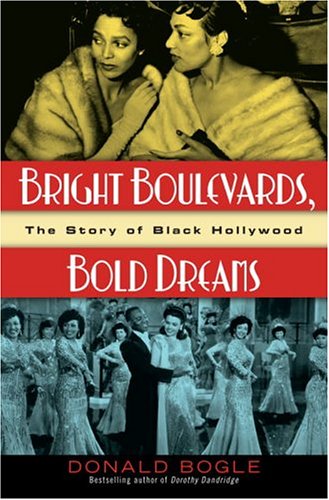



In Bright Boulevards, Bold Dreams, Donald Bogle tells–for the first time–the story of a place both mythic and real: Black Hollywood. Spanning sixty years, this deliciously entertaining history uncovers the audacious manner in which many blacks made a place for themselves in an industry that originally had no place for them. Through interviews and the personal recollections of Hollywood luminaries, Bogle pieces together a remarkable history that remains largely obscure to this day. We discover that Black Hollywood was a place distinct from the studio-system-dominated Tinseltown–a world unto itself, with unique rules and social hierarchy. It had its own talent scouts and media, its own watering holes, elegant hotels, and fashionable nightspots, and of course its own glamorous and brilliant personalities. Along with famous actors including Bill “Bojangles” Robinson, Hattie McDaniel (whose home was among Hollywood’s most exquisite), and, later, the stunningly beautiful Lena Horne and the fabulously gifted Sammy Davis, Jr., we meet the likes of heartthrob James Edwards, whose promising career was derailed by whispers of an affair with Lana Turner, and the mysterious Madame Sul-Te-Wan, who shared a close lifelong friendship with pioneering director D. W. Griffith. But Bogle also looks at other members of the black community–from the white stars’ black servants, who had their own money and prestige, to gossip columnists, hairstylists, and architects–and at the world that grew up around them along Central Avenue, the Harlem of the West. In the tradition of Hortense Powdermaker’s classic Hollywood: The Dream Factory and Neal Gabler’s An Empire of Their Own, in Bright Boulevards, Bold Dreams, Donald Bogle re-creates a vanished world that left an indelible mark on Hollywood–and on all of America. Bogle, black cinema historian and author of Primetime Blues: African Americans on Network Television (2001), celebrates the black movie colony that existed side by side with mainstream Hollywood during the first half of the twentieth century. Exploring the social and political backstory of black Hollywood before integration, Bogle presents a parallel universe that produced its own stars, had its own nightspots, and generated its own glamour. The cohesiveness that was born of segregation and limited opportunities also included roles for blacks as servants, hairdressers, architects, and assistants to the powerful. Bogle recalls the careers of black performers, including the Nicholas Brothers, Dorothy Dandridge, Lena Horne, Mantan Moreland, Hattie McDaniel, Stepin Fetchit, and Sammy Davis Jr. He explores the growth of black immigration to California as the allure of Hollywood seemed to promise greater opportunities. Each chapter focuses on a decade from the 1910s through the 1950s, chronicling the changes in race relations as reflected in the movies. The book includes more than 100 photographs that help re-create an era of glamour and segregation. Vanessa Bush Copyright © American Library Association. All rights reserved “Mr. Bogle continues to be our most noted black-cinema historian.” –SPIKE LEE Praise for Dorothy Dandridge “An ambitious, rigorously researched account of the long-ignored film star and chanteuse . . . [Bogle] has fashioned a resonant history of a bygone era in Hollywood and passionately documented the contribution of one of its most dazzling and complex performers.” – The New York Times Book Review “Donald Bogle, that pioneering safekeeper of the history of blacks in film, has completed the first definitive biography of Dandridge. Bogle’s epic biography depicts all the rich details of Dandridge’s life.” – Vogue Praise for Toms, Coons, Mulattoes, Mammies, and Bucks “Bogle is passionate and good-humored. His book is valuable as a film reference work and social document.” –GENE SISKEL “Far more inclusive and informative than previous books on the subject.” – The New York Times Donald Bogle is the foremost authority on African Americans in film. His books–which include Dorothy Dandridge; Toms, Coons, Mulattoes, Mammies, and Bucks and Primetime Blues–have won awards and wide critical acclaim. He teaches at New York University’s Tisch School of the Arts and the University of Pennsylvania and lives in Manhattan. If you can stand to look at them today, the vast majority of African-American characters featured in Hollywood's early years are blood-chilling caricatures. Donald Bogle summed it up best with the title of his landmark study, Toms, Coons, Mulattoes, Mammies, and Bucks (1973). And as Bogle demonstrates in his new book, Bright Boulevards, Bold Dreams, Hollywood wasn't much kinder to the actors who played these parts; indignities loomed from the casting call to the commissary to opening-night ceremonies. But just as Bogle's first book showed how certain actors were able to turn the stereotypes inside out, this chronicle presents the development of a dynamic black film community in sunny