Building LLMs from Scratch: Designing, Training, Evaluating, and Deploying a Large Language Models: Case Study of Building LLMs: Transformer, Data
$39.90
by Practicing Engineers Network



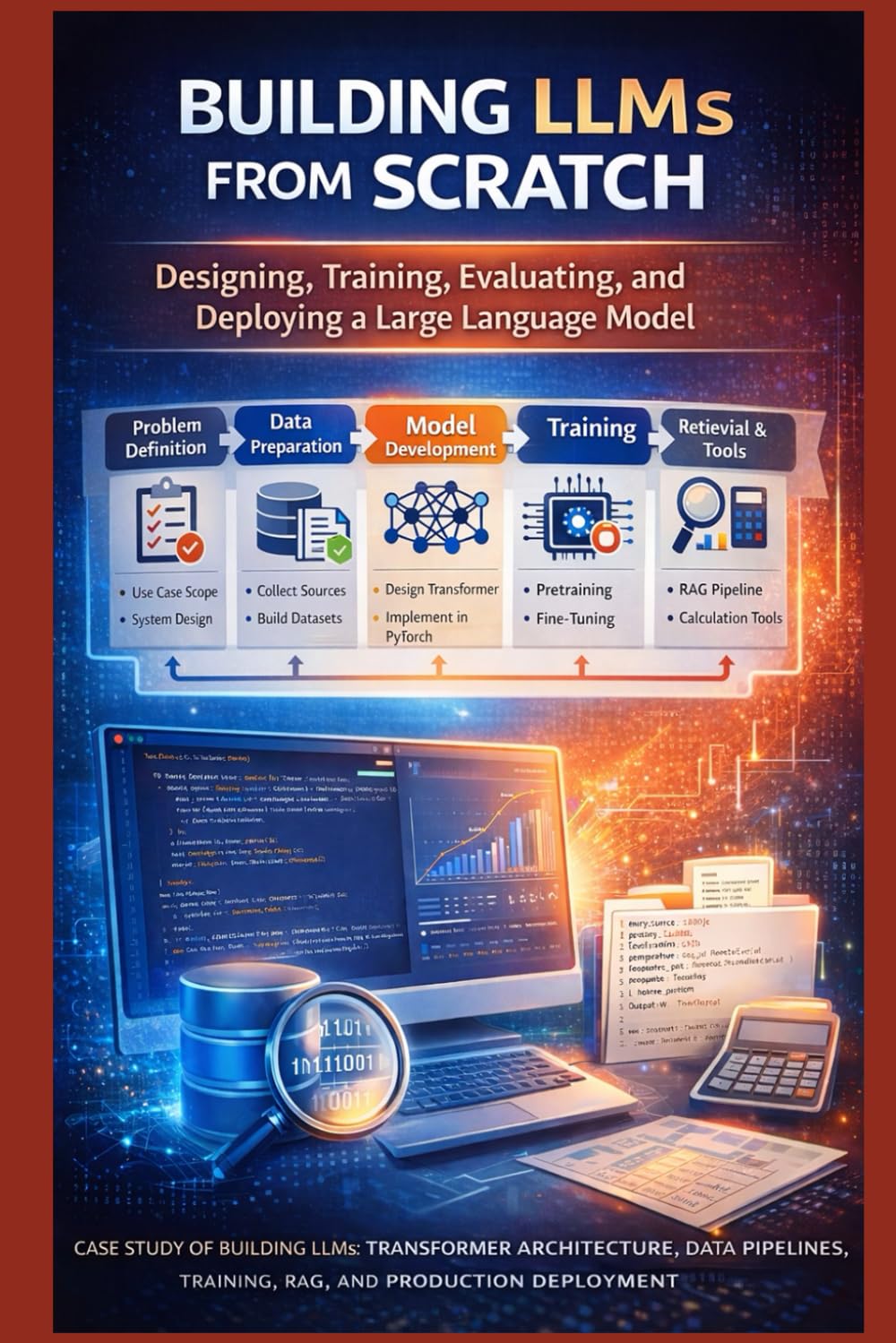
Building LLMs from Scratch is a complete, end-to-end guide to designing, training, evaluating, and deploying a real Large Language Model —not a toy example, not a wrapper around an API, and not a collection of disconnected tutorials. This book walks you through a single, cohesive use case : building a production-ready Engineering Copilot LLM from the ground up. Every chapter builds on the previous one, showing how modern LLM systems are actually constructed, governed, optimized, and maintained in the real world. You will learn not just how LLMs work, but how to engineer them responsibly . What This Book Covers This book takes you through the entire LLM lifecycle , including: Designing a transformer-based language model from first principles - Building and training a custom tokenizer for technical content - Pretraining and fine-tuning for structured, disciplined outputs - Implementing Retrieval-Augmented Generation (RAG) with authoritative sources - Integrating deterministic tools to eliminate numeric hallucinations - Enforcing strict schemas, safety rules, and refusal behavior - Designing ethics, liability boundaries, and audit logging requirements - Optimizing inference for performance, cost, and scalability - Deploying the LLM as a production service with clear API contracts - Managing versions, updates, regression testing, and long-term maintenance Every concept is backed by real file structures, real code, real configuration artifacts , and clear explanations of why each component exists . What Makes This Book Different Most LLM books focus on prompts, APIs, or theory. This book focuses on systems engineering . You will not just learn: what transformers are, but how to build one - what RAG is, but how to govern and audit it - what safety means, but how to enforce it in code - what deployment looks like, but how to keep it stable over time By the end of the book, you will understand how to build an LLM that is: grounded in real data - numerically trustworthy - refusal-aware and ethically bounded - auditable and defensible - deployable in real production environments Who This Book Is For This book is ideal for: Software engineers and ML engineers who want to truly understand LLM systems - Technical professionals building AI tools for regulated or high-risk domains - Engineers who want more than API usage—they want ownership and control - Architects and technical leads designing AI-powered systems - Advanced learners who want to move from “using AI” to engineering AI No prior deep learning research background is required, but readers should be comfortable with Python and basic software concepts. What You Will Walk Away With After reading this book, you will be able to: Design and implement an LLM system from scratch - Understand how modern LLM products are structured internally - Make informed decisions about safety, governance, and deployment - Confidently evaluate AI systems beyond surface-level demos This is not a shortcut book. It is a builder’s guide . If you want to understand how LLMs are actually built, operated, and maintained in the real world—this book is for you.