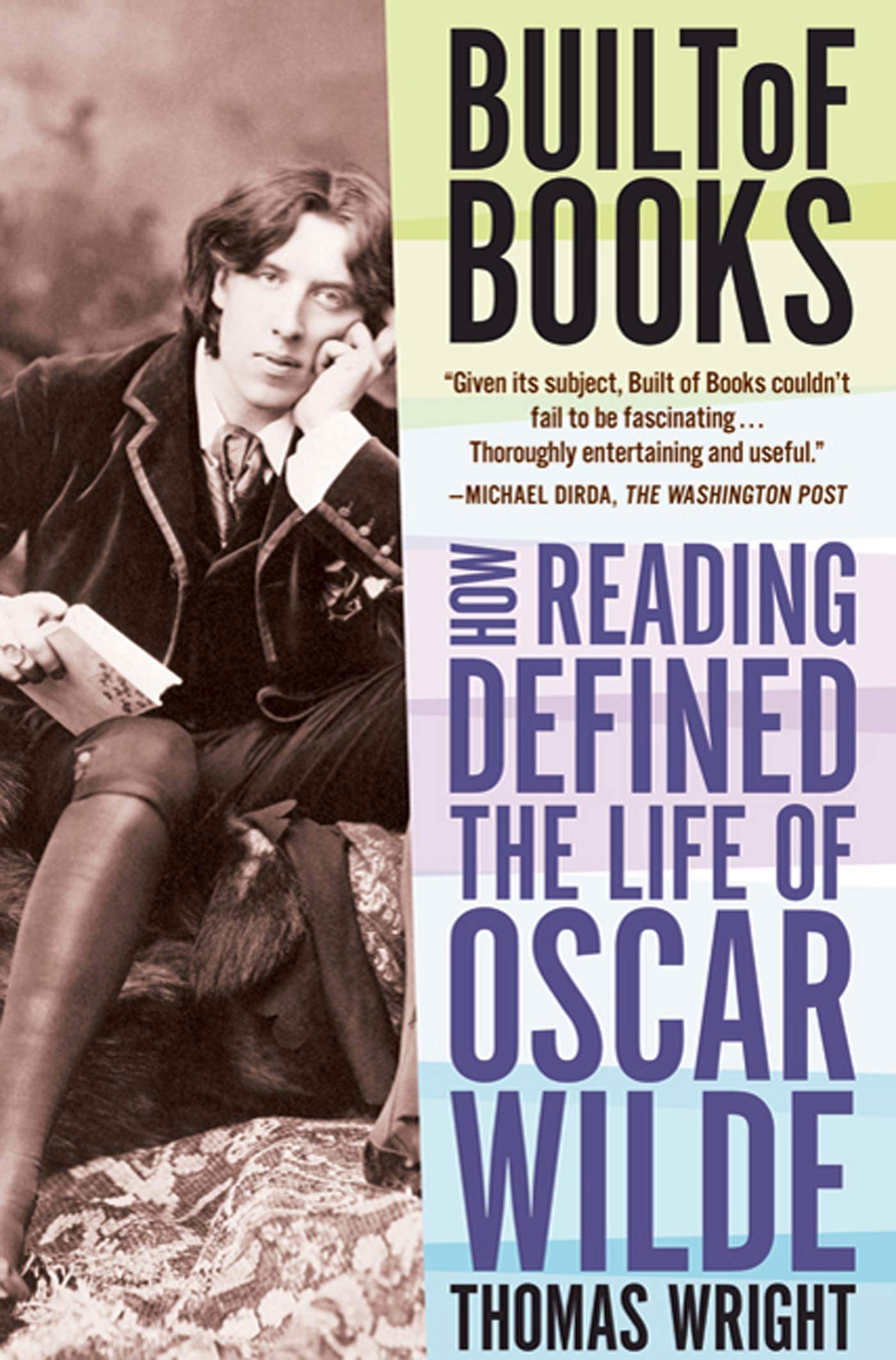



An entirely new kind of biography, Built of Books explores the mind and personality of Oscar Wilde through his taste in books This intimate account of Oscar Wilde's life and writings is richer, livelier, and more personal than any book available about the brilliant writer, revealing a man who built himself out of books. His library was his reality, the source of so much that was vital to his life. A reader first, his readerly encounters, out of all of life's pursuits, are seen to be as significant as his most important relationships with friends, family, or lovers. Wilde's library, which Thomas Wright spent twenty years reading, provides the intellectual (and emotional) climate at the core of this deeply engaging portrait. One of the book's happiest surprises is the story of the author's adventure reading Wilde's library. Reminiscent of Jorge Luis Borges's fictional hero who enters Cervantes's mind by saturating himself in the culture of sixteenth-century Spain, Wright employs Wilde as his own Virgilian guide to world literature. We come to understand how reading can be an extremely sensual experience, producing a physical as well as a spiritual delight. "Revealing portrait of the noted―and notorious―writer, viewed through the prism of the books that educated, inspired and comforted him ... The author accents this remarkable account with pages of Wilde’s reading lists, reproductions of annotated books and an index of referenced authors. " - Kirkus Reviews Thomas Wright was educated at Saint Thomas More School in Bedford, England. He lectures frequently on Wilde and has written countless articles about him. The author of Oscar Wilde's Table Talk , Wright lives in Genoa and London, and sometimes writes about subjects unconnected with his hero. Built of Books How Reading Defined the Life of Oscar Wilde By Thomas Wright Holt Paperbacks Copyright © 2010 Thomas Wright All right reserved. ISBN: 9780805092462 1. ‘Hear the song of Oscar!’ WHEN WILDE MADE his entrance on to the world’s stage on 16 October 1854, his mother came up with a name that produced intensely romantic vibrations: Oscar Fingal O’Flahertie Wilde.* Christening was a matter of the utmost importance for Wilde – like one of his fictional heroes, he believed that ‘names are everything’.1 Lovely names, he thought, could make even the ugliest objects beautiful: cigars were vile things, but when called ‘nut-brown cigarettes’ they became charming.2 Wilde’s friends too, were altered forever when he baptised them anew with names drawn from books. What unimaginative people referred to as the ‘real’ world could be transformed, apotheosised, and endowed with meaning through words, which took its brazen objects and magically turned them into gold. It was imperative then, that the bloody, screaming baby boy was licked quickly by language into shape and significance, and elevated from the mundane and formless world of nature to the golden world of words. Wilde’s mother, a famous poetess, proved equal to the task by conferring on her second son a name both marvellous and musical (Wilde’s elder brother, Willie, had been born in 1852). Two of Wilde’s names, ‘Oscar’ and ‘Fingal’, were drawn from James Macpherson’s celebrated eighteenth-century Ossian poems, which were based on ancient Celtic mythology; O’Flahertie was the name of a famously fierce Irish clan.3 Fingal is Macpherson’s name for Fionn MacCumhaill, the legendary Irish poet and warrior king. Oscar is Fingal’s grandson, and the son of the poet Ossian. According to one Celtic legend, a version of which Wilde would narrate years later, Ossian is enchanted by a fairy woman called Niamh, who carries him over the seas to Tír na nOg, the Celtic country of the eternally young, where the fairy child Oscar is born. After three hundred years, Ossian yearns to revisit the land of his fathers. Niamh warns him never to dismount from his horse in the land of mortal men – if he does, the three hundred years he has spent in Tír na nOg will suddenly catch up with him. But alas, when he returns, Ossian’s foot does touch the earth; his three hundred years suddenly fall upon him, and he is bowed double, and his beard sweeps the ground.4 Macpherson’s reconstruction of Celtic mythology, which draws on the rich oral folk traditions of Ireland and Scotland as well as on ancient manuscripts, has an epic flavour. It is full of archetypal stories concerning warriors, bards and women of ethereal beauty, who people a misty landscape haunted by ghosts and memories. The style too, with its solemn and plangent music and its extravagant formulaic epithets, has an epic grandeur. The young warrior Oscar is hailed as ‘the chief of every youth’, ‘the King of many songs’, ‘Oscar of the future fights’, and ‘Oscar of the dark brown hair’. His father and grandfather continually exhort him to heroic deeds: ‘O Oscar, pride of youth . . . Pursue the fame of thy fathers . . . Their deeds are the songs of bards.’ Oscar take