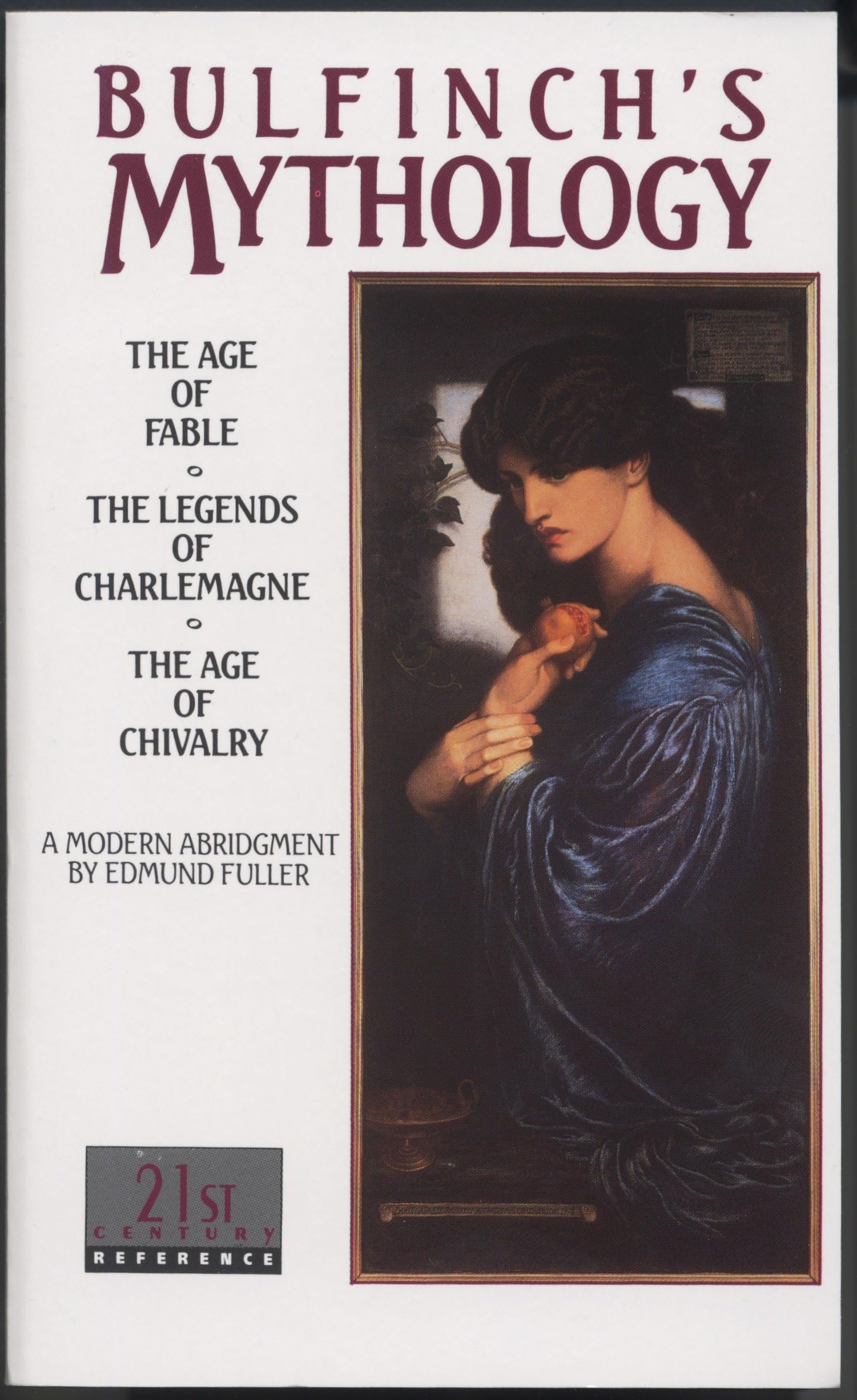
Bulfinch's Mythology: The Age of Fable / The Legends of Charlemagne / The Age of Chivalry (Laurel Classic)
$7.99
by Thomas Bulfinch



For almost 150 years, Bulfinch’s Mythology has been the text by which the great tales from classical antiquity, the Norse and Asian traditions, and the age of chivalry have been known. Here are lively versions of the myths of Zeus, Hera, and their cohorts on Mt. Olympus; the legends of the Trojan War and the epic wanderings of Ulysses and Aeneas; the tales of the joys of Valhalla and the furies of Thor; the adventures of King Arthur and his knights; and the sagas of Beowulf and Robin Hood. As Thomas Bulfinch himself wrote, “Without a knowledge of mythology much of the elegant literature of our own language cannot be understood and appreciated.” With stories that are eminently readable, Bulfinch’s Mythology gives us just that knowledge. The justly famous Mythology by Thomas Bulfinch contains three volumes the major contents of which are retained in this abridgment for the student and general reader. The Age Of Fable -- The gods and goddesses of Greece and Rome, as well as the mythology of the Germanic tribes, England and the Near East. The Legend Of Charlemange -- Accounts of the reign of the first great French Emperor, his wars and conquests. The Age Of Chivalry -- King Arthur and his court, Lancelot and Guenever, and the death of Arthur. amous Mythology by Thomas Bulfinch contains three volumes the major contents of which are retained in this abridgment for the student and general reader. The Age Of Fable -- The gods and goddesses of Greece and Rome, as well as the mythology of the Germanic tribes, England and the Near East. The Legend Of Charlemange -- Accounts of the reign of the first great French Emperor, his wars and conquests. The Age Of Chivalry -- King Arthur and his court, Lancelot and Guenever, and the death of Arthur. amous Mythology by Thomas Bulfinch contains three volumes the major contents of which are retained in this abridgment for the student and general reader. The Age Of Fable -- The gods and goddesses of Greece and Rome, as well as the mythology of the Germanic tribes, England and the Near East. The Legend Of Charlemange -- Accounts of the reign of the first great French Emperor, his wars and conquests. The Age Of Chivalry -- King Arthur and his court, Lancelot and Guenever, and the death of Arthur. Thomas Bulfinch (1796–1867) was an American writer, Latinist, and banker who wrote and collected the first popular English-language retellings of Greek, Roman, Eastern, Scandinavian, Arthurian, and medieval myths in his famous three-volume compilation, Bulfinch’s Mythology . "Without a knowledge of mythology," he wrote, "much of the elegant literature of our own language cannot be understood or appreciated." He added: "We trust our young readers will find it a source of entertainment," and his trust seems to have been justified, judging from the many generations who have found his books an enthralling and loving introduction to the worlds of classical and medieval myth and legend. Excerpt IF no other knowledge deserves to be called useful but thatwhich helps to enlarge our possessions or to raise our station insociety, then mythology has no claim to the appellation. But if thatwhich tends to make us happier and better can be called useful then weclaim that epithet for our subject. For mythology is the handmaid ofliterature; and literature is one of the best allies of virtue andpromoters of happiness. Without a knowledge of mythology much of the elegant literature of ourown language cannot be understood and appreciated. When Byron calls Rome"the Niobe of nations," or says of Venice, "She looks a Sea-Cybele freshfrom ocean," he calls up to the mind of one familiar with our subject,illustrations more vivid and striking than the pencil could furnish, butwhich are lost to the reader ignorant of mythology. Milton abounds insimilar allusions. The short poem "Comus" contains more than thirtysuch, and the ode "On the Morning of the Nativity" half as many. Through"Paradise Lost" they are scattered profusely. This is one reason why weoften hear persons by no means illiterate say that they cannot enjoyMilton. But were these persons to add to their more solid acquirementsthe easy learning of this little volume, much of the poetry of Miltonwhich has appeared to them "harsh and crabbed" would be found "musicalas is Apollo's lute." Our citations, taken from more than twenty-fivepoets, from Spenser to Longfellow, will show how general has been thepractice of borrowing illustrations from mythology. The prose writers also avail themselves of the same source of elegantand suggestive illustration. One can hardly take up a number of the"Edinburgh" or "Quarterly Review" without meeting with instances. InMacaulay's article on Milton there are twenty such. But how is mythology to be taught to one who does not learn it throughthe medium of the languages of Greece and Rome? To devote study to aspecies of learning which relates wholly to false marvels and obsoletefaiths is not to