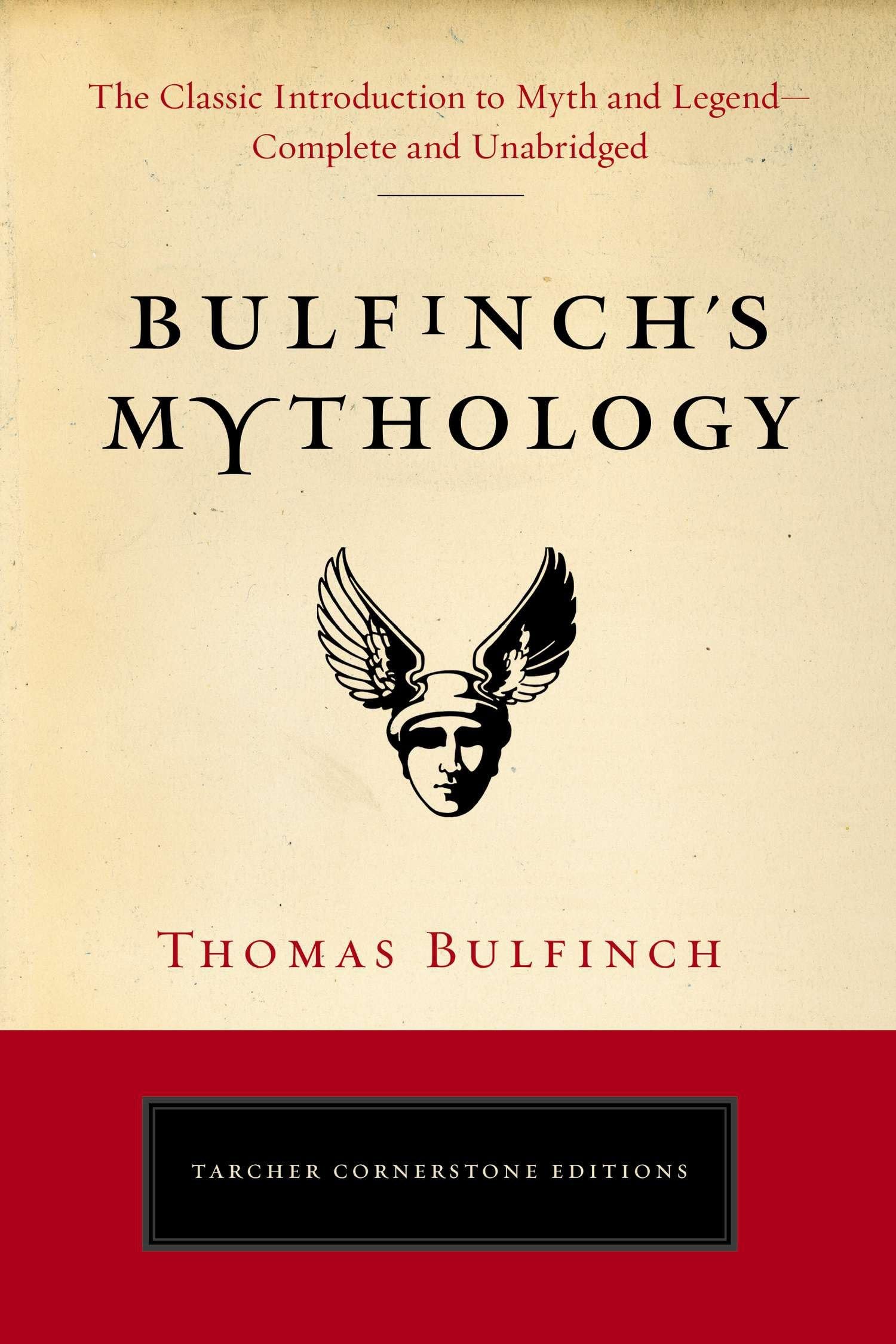
Bulfinch's Mythology: The Classic Introduction to Myth and Legend-Complete and Unabridged (Tarcher Cornerstone Editions)
$23.00
by Thomas Bulfinch



A beautifully packaged and affordably priced edition of this classic, accessible guide to world mythology, unabridged and complete. Thomas Bulfinch collected and interpreted the legends of the world for everyday people, so that those who lacked extensive schooling could still understand the mythological allusions that fill classic and contemporary literature. Bulfinch’s Mythology began as three separate volumes in the 1850s and ’60s. Bulfinch published "The Age of Fable, or Stories of Gods and Heroes" in 1855 and then moved on to publish two more collections: "The Age of Chivalry, or the Legends of King Arthur" in 1858; and "Legends of Charlemagne, or Romance of the Middle Ages" in 1863. When Bulfinch died in 1867, the three volumes were combined and retitled Bulfinch's Mythology and reprinted in 1881. It has remained one of the most trusted English-language interpretations of Greek and Roman mythology, Arthurian legend, and medieval romance ever since. Our Cornerstone Edition of Bulfinch’s Mythology offers readers an easily portable, complete collection of all three volumes—the only such edition of this beloved anthology currently available. "One of the most popular books ever published in the United States and the standard work on classical mythology for nearly a century" —Carl J. Richard, The Battle for the American Mind Thomas Bulfinch (1796–1867) was a Massachusetts-based writer and banker who wrote and collected the first popular English-language retellings of Greek, Roman, Eastern, Scandinavian, Arthurian, and medieval myths. Stories of Gods and Heroes CHAPTER I Introduction The religions of ancient Greece and Rome are extinct. The so-called divinities of Olympus have not a single worshipper among living men. They belong now not to the department of theology, but to those of literature and taste. There they still hold their place, and will continue to hold it, for they are too closely connected with the finest productions of poetry and art, both ancient and modern, to pass into oblivion. We propose to tell the stories relating to them which have come down to us from the ancients, and which are alluded to by modern poets, essayists, and orators. Our readers may thus at the same time be entertained by the most charming fictions which fancy has ever created, and put in possession of information indispensable to every one who would read with intelligence the elegant literature of his own day. In order to understand these stories, it will be necessary to acquaint ourselves with the ideas of the structure of the universe which prevailed among the Greeks—the people from whom the Romans, and other nations through them, received their science and religion. The Greeks believed the earth to be flat and circular, their own country occupying the middle of it, the central point being either Mount Olympus, the abode of the gods, or Delphi, so famous for its oracle. The circular disk of the earth was crossed from west to east and divided into two equal parts by the Sea, as they called the Mediterranean, and its continuation the Euxine, the only seas with which they were acquainted. Around the earth flowed the River Ocean, its course being from south to north on the western side of the earth, and in a contrary direction on the eastern side. It flowed in a steady, equable current, unvexed by storm or tempest. The sea, and all the rivers on earth, received their waters from it. The northern portion of the earth was supposed to be inhabited by a happy race named the Hyperboreans, dwelling in everlasting bliss and spring beyond the lofty mountains whose caverns were supposed to send forth the piercing blasts of the north wind, which chilled the people of Hellas (Greece). Their country was inaccessible by land or sea. They lived exempt from disease or old age, from toils and warfare. Moore has given us the “Song of a Hyperborean,” beginning “I come from a land in the sun-bright deep, Where golden gardens glow, Where the winds of the north, becalmed in sleep, Their conch shells never blow.” On the south side of the earth, close to the stream of Ocean, dwelt a people happy and virtuous as the Hyperboreans. They were named the Æthiopians. The gods favored them so highly that they were wont to leave at times their Olympian abodes and go to share their sacrifices and banquets. On the western margin of the earth, by the stream of Ocean, lay a happy place named the Elysian Plain, whither mortals favored by the gods were transported without tasting of death, to enjoy an immortality of bliss. This happy region was also called the “Fortunate Fields,” and the “Isles of the Blessed.” We thus see that the Greeks of the early ages knew little of any real people except those to the east and south of their own country, or near the coast of the Mediterranean. Their imagination meantime peopled the western portion of this sea with giants, monsters, and enchantresses