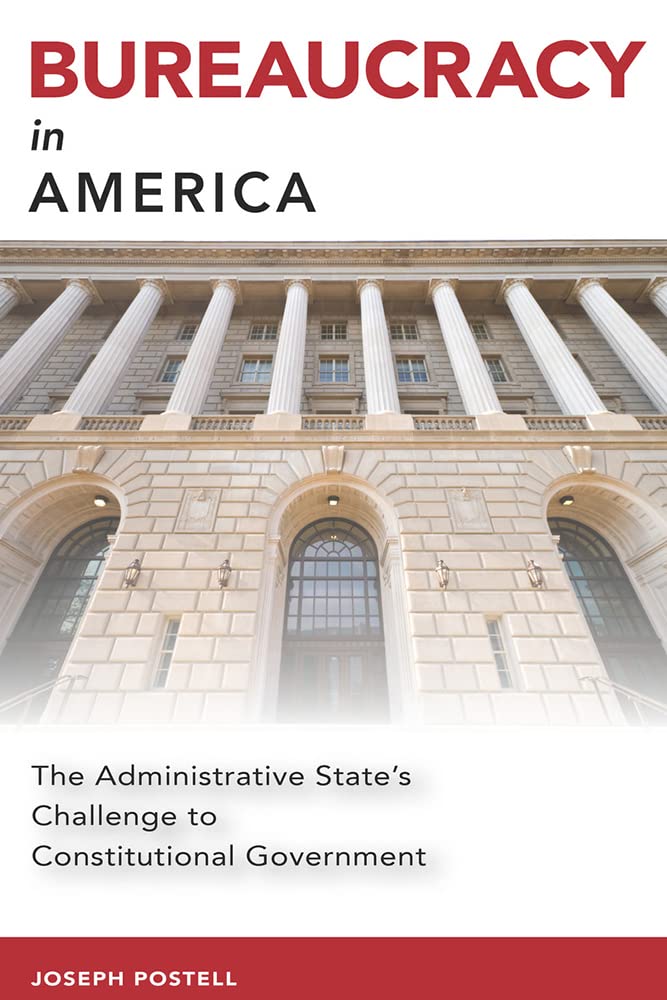
Bureaucracy in America: The Administrative State's Challenge to Constitutional Government (Studies in Constitutional Democracy)
$30.00
by Joseph Postell



The rise of the administrative state is the most significant political development in American politics over the past century. While our Constitution separates powers into three branches, and requires that the laws are made by elected representatives in the Congress, today most policies are made by unelected officials in agencies where legislative, executive, and judicial powers are combined. This threatens constitutionalism and the rule of law. This book examines the history of administrative power in America and argues that modern administrative law has failed to protect the principles of American constitutionalism as effectively as earlier approaches to regulation and administration. “Federal bureaucracy often seems to roam far beyond what Congress has clearly authorized and often does so without meaningful check from courts. Postell’s book demonstrates that Americans have worried about over-reaching officials since colonial times. Bureaucracy in America shows what we can learn from past efforts to secure the people’s rights, even from government officials.”—Jeremy A. Rabkin, George Mason University, author of Law without Nations? “The labyrinthine edifice of administrative law can be neither wholly reconciled with the nation’s deepest principles nor wholly efface them, and Postell’s clear explication of what is at stake in this notoriously complex subject will make this book a landmark in the field.”—Johnathan O’Neill, Georgia Southern University, author of Originalism in American Law and Politics: A Constitutional History “Postell’s book shines a light on the new reality of American government: critical national policies are made, by and large, by bureaucratic agencies today, not by Congress and not even, in many cases, by the president. This new reality raises vital constitutional questions—questions which have, with just a few exceptions, been ignored in the scholarly literature. Postell’s examination of these vital questions is meticulously researched, balanced, and persuasive. Employing a unique combination of political theory, American political thought, and administrative and constitutional law, Bureaucracy in America will be an important work to scholars in all of these disciplines, and will also be of interest to citizens and policymakers alike.”—Ronald J. Pestritto, Graduate Dean at Hillsdale College and author of Woodrow Wilson and the Roots of Modern Liberalism “A definitive model of outstanding scholarship and a timely, much needed contribution to our contemporary national dialogue on political governance and policy making.”— Midwest Book Review “This book is worth the time and effort to read because of what it says about the future of the Constitution.”— The Electric Review “Postell succeeds in telling what is admittedly dense and complex history. Administrative law tempts scholars into either vague abstraction (in an effort to cover a wide-range of government activities) or mind-numbing detail (in an effort to get to the core of agency decisions). Mercifully, Postell avoids both temptations, steering a middle course that is accessible and readable.”— Public Discourse Beauracracy in America is a new title in the series Studies in Constitutional Democracy. The United States presents world political history with a paradox: a constitutional democracy whose constitution barely mentions democracy. A constantly roiling political free-for-all, it has yet remained more rigidly bound to its constitutional rules, and more constitutionally stable, than any other country. The interplay of these fluid elements is both the inspiration and subject matter for this series. Series Editors: Justin B. Dyer, Director of the Kinder Institute on Constitutional Democracy, is Associate Professor of Political Science at the University of Missouri–Columbia and author of American Soul: The Contested Legacy of the Declaration of Independence; Natural Law and the Antislavery Constitutional Tradition ; and Slavery, Abortion, and the Politics of Constitutional Meaning . Jeffrey L. Pasley, Associate Director of the Kinder Institute on Constitutional Democracy, is Professor of History at the University of Missouri–Columbia, author of The First Presidential Contest: 1796 and the Founding of American Democracy and “The Tyranny of Printers”: Newspaper Politics in the Early American Republic , and co-editor of Beyond the Founders: New Approaches to the Political History of the Early American Republic . Joseph Postell is Assistant Professor of Political Science at the University of Colorado-Colorado Springs, where he teaches courses in Administrative Law, American political thought and American political institutions, particularly Congress and political parties. He received his Ph.D. in 2010 from the University of Dallas. Postell is the editor (with Bradley C.S. Watson) of Rediscovering Political Economy (Lexington, 2011) and (with Johnathan O’Neill) Toward an American Conservatism: