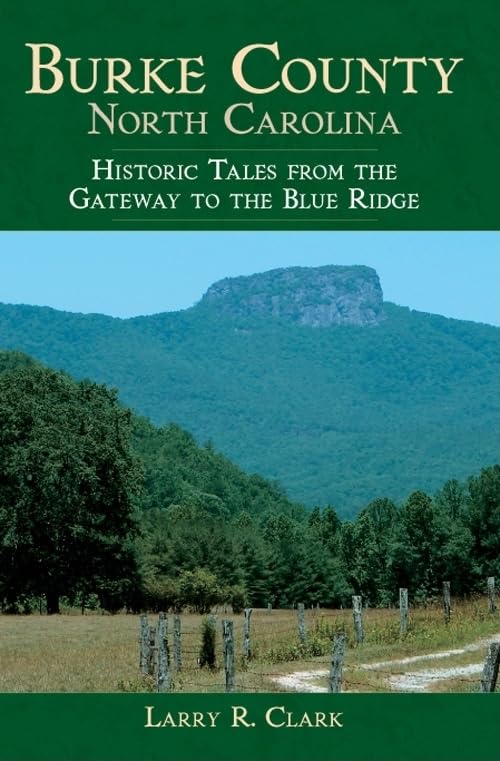
Burke County, North Carolina:: Historic Tales from the Gateway to the Blue Ridge (American Chronicles)
$21.99
by Larry R. Clark



Author and historian Larry R. Clark presents both fact and fiction about the fascinating people, places and events that influenced modern-day Burke County, North Carolina. Discover Burke County's exciting past from its first Indian inhabitants thousands of years ago, Spain's Fort San Juan built in 1567, the Irish, Scot, English and German pioneers, and famous Patriots of the American Revolution. Other subjects include the heartbreak of Civil War along with tales of the Great Gold Rush, moonshiners, floods and Waldensian immigrants from Italy. All are gathered here in an engaging collection of history, legends and Burke County lore. TABLE OF CONTENTS Indian, Spanish, English, Irish, Scot, Welsh, African, German 9Table Rock--A Gateway to the Blue Ridge Mountains 12Native Americans of Western North Carolina2 15Nature's Little Secrets Along the Catawba River 18Way Back When Burke Was Part of Spanish Florida 21Captain Juan Pardo and the Spanish Empire 24Lord John Carteret and the Granville Line 27250-Year-Old Diary Describes Old Burke 30Who Named Quaker Meadows? 33Quaker Meadows Presbyterian Church 35Kings Mountain Battle has Deep Roots in Burke 37General Daniel Morgan--American Hero at Cowpens 40Thomas Burke--Statesman and Patriot 43Waightstill Avery--Patriot and Gentleman 45The State of Franklin Secedes from Old Burke 48André Michaux Slept Here 51There's Gold in Them Th'r Hills 54Confederate Training Camp Destroyed 57Stoneman's Raiders Attack Morganton 60Western N.C. Rail Road Changed Burke County 62Community Names Also Tell Local History 66Moonshiners and Bootleggers 69Let's Name a High School for Robert Logan Patton 72The Waldenses of Italy--and Burke 75Burke County--January 1, 1900 78Legends, Myths and Folklore 82Burke is Home to the "Master of the World" 87William George Randall 1860-1905 90The Lost Community of Fonta Flora 93When Textile Was "the King" 96And When Furniture Was "the Queen" 100Seen A Good (old) Magazine Lately? 104Burke County Fair, One of the Best--Again! 107Senator Sam: A Native Son Remembered 110Spring! It's Snipe Hunting Season 113Motorcyclists Love Ripshin Ridge 116Rejoice! It's Springtime in Irish Creek Valley 119You're from Burke County When... 121 As a career educator, teacher of world history and general anthropology at a small community college in western North Carolina, the author developed a special interest in the region's ancient Native Americans and the unique history associated with its earliest European pioneers. A limited, self-published edition of Indians of Burke County and Western North Carolina was printed as archaeologists began to excavate a large native village near his home. In addition, for more than a decade, he periodically wrote about Burke County's past for a local newspaper, the News Herald, and eventually published with The History Press of Charleston a collection of these stories in Burke County: Historic Tales from the Gateway to the Blue Ridge. During this same period "our archaeologists" made an unexpected discovery at the Berry's farm that began to rewrite the history of early colonial America -- Spanish artifacts were uncovered in the 16th century Indian village of Joara among the remains of several burned "cabins" once occupied by soldiers of Captain Juan Pardo. Additional research revealed that Pardo had followed an earlier path of Captain Hernando de Soto to claim this land for King Philip II and the Empire of Spain, thereby making this Spanish settlement the first inland European colony in North America some twenty years before England's "Lost Colony" arrived on Roanoke Island, North Carolina, and four decades before the English settled James Town, Virginia. This author became so fascinated with the idea of Spanish conquistadors marching across these lands that he first wrote Of Eagles & Wolves, a play about Pardo's explorations into western North Carolina, and then published with McFarland & Company a book entitled Spanish Attempts to Colonize Southeast North America: 1513 - 1587. Today, the author resides with his wife Patricia in Irish Creek Valley along a creek that flows into the Berry site of Joara and Fort San Juan. Used Book in Good Condition