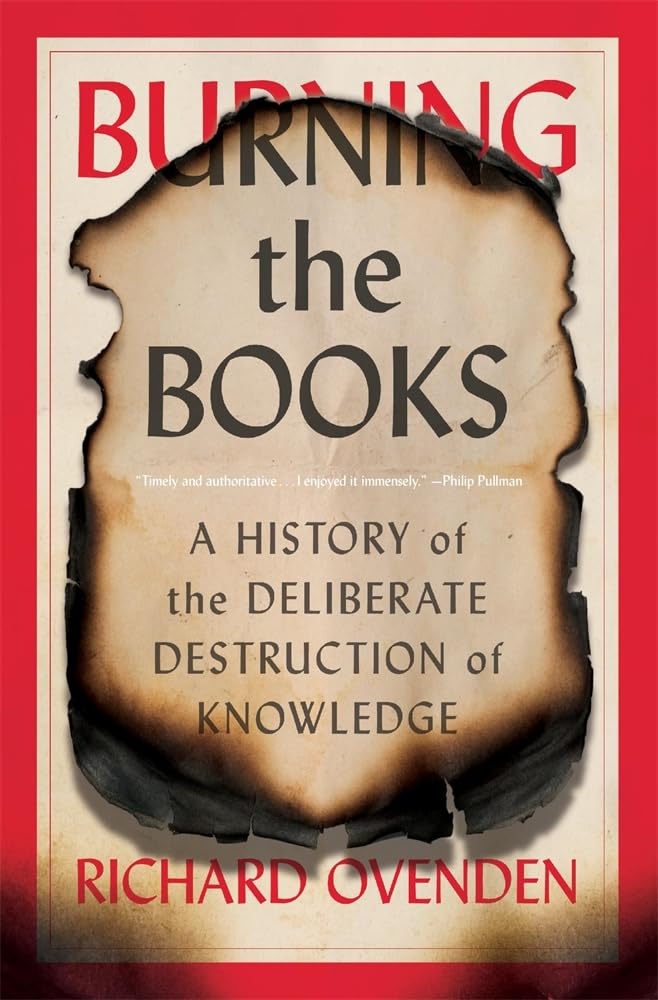
Burning the Books: A History of the Deliberate Destruction of Knowledge
$17.71
by Richard Ovenden



A Wolfson History Prize Finalist A New Statesman Book of the Year A Sunday Times Book of the Year “Timely and authoritative…I enjoyed it immensely.” ―Philip Pullman “If you care about books, and if you believe we must all stand up to the destruction of knowledge and cultural heritage, this is a brilliant read―both powerful and prescient.” ―Elif Shafak Libraries have been attacked since ancient times but they have been especially threatened in the modern era, through war as well as willful neglect. Burning the Books describes the deliberate destruction of the knowledge safeguarded in libraries from Alexandria to Sarajevo, from smashed Assyrian tablets to the torching of the Library of Congress. The director of the world-famous Bodleian Libraries, Richard Ovenden, captures the political, religious, and cultural motivations behind these acts. He also shines a light on the librarians and archivists preserving history and memory, often risking their lives in the process. More than simply repositories for knowledge, libraries support the rule of law and inspire and inform citizens. Ovenden reminds us of their social and political importance, challenging us to protect and support these essential institutions. “Wonderful…full of good stories and burning with passion.” ― Sunday Times “The sound of a warning vibrates through this book.” ― The Guardian “Essential reading for anyone concerned with libraries and what Ovenden outlines as their role in ‘the support of democracy, the rule of law and open society.’” ― Wall Street Journal “Ovenden emphasizes that attacks on books, archives, and recorded information are the usual practice of authoritarian regimes.” ―Michael Dirda, Washington Post “A stark and important warning about the value of knowledge and the dangers that come from the destruction of books. Vital reading for this day and age.” ― Peter Frankopan, author of The Silk Roads “If you care about books, and if you believe we must all stand up to the destruction of knowledge and cultural heritage, this is a brilliant read―both powerful and prescient.” ― Elif Shafak “Compelling…a book of great power and reach.” ― Edmund de Waal “[Ovenden] is acutely aware of the many ways in which books and paper archives cease to exist: not only through deliberate destruction―acts of moral outrage, retribution, even efforts to literally erase history―but also simple neglect…Fortunately, he has devoted a great deal of time to thinking about these disasters and how to prevent them. His compelling thoughts are now gathered in the eminently readable (and provocatively titled) Burning the Books …Essential reading for anyone concerned with libraries and what Ovenden outlines as their role in ‘the support of democracy, the rule of law and open society.’” ― Wall Street Journal “Present-day anxieties confer unwelcome relevance to Richard Ovenden’s Burning the Books …[He] emphasizes that attacks on books, archives and recorded information are the usual practice of authoritarian regimes. Control what people know and you control them; control the past and you control the future…Ovenden argues that libraries should be used to safeguard our digital data, so that the powerful don’t simply delete anything they don’t like or wish to repudiate.” ― Michael Dirda , Washington Post “Like an epic filmmaker, Richard Ovenden unfolds vivid scenes from three millennia of turbulent history and closes in to mount passionate arguments for the need to preserve the records of the past―and of the present. In the current changing landscape of knowledge and power, this urgent, lucid book calls out to us all to recognize and defend one of our most precious public goods―libraries and archives.” ― Marina Warner, President of the Royal Society of Literature and author of Stranger Magic “The sound of a warning vibrates through this book…Takes a nightmare that haunts many of us―the notion of the past erased―and confirms that it is no fiction but rather a recurring reality. In the process, Ovenden stays true to his calling, reminding us that libraries and librarians are the keepers of humankind’s memories: without them, we don't know who we are.” ― Jonathan Freedland , The Guardian “Chronicles how libraries have served as sanctuaries for knowledge under constant threat, and what that means for the present and the future…Shows that when knowledge in print is threatened by power, it’s people pledged to the printed page, rather than armies, who step in…Made clear to me just how vulnerable libraries really are. When we don’t properly fund them, we risk lies becoming the truth, and the truth becoming a joke.” ― Slate “Whether we are looking at history ancient or modern, the wicked behavior is the same. And those seeking to destroy accumulated knowledge do not only deploy violent methods. One of the subtle themes in the book is how long-term destructive behavior toward learning and knowledge manifests itself―not as book-burning so much