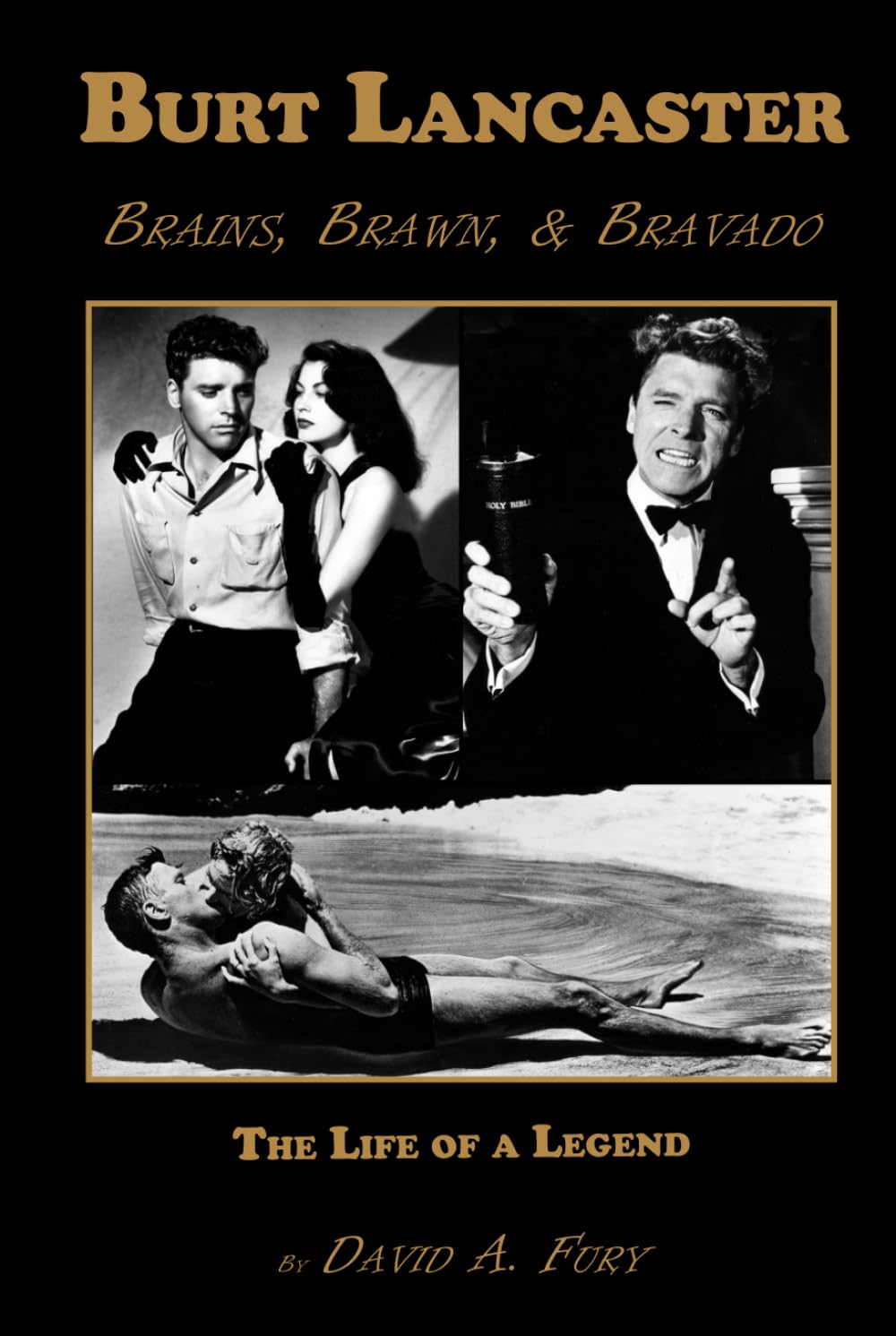



This is the Burt Lancaster story, as true and accurate as possible. Burton Stephen Lancaster grew up in a tough East Harlem neighborhood during the Roaring Twenties, the son of a postal worker and a mother who was a strong disciplinarian and a woman of immense principle. His close-knit nuclear family included two brothers and one sister, he and his siblings all tightly grouped in age. During the decade of the Great Depression, the young man toured across America as a circus and vaudeville acrobat, performing with his childhood buddy, Nick Cravat. And during World War II, Lancaster served as an enlisted man in North Africa and Italy, entertaining troops with comedy sketches and no doubt, a few acrobatics thrown into the mix. By the end of the Big War, September 1945, Lancaster was mustered out of the Army. At age 31, he had a few dollars in his pocket and a fiancée, Norma Mari Anderson, a U.S.O. entertainer the young soldier had met while serving in Italy. Riding the elevator in the Royalton Hotel to meet Norma for lunch, the uniformed Lancaster was being “eyeballed” by a Broadway talent scout, who subsequently offered him an audition for an upcoming play, The Sound of Hunting . Burt landed the role of an army sergeant, a member of a battle-weary platoon in war-torn Cassino, Italy; although the play lasted less than a month on Broadway, his career was launched. The various talent hounds who buzzed the Broadway beat searching for new Hollywood players were impressed, and Burt ultimately landed a movie deal with producer Hal Wallis. And before he ever worked for Wallis, Lancaster took advantage of a clause in his contract to make a film for independent producer Mark Hellinger, a former New York City columnist who went west to California to make motion pictures. That film turned out to be one of the classic crime dramas of all-time, The Killers , and in fact two new stars were born: Burt Lancaster and Ava Gardner. Over the next 45 years as an actor Burt would always be a top-billed star of the highest magnitude. He also became the most important and powerful of the independent actor-producers of the 1950s, and along with his partner Harold Hecht, produced a dozen of the finest dramas and adventure films of any era. One measure of an actor’s ability would be how many times he was honored by his peers with the highest awards of the industry. It is well-known that Mr. Lancaster was nominated for Best Actor four times, winning the coveted Oscar for Elmer Gantry (1960). In addition, Burt was awarded the New York Film Critics Circle prize for Best Actor three times: From Here to Eternity (1953), Elmer Gantry (1962), and Atlantic City (1981). In his films, two women each won the Oscar for Best Actress: Shirley Booth as Lola in Come Back, Little Sheba (1952), and Anna Magnani as Serafina in The Rose Tattoo (1955). Upon that big silver screen, well, Burt Lancaster was really something. Sometimes, it was his humanity and fallibility that we, as the audience, identified with in our own lives. Other times it was his marvelous athleticism and willingness to risk his own valuable neck, as he ran, jumped, leaped, fought with swords, guns, fists, anything and everything that he could throw at a screen adversary in performing stunts that we could only marvel at and call simply amazing. And often it was just that big, beautiful Lancaster smile that he broke out in many of his hero, villain, and even anti-hero roles. The actor’s screen persona was invariably charming and sometimes menacing, but it was always a force; your ears absorbing the voice, alternating velvet and gravelly texture, while your eyes tracked his movements to discover what surprising things were in the Lancaster bag of tricks. This is Burt Lancaster’s true story, with his triumphs and failures, his flaws and his faults, his analytical thinking, his bravado on screen, and his warmth and sincere caring for his fellow man.