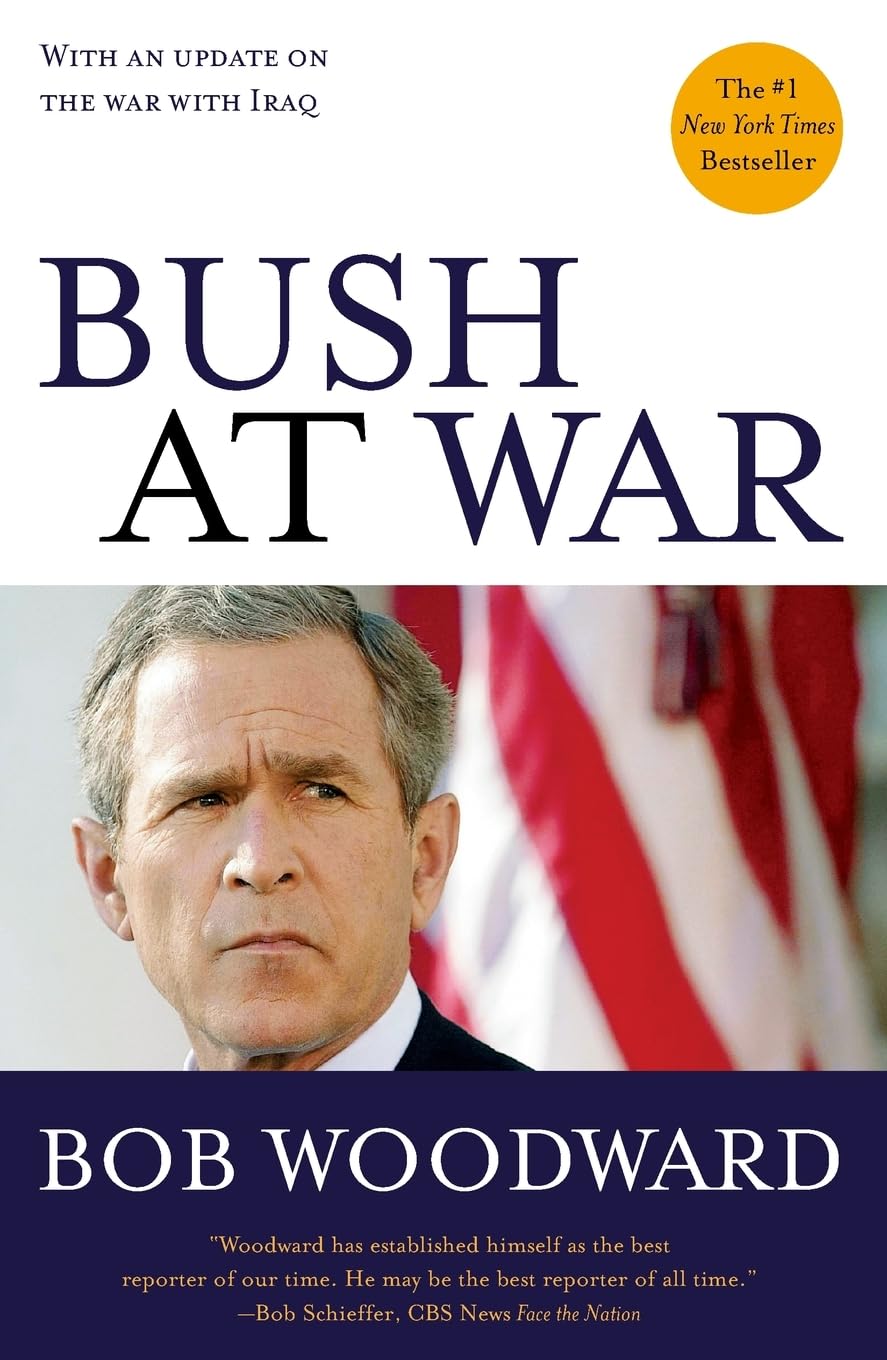



Bush at War reveals in stunning detail how an untested president with a sweeping vision for remaking the world and war cabinet members often at odds with each other responded to the September 11 terrorist attacks and prepared to confront Iraq. Woodward's virtual wiretap into the White House Situation Room is the first history of the war on terrorism. Thomas Powers The New York Times Book Review Remarkable... Bush at War is akin to an unofficial transcript of 100 days of debate over war in Afghanistan. Evan Thomas Newsweek Human and convincing in its telling detail. Steve Neal Chicago Sun-Times Woodward has produced the best book yet written about the September 11 terrorist attacks on America and how Bush fought back. Fred Barnes The Weekly Standard Woodward...is the best pure reporter of his generation, perhaps ever. He uncovers more things than anyone else. James Rubin The New York Observer A great read...Bob Woodward has unearthed important new information on the behind-the-scenes struggles that have led to success -- and failure -- in President Bush's War on Terror. Fouad Ajami The Washington Post Book World A work of spareness and authority...We are fortunate to have this richly detailed view of our nation's central policy command. Bob Woodward is the author of three consecutive #1 New York Times bestsellers on President Trump— Fear (2018), Rage (2020), and Peril (2021) with Robert Costa—and an audiobook of 20 interviews with Trump. He has authored 22 bestselling books, 15 of which have been #1 New York Times bestsellers, covering every president from Nixon to Biden. Chapter 1 Tuesday, September 11, 2001, began as one of those spectacular pre-fall days on the East Coast, sunny, temperatures in the 70s, light winds, the sky a vivid light blue. With President George W. Bush traveling in Florida that morning promoting his education agenda, his intelligence chief, CIA Director George J. Tenet, didn't have to observe the 8 A.M. ritual of personally briefing the president at the White House on the latest and most important top secret information flowing into America's vast spy empire. Instead Tenet, 48, a hefty, outgoing son of Greek immigrants, was having a leisurely breakfast at the St. Regis Hotel, three blocks north of the White House, with the man who was most responsible for his rise in the world of secret intelligence -- former Oklahoma Democratic Senator David L. Boren. The two had struck up an unusually close friendship going back 13 years when Tenet was a mid-level staffer on the Senate Intelligence Committee, which Boren chaired. Boren had found Tenet to be a gifted briefer and had jumped him over others with more seniority to make him staff director, a post which granted him access to virtually all the nation's intelligence secrets. Boren then recommended Tenet to President-elect Bill Clinton in 1992, urging that he be appointed to head the administration's transition team on intelligence. The following year, Tenet was named National Security Council staff director for intelligence, responsible for coordinating all intelligence matters for the White House, including covert action. In 1995, Clinton named him deputy CIA director, and two years after that, he appointed him director of central intelligence (DCI), charged with heading the CIA and the vast U.S. intelligence community. High-strung and a workaholic, Tenet had a heart attack while he was NSC intelligence staff director. He could be volatile. During President Clinton's second term, when he was CIA director, he stormed out of a principals' committee meeting that included the secretaries of state and defense but not the president. He thought the meeting, which was keeping him from attending his son's school Christmas play, was droning on too long. "Fuck you, I'm leaving" had been his parting comment. But Tenet had since learned how to control his temper. In early 2001, Boren called President-elect Bush, praising Tenet as nonpartisan and urging him to keep him on as CIA director. Ask your father, he suggested. When the younger Bush did, the former President George H.W. Bush said, "From what I hear, he's a good fellow," one of the highest accolades in the Bush family lexicon. Tenet, who has a keen nose for cultivating political alliances, had helped the senior Bush push through the controversial nomination of Robert Gates as CIA director in 1991, and later led the effort to rename CIA headquarters for Bush, himself a former DCI. The former president also told his son, the most important thing you'll do as president every day is get your intelligence briefing. Beginning with his time heading the Senate Intelligence Committee staff, Tenet had developed an understanding of the importance of human intelligence, HUMINT in spycraft. In an era of dazzling breakthroughs in signals intelligence, SIGINT -- phone, teletype and communications intercepts and code breaking -- and overhead satellite photography and ra