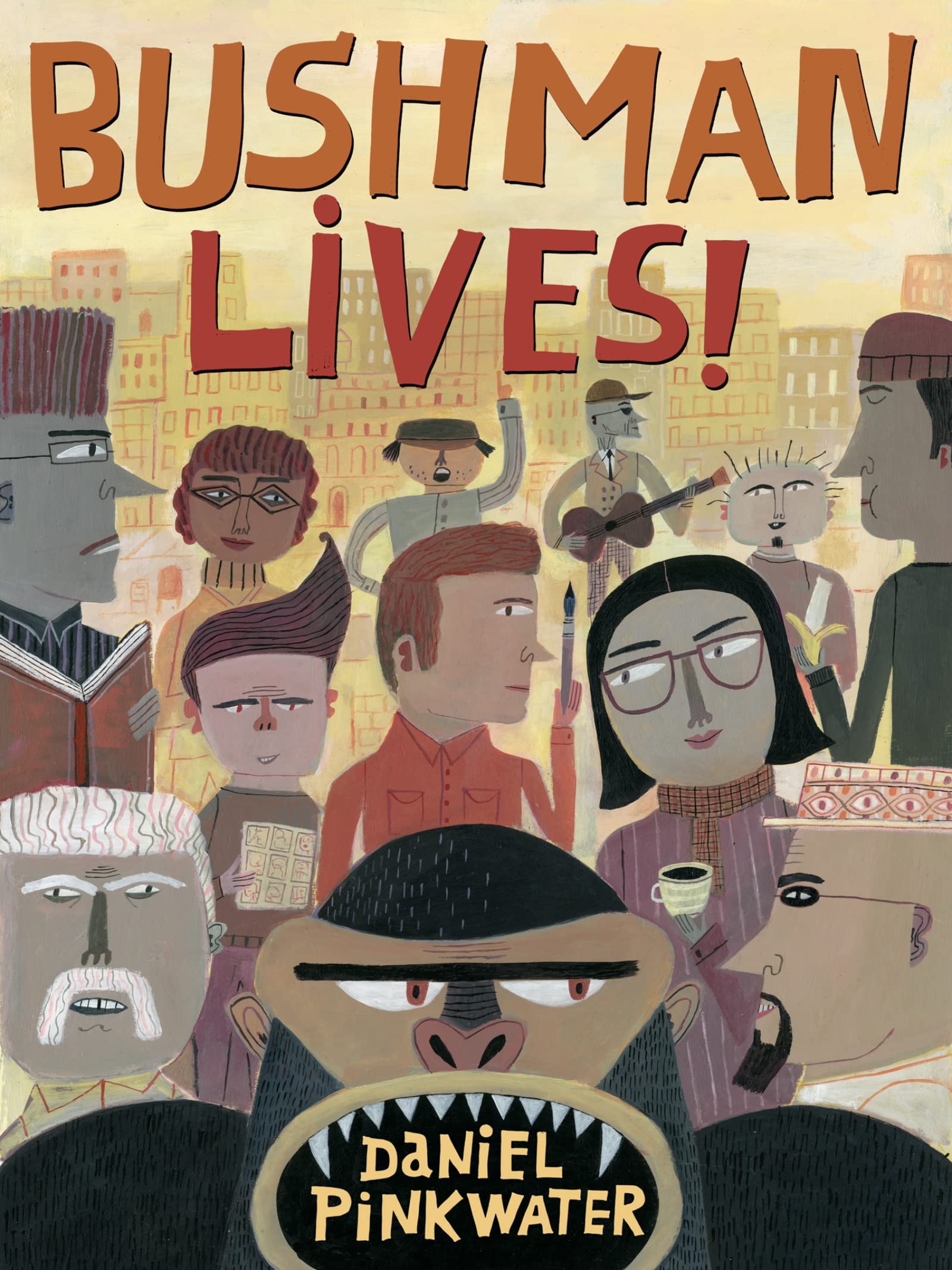



“What Pinkwater does is magic, and I’m grateful for it.” --Neil Gaiman (about The Neddiad ) Is Bushman the gorilla alive? According to the papers, he died a long time ago. Why is he so important to the high school senior and aspiring Great Artist Harold Knishke? It’s a hot summer in 1960s Chicago, and people are on the streets late at night, including the Chicken Man and Molly the dwerg. While reading this hilarious young adult novel (with illustrations by Calef Brown!) teens will ask themselves, “Why am I reading this?” and “Is Harold about to embark on a voyage of great adventure?” He is. Let’s face it: Pinkwater is sui generis—there isn’t anyone else quite like him. And if you doubt that, you haven’t read his latest, a book that is almost impossible to synopsize. Suffice it to say, it is a story set in 1950s Chicago of teenager Harold Knishke, who—inspired or perhaps enchanted by a de Kooning painting—decides to ditch his flute lessons and become an artist instead. The result is a bildungsroman as surrealistic romp, involving Harold’s best friend, Geets, whose talent is climbing tall buildings; the famous gorilla Bushman, who may or may not be dead; strange mentors; a spooky, white house; an apocryphal island; and enough coincidences to make Dickens green with envy. The wacky, sometimes bewildering story is told in 79 brief chapters, some no longer than a single page. The prevailing tone is Pinkwateresquely insouciant, and the abrupt ending may leave some readers scratching their heads and others chortling. Clearly not for every reader, but Pinkwater’s many fans will rejoice. Grades 6-9. --Michael Cart "Pinkwater saturates his customary eccentricities with a Beat-era flavor." — Kirkus "Pinkwater's talent for odd but unforgettable characters continues apace, and his storytelling ability is legendary." — Publishers Weekly "Pinkwater's many fans will rejoice." — Booklist "Plenty of teens will recognize the issues that Harold confronts—subjectivity of taste, the lure of selling out—as he tries to figure out what art is." — Bulletin "This is a paean to the transformative power of art, and vintage Pinkwater." — School Library Journal — Daniel Pinkwater lives with his wife, the illustrator and novelist Jill Pinkwater, and several dogs and cats in a very old farmhouse in New York’s Hudson River Valley. A Goon in My Room I must have been asleep for an hour or two. I woke up sensing there was someone in my room. “Geets?” “Ook ook, Bushman lives,” Geets Hildebrand said. “Ook,” I said. I switched the light on. Geets was sitting cross-legged next to my bed. He had done this before. Sometimes I would wake in the morning and there he would be, sleeping on the rug. I could never get him to tell me how he got in—how he got into a building with a doorman, into a locked elevator area, into our locked apartment, and into my locked bedroom. Had he slipped past the doorman and picked three locks? Had my father, who disliked and mistrusted all my friends, let him in and for some reason agreed not to say anything about it? It was a mystery. “Drink to Bushman,” Geets said. He pulled four bottles of Guinness out of his jacket, and two bananas. This was our ritual. We would drink to Bushman the Gorilla at the Lincoln Park Zoo, and eat bananas, which actually went quite well with the thick, bitter Guinness. Bushman was a hero to us. Bushman weighed 427 pounds, and was completely ugly, even for a gorilla. He wasn’t round and paunchy like most gorillas you see in zoos. He had the build of a weightlifter, a cruel face, white sharp teeth, and these tiny black eyes. I used to get close to the bars when I was a little kid and gaze into those eyes. Bushman would get his chin down to the floor of the cage and gaze back into mine. It felt like we were having a conversation, that I knew what he was thinking. He resented being caged, but he was not mad at anyone. He liked people, especially kids. His keeper would hand him quarts of milk through the bars, and he would politely hand the empties back. Sometimes he would catch mice in his cage and play with them gently. When Bushman was a baby and a young ape, the keepers would take him out on the lawn to wrestle and pass a football with him. But the day came when Bushman realized he didn’t need to go back into the cage if he didn’t want to, and it took six keepers three hours to get him there. After that he was never taken outside again. Bushman knew he was a prisoner, confined through no choice of his own, and he didn’t pretend to like it. He remembered that time on the lawn and wanted to get out there again, only this time he would not let them get him back into the Great Ape House. He got along with his keepers, and of course kids. But he didn’t express friendliness in some undignified way. He didn’t make cute faces or do little tricks to please the crowd like some chimp. He was not a smiley gorilla. He kept his dignity. He’d had a bad break, but he wasn’t about to let it break