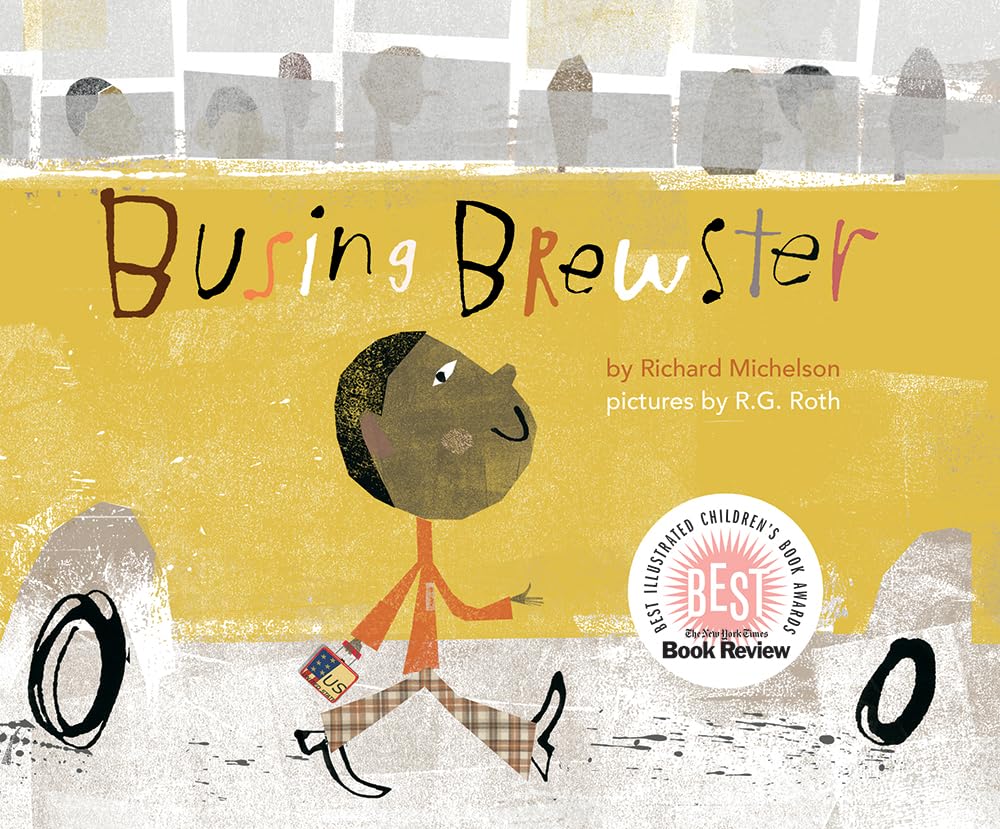



In the desegregation era of the 1970s, a first grader copes with being bused to a white school in this story for young children about racism and an essential time of change. “One of the Ten Best Books of the Year,” The New York Times . Brewster is excited about starting first grade . . . until Mama announces that he'll be attending Central, a school in the white part of town. Mama says they have art and music and a library bursting with books, but Brewster isn’t so sure he’ll fit in. And he’s right. Being black at a white school isn't easy. Brewster winds up spending his first day in detention at the library. But there he meets a very special person: Miss O’Grady. The librarian sees into Brewster’s heart and gives him not only the gift of books but also encourages Brewster to believe in himself. This is an invaluable, unique, view into a tumultous time and the good that came into the lives of school children. Praise for Busing Brewster “I loved its understated honesty, the way it introduces violence without melodrama, and avoids the easy ending. Busing is an opportunity. It is also a pain. No one is immediately converted away from racism and prejudice, but the book does not reject the possibility of redemption …Recent news accounts suggest that some parents have lost faith in the picture book… Busing Brewster could change their minds.”― New York Times “Though broaching the idea of segregation with young children is a sensitive proposition, Busing Brewster helps put a human face on an important issue and shows what ‘forced busing’ felt like to those on the inside.”― San Francisco Book Review “This memorable book looks at what it was like to be a part of the desegregation of schools in America. In addition, it shows readers how books can open up doors in the minds of children; books can help children to see that they do have the power to change their world if they want to.”― Through The Looking Glass Review “This powerful and tender story of desegregation busing in the 1970s introduces readers to the brave young heroes who helped to build a new world.”― Powell’s Books “Richard Michelson, has succeeded, again, in writing an engaging picture book about tough race relations with great sympathy and interest.”― The Odyssey Bookshop “While many teachers cover desegregation in their curriculum, they haven’t had as fine a resource as Busing Brewster. This is definitely a title to add to your classroom collection.”― Picture Book Review Brewster is excited to begin the first grade "" until his mother informs him that he will be leaving the school in his neighborhood to go to Central, the white school. Riding through the streets of Boston, Brewster and his brother are confronted with protesting adults and spiteful children, who have learned their parents' prejudices. Inside the school, Mrs. O'Grady, a kind librarian, develops a particular fondness for Brewster and dedicates herself to teaching him to read. Focusing on the personal stories that can be found within the margins of history, Michelson narrates with sensitivity to nuance and an eye to how children process these events individually and without the ideological trappings of adults. Guided by funky illustrations decidedly of the 1970s, the book highlights the potential for new friendships and greater opportunity to learn, though attentive to the personal and social consequences of forced busing for children, such as separation from friends and other familiar faces, and often a frequently hostile environment, at a critical stage in their development. Busing Brewster promotes dialogue between parents and children and provides a way in to what can be a difficult topic to approach with young children. An author's note at the end examines the story in the larger context of American history and civil rights, and has been updated to reflect on events that have transpired since its original publication in 2010. Richard Michelson is the author of many books for children, teens and adults that have been listed among the Ten Best Books of the Year by The New York Times , Publishers Weekly , and The New Yorker ; and among the Best Dozen of the Decade by Amazon.