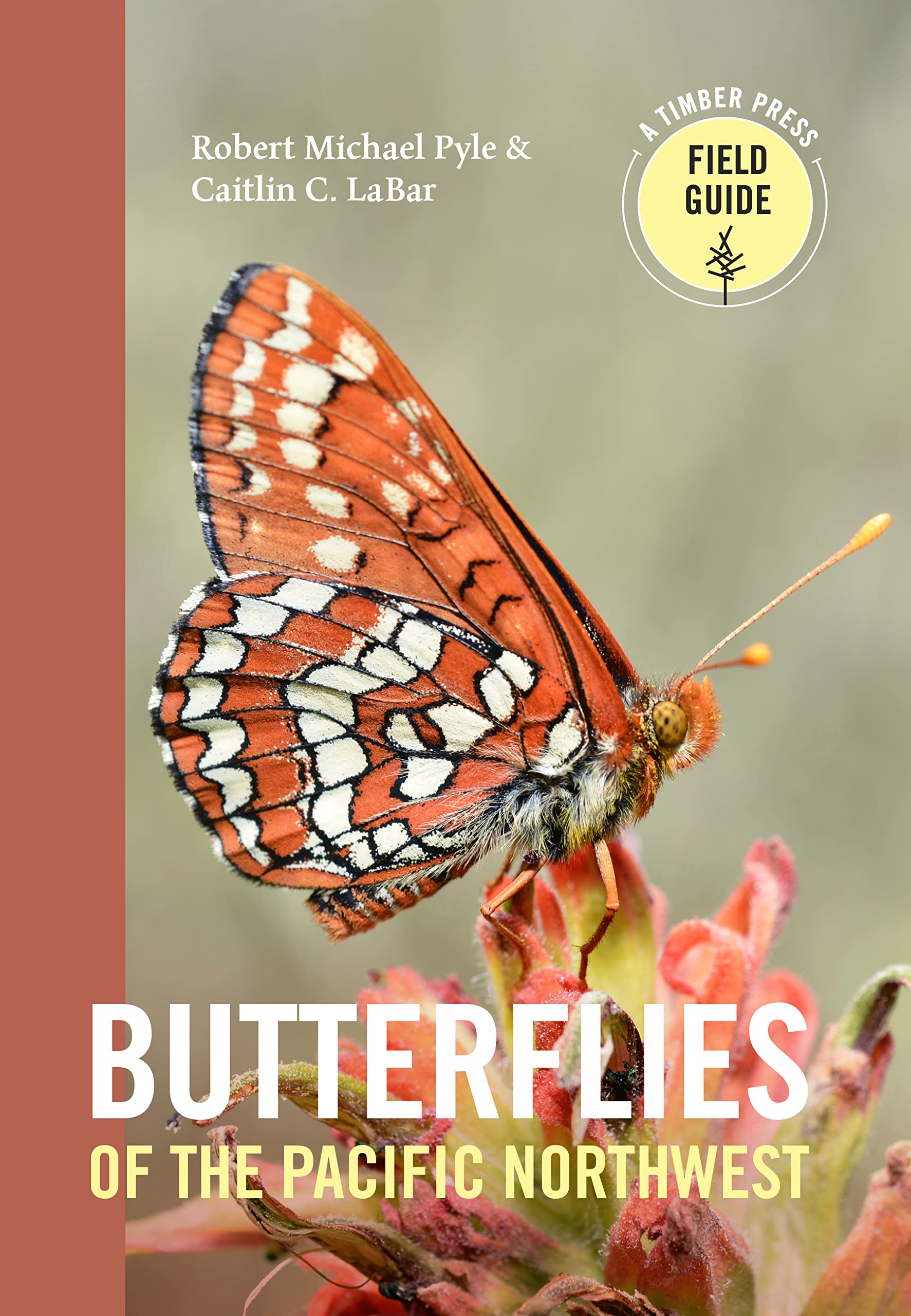
Butterflies of the Pacific Northwest (A Timber Press Field Guide)
$16.88
by Robert Michael Pyle



Ideal for birders, hikers, and foragers, the Timber Press Field Guides are the perfect tools for loving where you live. Butterflies of the Pacific Northwest is a comprehensive field guide to the region’s most common and distinctive butterflies. Profiles include preferred common name for both genus and species, conservation status, the look and distinguishing traits of each butterfly, habitat, and range, and much more. Additional information includes a brief introduction to how butterflies work and details on ecology and conservation. Covers Washington, Oregon, western Idaho, northern California, and British Columbia - Describes and illustrates 200 of the most common and distinctive butterflies - 712 spectacular photographs, 200 range maps, and 17 illustrative plates for comparing and identifying species - Clear color-coded layout “Pyle has done it again, authoring a brand-new butterfly book that's just grand. It's easy to use and beautifully illustrated. . . . Butterflies of the Pacific Northwest is a must-have for nature lovers in this region.” — Source Weekly “In this outstanding guide, over 200 different butterflies found in the Pacific Northwest are pictured and described. All the small details which make a topnotch guide are present: hardy paper cover, color-coded layout, range maps, comparison plates, crisp color photography and clear and understandable text. It’s the perfect guide for Northwest butterfly enthusiasts young and old.”— National Outdoor Book Awards Describes more than 200 of the region’s most common and distinctive butterflies - More than 600 superb color photographs - 17 illustrative plates for comparing and identifying species - Nearly 200 range maps - Clear color-coded layout - Covers Oregon, Washington, and adjacent areas of British Columbia, Idaho, and California - Essential reference for nature enthusiasts of all ages and skill levels Noted lepidopterist and writer Robert Michael Pyle is the founder of the Xerces Society for Invertebrate Conservation and the founding chairman of the IUCN/SSC’s Lepidoptera Specialist Group. A Yale-trained ecologist and Guggenheim fellow, he is a full-time biologist, teacher, and speaker, and the author of numerous books. Pacific Northwest native Caitlin C. LaBar was born with a fascination for insects, which has developed into an interest in studying the habitats and life histories of butterflies. A geographer and GIS technician by training and a conservationist by nature, she enjoys photographing and collecting local butterflies and working on various butterfly mapping projects. Introduction In the summer of 1967, I was a 20-year-old undergraduate at the University of Washington. Instead of returning to a summer job as a Denver postman, I remained in Seattle to try to teach a class on the natural history of butterflies. In the half-century since, I have taught hundreds of such classes, but back then the idea was a novel one; no one knew what to make of it. At the first class meeting, only one student showed up: a rising Garfield High School junior named Jonathan P. Pelham. It soon became apparent that Jon knew as much about butterflies as I did, and much more about the local species. I dropped the pretense of the class, got a job with the Sierra Club, and became instant field colleagues with Jon—a relationship we have now enjoyed for 50 years. Before long, we decided a Washington butterfly book was needed. Starting with Ben Leighton’s 1946 checklist, and with the assistance of all the local collectors, we began the Northwest Lepidoptera Survey and a book project. Jon Shepard, then at the University of California at Berkeley, contributed his large set of records. Grant W. Sharpe, my postgraduate professor in the College of Forest Resources, enabled me to write an interpretive field guide to the state’s butterflies as a master’s thesis. Hazel Wolf and Earl Larrison paved the way for it to be published in Seattle Audubon Society’s Trailside Series as Watching Washington Butterflies ( WWB ) in 1974. Jon Pelham became Curator of Lepidoptera at the Burke Museum and proceeded to build a superb reference collection and data base. Not only WWB but also my 1976 doctoral thesis on the ecogeography of Washington butterflies and Washington Butterfly Status Report and Conservation Plan (1989) owed a great deal to Pelham’s data and review. Around 1978, a group of lepidopterists (Jon Pelham, Jon Shepard, John Hinchliff, Dave McCorkle, and I, and later Paul Hammond) came together as the Evergreen Aurelians, with a view toward expanding the Northwest Lepidoptera Survey by assembling records from scores of collectors, and through further field work. The labors of the Evergreen Aurelians came to fruit in the form of atlases of Oregon and Washington butterflies, edited and prepared by master datakeeper and mapmaker John Hinchliff (1994, 1996). These works summarized the distributional knowledge of a century of butterfly study i