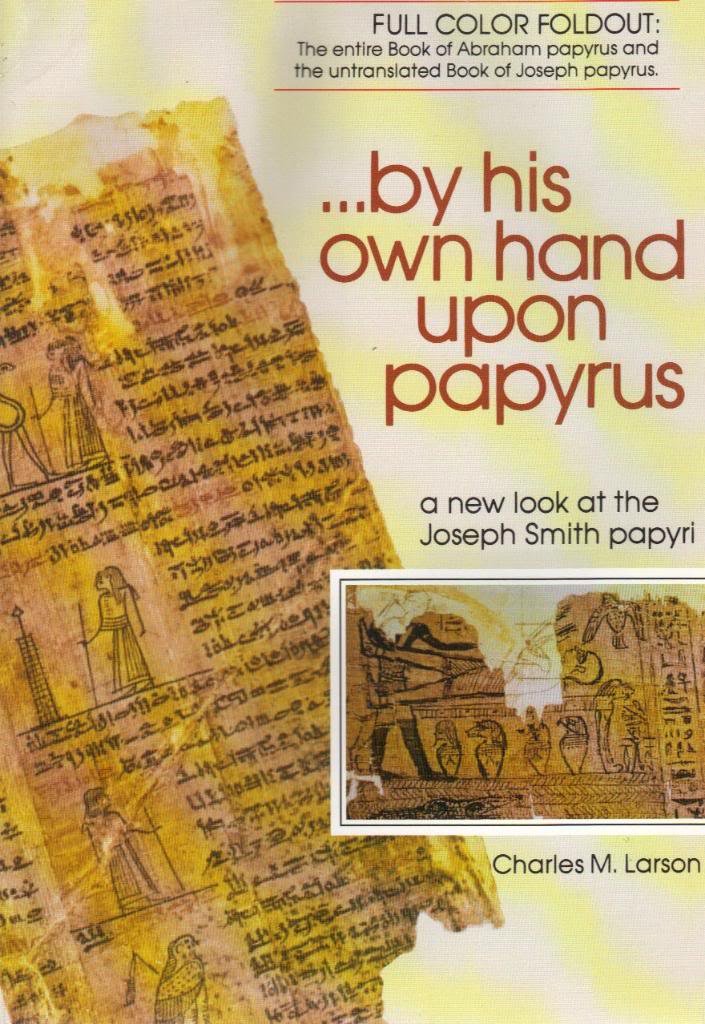
By His Own Hand upon Papyrus: A New Look at the Joseph Smith Papyri
$44.95
by Charles M. Larson



A survey of the controversy surrounding Mormon founder Joseph Smith's claim that he translated the Book of Abraham from an ancient Egyptian papyrus. Charles Larson does an excellent job of presenting the facts about how drastically different Egyptomologists and Joseph Smith translate the same hieroglyphics, while maintaining an attitude of Christian love toward those who have trusted Joseph Smith. His purpose is to spread the knowledge of the truth, and draw all his readers closer to Christ. He's obviously done a tremendous amount of research. I was very impressed with every aspect of this book. The photos are wonderful. The papyrus speak for themselves. I would recommend this book to anyone who cares if "The Book of Abraham" is truly from God. In the words of Christ, "You shall know the truth, and the truth shall set you free." May God bless your search for truth. -- angeline_olson@hotmail.com from Marysville, WA, U.S.A. , September 15, 1998 This book examines one of the most significant events in modern Mormon history - the rediscovery in 1967 of the Egyptian papyri from which Joseph Smith claimed to translate the Book of Abraham in the Pearl of Great Price. In the first two chapters of By His Own Hand Upon Papyrus, former Mormon and Brigham Young University graduate Charles M. Larson, recounts the circumstances under which Joseph Smith acquired the two Egyptian scrolls, and his claim to have identified one of them as an account by the Biblical patriarch Abraham of his sojourn in Egypt (as described in Genesis 12:10-20). Then in chapters 3-10 Larson steps the reader through a detailed array of primary physical evidences which establish four major points: (1) the papyri which came to public attention in 1967 (color photographs of which are reproduced in the book) are indisputably those which Joseph had in his possession when he produced the Book of Abraham, (2) Joseph Smith did purport that the Book of Abraham was a translation from one of these papyrus scrolls, (3) the scrolls are now known to date from around the time of Christ, some 2,000 years after the time of Abraham, and (4) the scrolls have been identified by Egyptologists - including LDS scholars - as common, pagan Egyptian burial documents, that do not mention Abraham and have no connection to the contents of the Book of Abraham in the Pearl of Great Price. By His Own Hand Upon Papyrus includes an impressive foldout panel with the first published full-color photographs of the Joseph Smith papyri. It also includes photographs of Joseph Smith's original translation manuscripts for the Book of Abraham, and translations by modern Egyptologists of the Egyptian text of the Joseph Smith papyri. Later chapters of the book provide an up-to-the-minute examination of the various theories which Mormon scholars have put forth to defend the integrity of the Book of Abraham. Since its initial publication and release, this book has occasionally been criticized by some LDS apologists who do not seem to approve of the conclusions it draws, yet I am pleased to report that it has achieved an excellent reputation for accuracy, reliability, and quality of research among scholarly professionals -- including some who are even members of the LDS Church. I have been gratified to see it become one of the preeminent reference works in the field of LDS studies, and have been deeply moved by the personal accounts of many who have been affected in a positive way by the information it contains. The stage was finally set for resolving the long, puzzling story of the Book of Abraham papyri: the ancient Egyptian hieroglyphic language had been deciphered by scholars, Joseph Smith's original papyri had been rediscovered and were available for study, and the three translation manuscripts pinpointed the specific fragment from which the Book of Abraham text had been taken, as well as providing a guide to how the Prophet related the Egyptian symbols to the English translation. All of the requirements for validation which both LDS Church apologists and the critics had insisted on for the last hundred years had been met. The question of whether or not Joseph Smith was telling the truth could at last be determined.