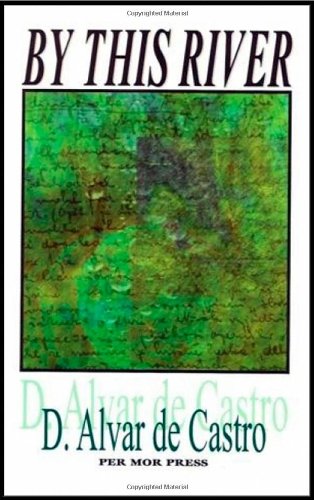



----The poetry of D. Alvar de Castro is based upon the principles of the cubist movement at the beginning of the XX century and in the techniques of collage that followed it, in the techniques of film making and in the movies of special effects at the end of the millennia. All of this, gives D. Alvar's poetry its own particular profile. Through forms he has chosen D. Alvar de Castro achieves very vivid representations of social pathologies, recounts of erotic and filial love, explorations into the mystical and ethereal world of minimalism and haiku; he also offers his readers a second view at contemporary history. The influence of the cubism is denoted mostly in the poems related to social pathologies. In these poems, images and allegories seemed to be opposed or overlapping. But, this is nothing but the cubist exercise of multiple selection of the objective focus, derived of an assiduous intellectual reflection by the author intending to show another view to the proposed reality: a reality, more truthful and subversive than the reality already established. Throughout the book the author frequently replaces the poetic voice with that of other characters he assumes. In this book what counts is aesthetics, not ego. D. Alvar de Castro is possessor of great hope and compassion that he wishes to share with his reader. And by this, help to establish a better world - a fairer world. A POET OF MULTIPLE CULTURES. July 23, 2009. By This River is David Alvar de Castro's second book of poems, and his first collection completely in English. His previous work, Cleo, was a bilingual Spanish-English collection published in 2003. Although some of the themes of Cleo reappear here, By This River is a more contemplative, wistful work. David is a poet of multiple cultures and languages. Though born and brought up in Chile, where he experienced the ferocity of Pinochet's coup d'Etat against Salvador Allende in 1973, he was only in high school at the time, and immigrated to Canada at the age of seventeen. He is thus of a younger generation than many of the other Chilean-Canadian writers and poets who were university students or established activists and artists when the coup occurred. The combination of his Chilean and Quebec experiences have made him a man of three cultures, who writes fluently in both Spanish and English. In this sense, he's both a multilingual or polylingual writer and a poet who is able to play with languages and the interface between them, inhabiting his own unique interlinguistic and intercultural space. The poems in this collection are concise: this is bare-bones poetry, clear and resounding, and carefully crafted. Several are about highly dramatic, legendary, or semi-mythological themes that include epic elements. There is sometimes a touch of the Medieval in the phrasing, perhaps due to a trace of Spanish syntax, and a trace of Old English alliteration. The images are original and fresh, and there is a skillful simplicity in the haikus and longer poems, such as "January March," which describes the solidarity and idealism of the protests in Montreal against the Iraq War in early 2003. The book closes with the poem "Missing," in which the speaker laments the loss of someone he has loved and lost, and expresses the need to find some philosophical explanation for his anguish. Hugh Hazelton, Montreal ----Hugh Hazelton, Phd.; Modern Languages Concordia University; Montreal BY THIS RIVER - A Modern Myhology.........Without The Pathos. The use of language is both sincere and contained, demonstrating D Alvar's mastership of poetics. The writer is not in any way overwhelmed by either his senses or his own poetic imagery, but masters them thoroughly and thoughtfully. He has infused his language with an original way of thinking - a quality that cannot be overstressed - for so seldom we come across poetry so totally unencumbered by the ego. D. Alvar de Castro is among the few writers who make a difference in today's Canada, with its complex, inclusive new culture. This collection of poems is not merely a delight to the senses and language itself, but also a snapshot of what we feel as we move within the contemporary spectrum. Any poeticization, a plague of language, even in modern texts, is thoroughly absent. Therefore, we may expect a direct form of poetic expression, which is extremely heartfelt while demonstrating a particular talent for expressing the world of the senses in language. BY THIS RIVER is a humane message for society, without ever becoming didactic. There is more that meets the ear and eye. ----------Ann Marie Saarelainen-Simard; Researcher, linguistics and poetics; UQAM; Qc. CANADA A Poet of Multiple Cultures. July 23, 2009 This is David Álvar de Castro's second book of poems, and his first collection completely in English. His previous work, Cleo, was a bilingual Spanish-English collection published in 2003. Although some of the themes of Cleo reappear here, By This River is a more cont