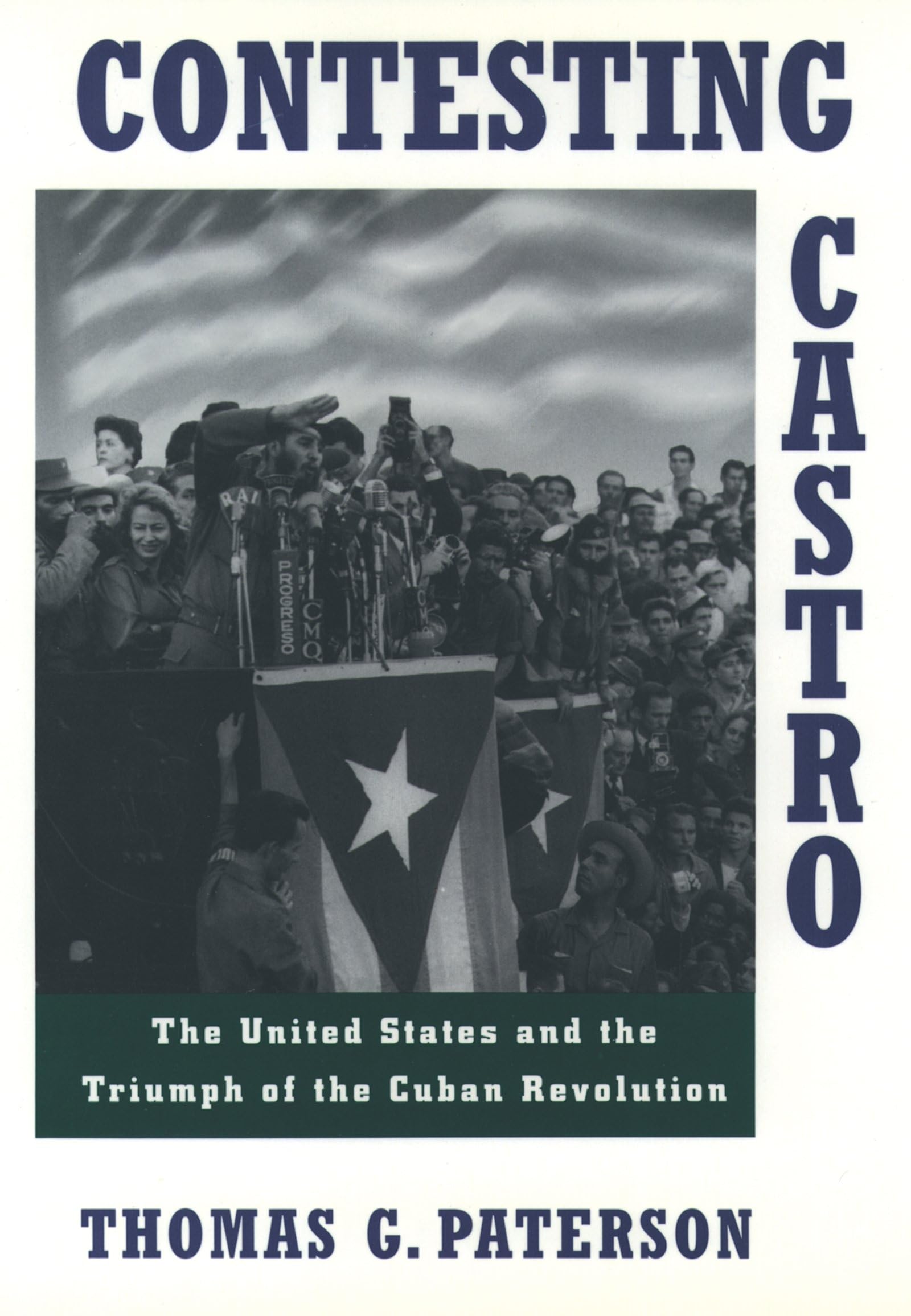
CONTESTING CASTRO: US & TRIUMPH OF CUBAN REVOLUTION: The United States and the Triumph of the Cuban Revolution
$19.92
by Thomas G. PATERSON



Today they stand as enemies, but in the 1950s, few countries were as closely intertwined as Cuba and the United States. Thousands of Americans (including Ernest Hemingway and Errol Flynn) lived on the island, and, in the United States, dancehalls swayed to the mambo beat. The strong-arm Batista regime depended on Washington's support, and it invited American gangsters like Meyer Lansky to build fancy casinos for U.S. tourists. Major league scouts searched for Cuban talent: The New York Giants even offered a contract to a young pitcher named Fidel Castro. In 1955, Castro did come to the United States, but not for baseball: He toured the country to raise money for a revolution. Thomas Paterson tells the fascinating story of Castro's insurrection, from that early fund-raising trip to Batista's fall and the flowering of the Cuban Revolution that has bedeviled the United States for more than three decades. With evocative prose and a swift-moving narrative, Paterson recreates the love-hate relationship between the two nations, then traces the intrigue of the insurgency, the unfolding revolution, and the sources of the Bay of Pigs invasion, CIA assassination plots, and the missile crisis. The drama ranges from the casino blackjack tables to Miami streets; from the Eisenhower and Kennedy White Houses to the crowded deck of the Granma , the frail boat that carried the Fidelistas to Cuba from Mexico; from Batista's fortified palace to mountain hideouts where Rau'l Castro held American hostages. Drawing upon impressive international research, including declassified CIA documents and interviews, Paterson reveals how Washington, fixed on the issue of Communism, failed to grasp the widespread disaffection from Batista. The Eisenhower administration alienated Cubans by supplying arms to a hated regime, by sustaining Cuba's economic dependence, and by conspicuously backing Batista. As Batista self-destructed, U.S. officials launched third-force conspiracies in a vain attempt to block Castro's victory. By the time the defiant revolutionary leader entered Havana in early 1959, the foundation of the long, bitter hostility between Cuba and the United States had been firmly laid. Since the end of the Cold War, the futures of Communist Cuba and Fidel Castro have become clouded. Paterson's gripping and timely account explores the origins of America's troubled relationship with its island neighbor, explains what went wrong and how the United States "let this one get away," and suggests paths to the future as the Clinton administration inches toward less hostile relations with a changing Cuba. "Succeeds admirably...in telling a story that is crucial to understanding the frigid standoff that has defined relations between the United States and Cuba for the last 30 years."-- New York Times Book Review "Well-written [and] soundly documented....Riveting."--George McGovern "Well-told, insightful look at U.S. relations with Castro--private and public--up to triumphs of Revolution."--Max Friedman, University of Colorado "His research in American and English-language sources is exemplary....Paterson is at his best in delineating the complicated processes by which American policy was formed and in tracing the events that led inexorably to the failure of that policy."-- The Journal of American History "An engaging, lively, well-written account of U.S.-Cuban relations in the broadest sense, between 1956-59. Brings together a lot of disparate and interesting information. A good overview."--Professor Richard J. Walter, Washington University "[A] well-constructed, persuasively written, and richly detailed account of two governments and political cultures from the early 1950s until the victory of Fidel Castro's guerrilla forces in 1959."-- The Americas "[A]ccess to previously classified information (patchy though this may be at times) has enabled Professor Paterson to write incomparably the best account of why the United States was unable to respond to the Cuban challenge except negatively, and thus came to be saddled with its most intractable foreign policy problem....[S]uperb, thorough and judicious study."-- International Affairs "[C]omprehensive, masterful diplomatic history"-- Florida Historical Quarterly "He succeeds admirably...in telling a story that is crucial to understanding the frigid 'standoff' between the two countries."-- The New York Times Book Review "Thomas Paterson's fine new book takes us back to the beginning, when Cuba, under Batista behaved as a good little semicolony should, and all was more or less right with the world. Paterson then reconstructs the twists and turns in U.S. policy from 1956 to 1959 and concludes with a terse summary chapter covering the period from 1960 to the present.... Contesting Castro is the best available account of U.S. policy toward the Cuban revolution."-- American Quarterly "[A] judicious and thoughtful book....Paterson...makes good use of now-declassified U.S. State Department d