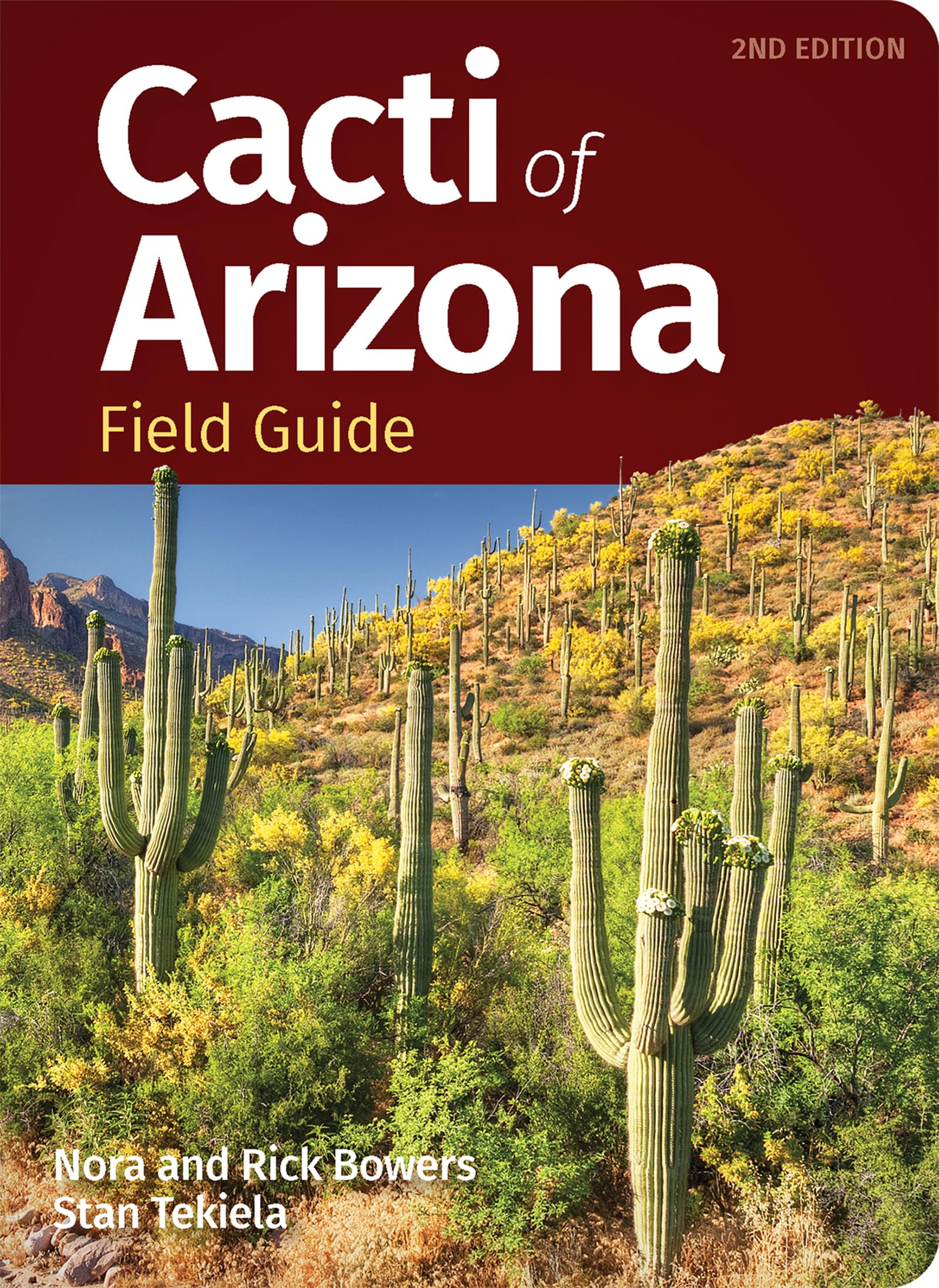



Identify Arizona succulents with this easy-to-use field guide, organized by shape and featuring full-color photographs and helpful information. Learn about a variety of cactus species in Arizona. With this famous field guide by Nora Bowers, Rick Bowers, and Stan Tekiela, cactus identification is simple and informative. The Cacti of Arizona Field Guide features 50 of the most common and widespread species found in the state, organized by shape. Just look at the overall plant or stem shape, then go to the correct section to learn what it is. Fact-filled information contains the particulars that you want to know, while professional photographs provide the visual detail needed for accurate identification. Inside you’ll find: Range maps and shape icons that help narrow your search - More photos per cactus than any other field guide, making visual identification quick and easy - Compare feature to help you decide between look-alikes - Close-up images of spines, flowers, and fruit to aid identification - Fascinating natural history about 50 cactus species This second edition includes updated photographs, expanded information, and even more of the authors’ expert insights. So grab the Cacti of Arizona Field Guide for your next outing to help ensure that you positively identify the cacti you see. Nora Mays Bowers is a writer and nature photographer. She likes being in nature and looking at birds, wildlife, and plants. Long ago, she earned a Master of Science degree in Ecology from the University of Arizona. She is the primary author of Wildflowers of Arizona, Wildflowers of the Carolinas, Wildflowers of Texas, Cactus of Texas, Cactus of the Southwest, and Kaufman Focus Guides: Mammals of North America. Most of the photographs in all of these guides were taken by her and her husband, Rick Bowers. Rick Bowers began birding at age 10 while living on Ft. Huachuca, Arizona. In less than a year he was leading birders to the specialty birds of southeastern Arizona. During high school and college, he led individuals and groups on tours in southeastern Arizona. For 16 years after college Rick led birdwatching tours for Victor Emanuel Nature Tours. Now when not working on books or photography, Rick leads photography and birding tours around the world through his company, Bowers Birding & Photo Safaris. Naturalist, wildlife photographer, and writer Stan Tekiela is the author of more than 190 field guides, nature books, children’s books, and playing cards, presenting many species of birds, mammals, reptiles, amphibians, trees, wildflowers, and cacti in the United States. With a Bachelor of Science degree in Natural History from the University of Minnesota and as an active professional naturalist for more than 30 years, Stan studies and photographs wildlife throughout the United States and Canada. He has received various national and regional awards for his books and photographs. Also a well-known columnist and radio personality, his syndicated column appears in more than 25 newspapers and his wildlife programs are broadcast on a number of Midwest radio stations. Heyder Pincushion Mammillaria heyderi Size: H 1/4–1" (.6–2.5 cm); W 3–6" (7.5–15 cm) Shape: low-growing, disk-shaped cactus with a flat top Stem: single stem covered with conical green bumps (tubercles), each topped with a cluster of spines; stem has a milky white sap Spines: grayish white or pinkish brown with dark tips, 1/5–7/10" (.5–1.8 cm) long Spine Clusters: 10–22 spines per cluster; each cluster has 1 short rigid outward-pointing central spine within a semicircle of needle-like radial spines hugging the stem; lowest radials are longest Flower: small cream or pinkish blossoms in a ring at the top of stem; each flower, 1–1 1/2" (2.5–4 cm) wide, has a wide brownish green or pink stripe on the petals and a pink and green center Blooming: March–April Fruit: conical green pod, 1/2–1 3/8" (1–3.5 cm) long, with fleshy walls and tiny reddish-brown seeds, ripens 6 months to a year after blooming, elongating into a cylindrical red pod Zone/Habitat: higher desert scrub and grasslands from 3,500–6,000' (1,065–1,830 m); rocky limestone hills, washes, among grasses, or under shrubs Range: southeastern corner of Arizona, from the junction of Highway 83 and Interstate 10 (east of Tucson) northeast to the New Mexico border through Duncan and south to the Mexico border through Bisbee Compare: Heyder looks like MacDougal Pincushion (pg. 27) when not in bloom but is easily identified when it is flowering. Heyder has cream-to-pink flowers, unlike the yellow flowers of MacDougal. MacDougal has a full circle of radial spines, whereas Heyder has a semicircle of radial spines. Notes: A low, flat cactus with a stem that shrinks in winter to just above ground level or sometimes below. Grows among grasses or hides under shrubs and is often overlooked until it blooms. Some cactus lovers searching for a glimpse of this interesting plant have nearly walked on it while