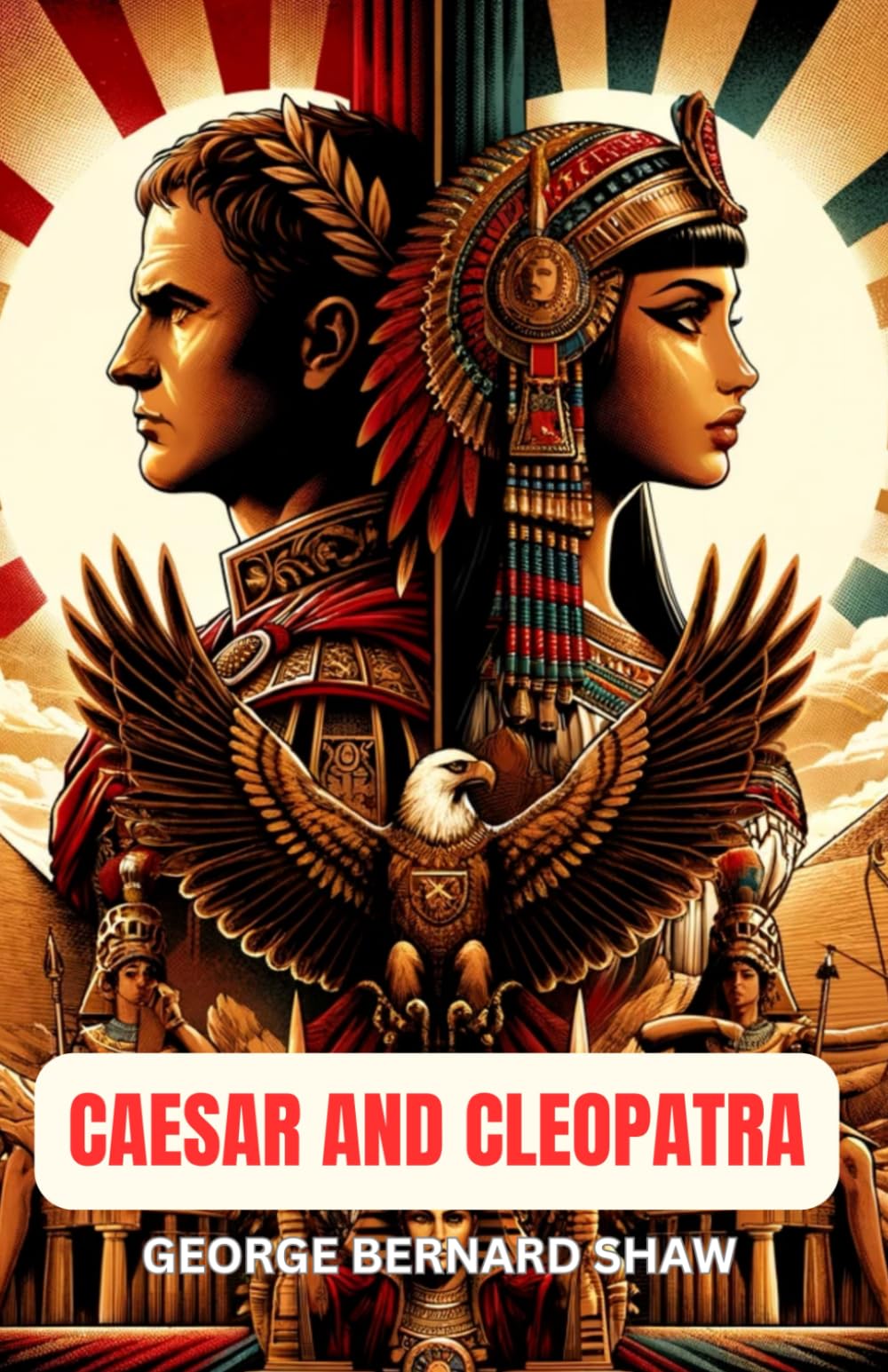



"Caesar and Cleopatra" is a play by George Bernard Shaw, first published in 1898. It is a comedic drama that explores the relationship between Julius Caesar, the Roman dictator, and Cleopatra, the young Queen of Egypt. The play is set in 48 BC, during Caesar's occupation of Egypt, and it is notable for its focus on the political and personal dynamics between the two titular characters. The play begins with Caesar's arrival in Egypt, where he encounters Cleopatra hiding in the Sphinx, afraid of her brother Ptolemy and his advisers, who seek to oust her from power. Caesar, portrayed as a wise and somewhat paternal figure, decides to mentor Cleopatra, teaching her how to rule effectively. Throughout the play, Shaw presents Caesar not as a conqueror, but as a civilizing force who seeks to educate Cleopatra in the ways of leadership and governance. Cleopatra, on the other hand, is initially depicted as naive and childish but grows into a more mature and capable ruler under Caesar's guidance. Their relationship is intellectual and platonic, with Shaw emphasizing their mutual respect and the exchange of ideas rather than a romantic involvement. Shaw uses the historical backdrop to explore themes of power, leadership, and the clash of cultures. He contrasts the decadent, mystical East (represented by Egypt) with the rational, disciplined West (represented by Rome), while also critiquing both societies. Shaw's Caesar is a figure of enlightenment, advocating for reason and justice over brute force and tradition. "Caesar and Cleopatra" also delves into the complexities of colonialism, as Caesar's intentions for Egypt are portrayed as benevolent, yet still embody the imposition of one culture over another. The play challenges the audience to consider the nature of power and its use in shaping societies. Despite its historical setting, "Caesar and Cleopatra" is imbued with Shaw's characteristic wit and humor, making it both a thought-provoking commentary on politics and power, and an entertaining theatrical experience. The play has been celebrated for its sharp dialogue, complex characters, and its ability to blend historical drama with contemporary issues, reflecting Shaw's skills as a playwright and his philosophical insights into human nature and society.