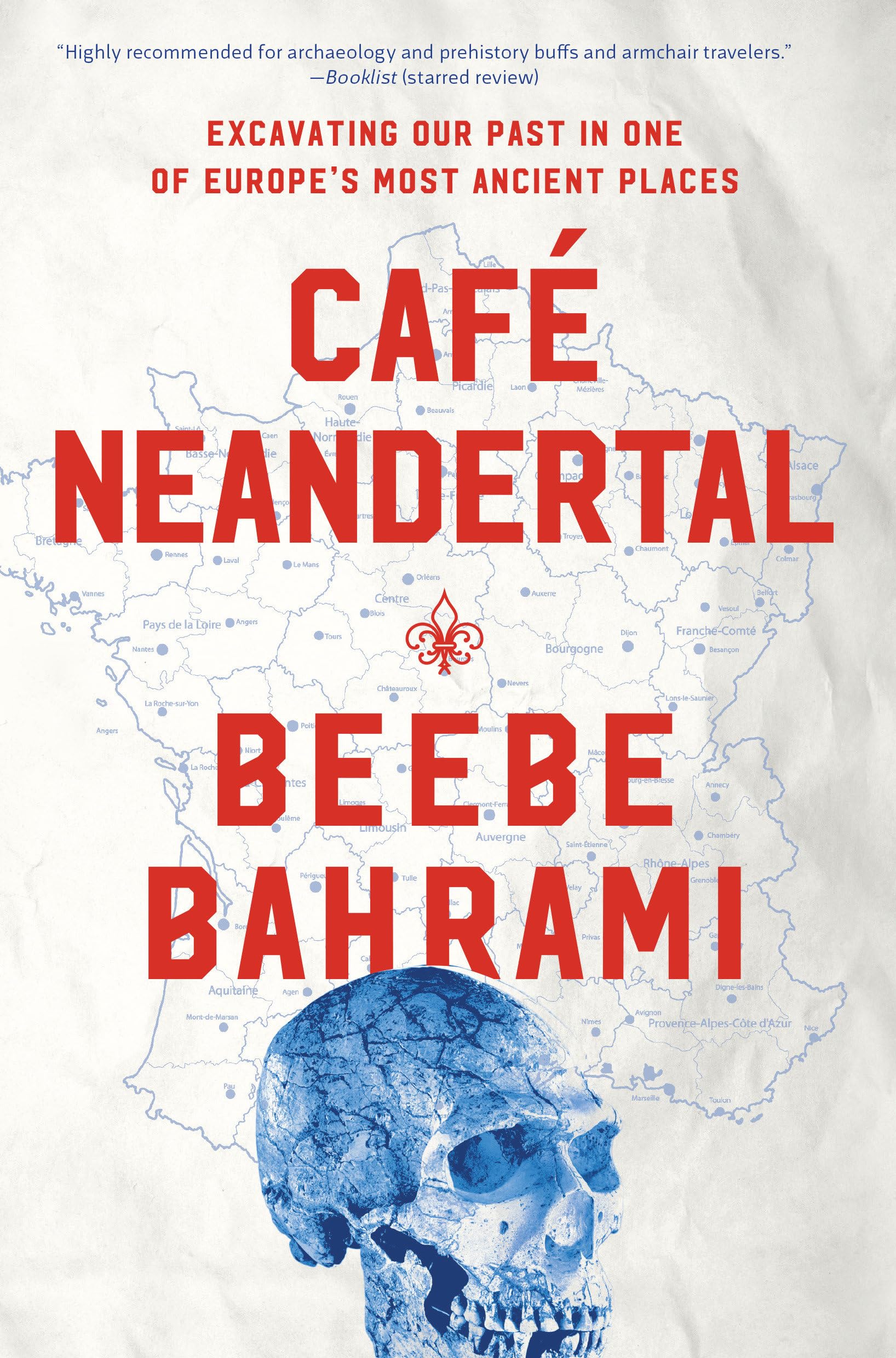
Café Neandertal: Excavating Our Past in One of Europe's Most Ancient Places
$17.95
by Beebe Bahrami



"Award–winning writer Bahrami is a delightful guide in this thoroughly enjoyable look into the research and recovery of a group of Neandertal remains in the French Dordogne region . . . Her wide interests in travel, memoir, food, wine, and more make this exceedingly engaging title more like a French version of Under the Tuscan Sun ." — Booklist (starred review) Centered in the Dordogne region of southwestern France, one of Europe’s most concentrated regions for Neandertal occupations, Café Neandertal features the work of archaeologists doing some of the most comprehensive and global work to date on the research, exploration, and recovery of our ancient ancestors, shedding a surprising light on what it means to be human. Praise for Café Neandertal "[A] beautifully crafted book . . . Bahrami is a wonderful writer who brings many of the attributes of the novel to a clear and compelling narrative that encapsulates a snapshot of the state of our current knowledge about Neanderthals. Peopled with a vast cast of fascinating characters, from village locals to querulous scientists, it brings to life the excitement of unearthing the past and describes the ‘new, more enlightened era in studies of human evolution’ that is dawning." — Cosmos Magazine "Highly recommended for archaeology and prehistory buffs and armchair travelers." — Booklist (starred review) "We need to understand who we were in order to know where we are headed. In the caves and forests of France’s Dordogne region, Beebe Bahrami guides us on a haunting encounter with what may be our earlier selves, a creature whose passions and powers and motives we have only begun to fathom. A fascinating read for anyone who claims to be human." —Peter Stark, author of Astoria: John Jacob Astor and Thomas Jefferson’s Lost Pacific Empire; A Story of Wealth, Ambition, and Survival "With a pilgrim’s reverence and a scientist’s exactitude, Bahrami captures the textures, smells, and sounds of the excavation sites and adjacent towns . . . At the heart of this story is Bahrami’s trek through densely overgrown prehistoric territory in search of a visceral connection to and deeper understanding of all humankind." — Publishers Weekly "Written with all the flair and enthusiasm of an experienced writer eager to share her love of her subject."" — Kirkus Reviews Beebe Bahrami is a professional writer known for award–winning travel, memoir, archaeology, outdoors and adventure, food and wine, spiritual, and cross–cultural writing. Author of The Spiritual Traveler Spain (Paulist Press, 2009) and Historic Walking Guides Madrid (DestinWorld Publishing, 2009), her work also appears in Archaeology , Wine Enthusiast, Bark , The Pennsylvania Gazette , National Geographic Books, and Michelin Green Guides , among others. She wrote two travel apps, The Esoteric Camino France and Spain and Madrid Walks , and maintains two blogs, Café Oc , on life in the Dordogne, and The Pilgrim's Way Café , dedicated to exploring the world on foot. Read more at beebebahrami.weebly.com. AUTHOR’S NOTE With such a complex topic, involving so many people and places, past and present, I have made every effort to be meticulously accurate. If any errors have made their way in, they are wholly unintended. Also, at times I had to sacrifice the chronology of certain encounters to forefront clarity and present the wholeness and integrity of each chapter’s topic. The events here cover the period from 2010 to 2015. The main dig featured, at La Ferrassie, went for five years, from 2010-2014. The summer after, in 2015, the key researchers met in Carsac to discuss the findings and possible interpretations based on the current body of evidence. That year I also did some long distance trekking across southwestern France and northern Spain and visited other Neandertal sites. In all, I have remained true to the knowledge and experience of the encounters described herein. And lastly, I spell Neandertal without an “h” for a very particular reason, which I explain two-thirds of the way in. If you really want to know why before then, there is no harm in flipping ahead to find out. CHAPTER 1: THE LA FERRASSIE SEVEN Seven bodies lay scattered across the cave floor like leaves in the wind. Some were missing limbs or parts of their torso or craniums. One’s detached head had rolled a few feet away. Standing at the mouth of the cave, I made out the first body in the haphazard line of corpses beginning directly in front of my line of vision. There lay a large man in his forties. His lifeless arms and legs were folded in toward his body as if, in his last moments, he had been trying to keep warm. To the left of where he lay was a similarly positioned person, a woman in her late twenties or early thirties. Scanning to the right from both were the remaining five, all children, splayed helter-skelter, two not far from the man, one a little farther away, and the last separated from them all at the oppo