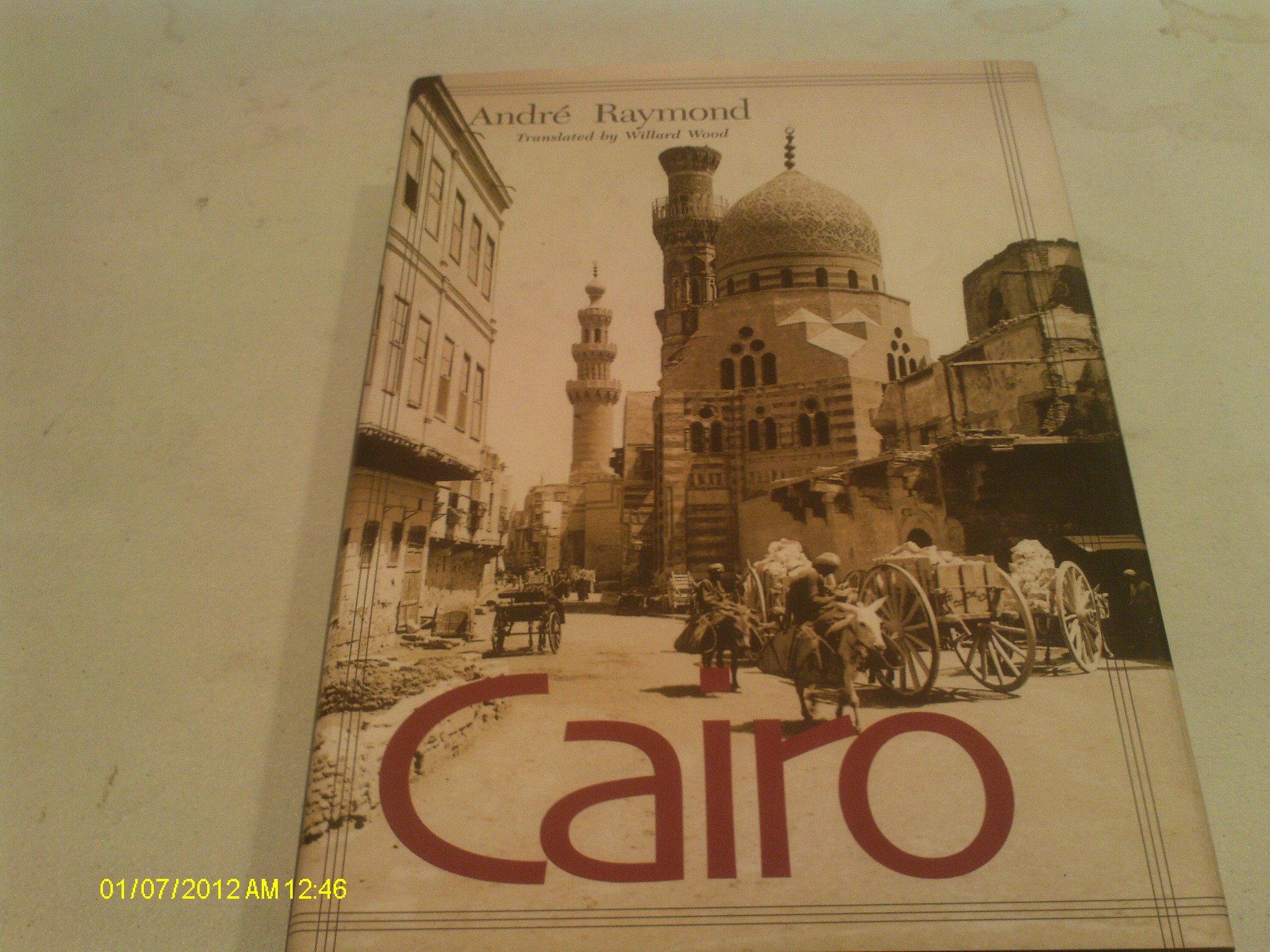



Gaze toward the Nile from the desert hills of Mukattam, and the vast city of Cairo unfolds before you, with its monumental architecture, teeming populace, and thousands of years of rich history. The extraordinary tapestry of Cairo's past and present comes vividly to life in this magisterial study by André Raymond, arguably the premier social historian of the Arab world. The most deeply observed and historically nuanced account ever given of the greatest Arab city of northern Africa, this book shows us Cairo from the glimmer of its beginnings in the Arab conquest of Egypt in 640 through its transformation into the modern center of Middle Eastern life today. Here are the Fatimids, the Mamluks, and the Ottomans, the invasions, dynastic changes, and religious conflicts that one after another altered and shaped Cairo's destiny. And here, alongside rulers and religious leaders, are the merchants and artisans who have given Cairene life its distinctive character over time. Raymond depicts life in Cairo through the centuries, chronicling the coming of European influence, the vagaries of social evolution, and the development of economic structure and urban design. His work reflects all facets of Cairo's historical and social reality, weaving commerce, politics, religion, and culture into a finely worked portrait of the foremost Arab city on the continent of Africa. With its splendid illustrations and maps and its meticulous attention to the topography and archaeology of the city, this book will prove as valuable to the serious traveler as to observers of Middle Eastern history and society. It stands as the definitive work on Cairo, unparalleled in scope, depth, and detail. Egypt has long served as the pulse of the Arab world...[and] a fascinating country for scholars and foreign travelers alike...In this comprehensive study, Raymond...meticulously traces Cairo's history to the present day. The narrative is enhanced by 15 interesting maps, drawings, and photos. Highly recommended. (Nader Entessar Library Journal 2000-11-15) Eminent French historian Raymond lucidly delineates how the city, intrinsically tied to Egypt's Islamic history...also reflects the multifaceted trends of modern Egyptian history and brings the city up-to-date in its transformation into the overcrowded, bustling, crumbling metropolis it is today...Adeptly translated and equipped with fabulous maps of Cairo during each historic phase, this is a useful and reliable primer on the physical, economic and political history of an important and vibrant city. ( Publishers Weekly 2000-11-20) This is a fabulously interesting work...Most books by westerners which even approach Cairo lose their marbles fairly quickly. [Raymond's book] maintains such a strong hold on them it should be required reading. (Louisa Young The Independent ) [Raymond describes] an evolving Cairo connected to its visible history but not defined by it...If you want to know a place (and, in this case, really know a place), it's vastly more rewarding to read about the whole of that place's culture and people throughout history than to skim over a glorified rundown of what there is to 'see and do.' ( Travelocity Magazine 2001-03-01) Raymond has written a thorough, detailed, and interpretive biography of one of the world's great cities. (B. Harris Jr. Choice 2001-07-01) André Raymond, who traces the growth of Cairo from the founding of the garrison city of Fustat by the Muslim conqueror Amr ibn Al-As in the 7th century to the present, has a sanguine attitude. He celebrates the city even as he charts its many problems. His book, like all good history, puts the present in context. He reminds us that however dodgy it is to walk along Cairo's streets in 2001, dodging people and animals, coping with intermittently unpleasant smells, the same walk 300 years ago would have been much worse. (Zachary Karabell Los Angeles Times 2001-11-25) A remarkable book, unlike any other in Middle Eastern history. Raymond offers a beautifully balanced longitudinal view of Cairo from the Arab conquest to 1992. Balance is a crucial term. You get archaeology, topography, architectural history, political history, social evolution, economic structure, and urban design, all in moderation and integrated into a holistic view of the urban fabric and experience. (Richard Bulliet, author of Islam: The View from the Edge ) André Raymond was Director of the French Institute for Arab Studies, in Damascus, and of the Institute for Research and Study on the Arab and Islamic World, in Aix-en-Provence. He is Professor Emeritus at the University of Provence and the author of numerous books, including The Great Arab Cities in the Sixteenth to Eighteenth Centuries: An Introduction . Used Book in Good Condition