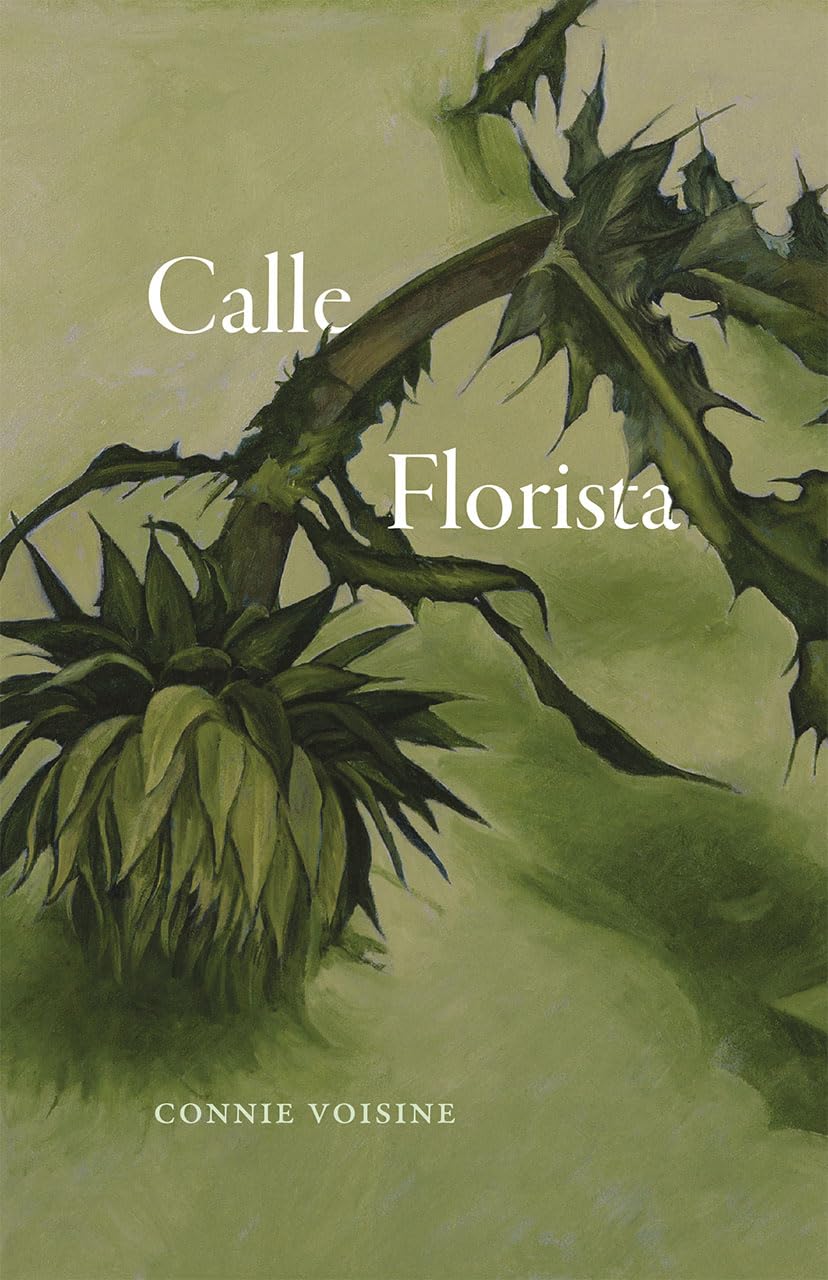



This World and That One Sometimes you defy it, I am not that , watching a stranger cry like a dog when she thinks she’s alone at the kitchen window, hands forgotten under the running tap. The curtains blow out, flap the other side of the sill. In you one hole fills another, stacked like cups. You remember your hands. Connie Voisine’s third book of poems centers on the border between the United States and Mexico, celebrating the stunning, severe desert landscape found there. This setting marks the occasion as well for Voisine to explore themes of splitting and friction in both human and political contexts. Whose space is this border, she asks, and what voice can possibly tell the story of this place? In a wry, elegiac mode, the poems of Calle Florista take us both to the edge of our country and the edge of our faith in art and the world. This is mature work, offering us poems that oscillate between the articulation of complex, private sensibilities and the directness of a poet cracking the private self open—and making it vulnerable to the wider world. "Aristotle said that the greatest thing by far is to be a master of metaphor, and to be one is to be a genius. Voisine is that great thing, and that genius. Nearly every line of every poem is its own poem. She has re-visioned our most looked-at things. She brings us new ways to see, and to be. To travel through the neighborhood of this collection is to be surprised at every corner turned, but to recognize it completely. There is no greater poetic gift, or thrill." ― Laura Kasischke, author of The Infinitesimals "'The next poem I write will be better,' begins the final poem in Connie Voisine's wonderful Calle Florista . This strikes me as quite a hefty promise, since the poems in this volume are already so gratifying and surprising. They carve a marvelous spot for themselves at the crossroads of joy and regret, pathos and humor, faith and doubt, elegance and quirkiness, making the very most, not only of 'the flimsy scraps that more genuinely / compose the day' but also of the very largest concerns: 'Maybe the soul isn’t a fussy eater-- / still, it is ravenous / and expensive.'" ― Jacqueline Osherow, author of Whitethorn "In her haunting new collection Calle Florista , Voisine dances at the edge of nihilism, an imaginative and moral strategy borrowed from George Herbert, whose style of doubt and recovery she celebrates throughout the book. Her poems flirt with ugliness and with nothingness, negating the body, the street, the desert flowers, the natural world itself. Yet an astonishing, powerful affirmative lyric drive wells up: ‘the way a wren /of a word then another gives itself to a sentence.’ These remarkable poems operate like everyday miracles, driving the reader from despair to belief, word by word—into the perfect radiance of profound poetic revelation." ― Carol Muske-Dukes, author of Sparrow Connie Voisine is associate professor of English at New Mexico State University. She is the author of two previous books of poems: Rare High Meadow of Which I Might Dream , also published by the University of Chicago Press; and Cathedral of the North . She lives in Las Cruces, New Mexico. Calle Florista By Connie Voisine University of Chicago Press Copyright © 2015 The University of Chicago All rights reserved. ISBN: 978-0-226-29532-9 Contents Acknowledgments, Calle Florista, As Well As You Can, The Internal State of Texas, We Are Crossing Soon, Rules for Drought, What Is True Is You're Not Here, Say Uncle, New World, I admit that I believe ideas exist regardless, Annunciation, Pilgrims, Testament, Summertime, You Will Come to Me across the Desert, Gravid, Midnight in the House, This World and That One, After the First Road, After, Two Years in That City, Once, Psalm to Whoever Is Responsible, A world's too little for thy tent, a grave too big for me, Ambidextrous, Prayer of the St. of the Hottest Night in Las Cruces, To the Crickets Which Sing in Unison, Ubi sunt qui ante nos fuerunt?, RIP, The Altar by George Herbert, Spanish Language in Mexico, 1993, In the Shade, Unfinished Letter to Death, The Self after Modernism, Notes, CHAPTER 1 Calle Florista Don't you remember our little house on Calle Florista, the calle with lots of flowers? There weren't flowers so much as cats, at least a hundred, lounging in the neighbor's yard while the bushes roiled with kittens. They weren't kittens so much as pecan trees and weeds of the nightshade family, unwatered except on irrigation days when the whole neighborhood stood up to its knees in water. And the water was not water so much as gravel, and the Calle was not a street, but more a bunch of rocks lined up in a particular way. And the "Florista" started last year. The maps still say Iris Lane. There were no irises so much as one fat Shar-Pei,