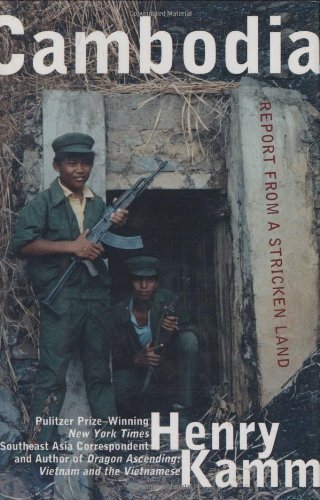



A New York Times Southeast Asia correspondent and Pulitzer Prize-winning journalist offers insider observations of Cambodia made over the last thirty years that help enable readers to understand some of the nation's tragedy and complexity. Cambodia has long been regarded as one of the lost causes of U.S. foreign policy. Many view it as the unfortunate stage upon which American and Communist forces battled during the Vietnam War in a savage struggle that tore up the land and shattered the fragile populace. Starting with the overthrow of Prince Norodom Sihanouk in 1970, South East Asia correspondent and Pulitzer Prize winner Henry Kamm recalls 30 years of revolution and genocide in Cambodia . He begins with the establishment of the Khmer Rouge, detailing the vicious Communist occupation that took place between 1975 to 1979, then moves on to the Vietnamese invasion, the 1991 Paris peace settlement, and the demise of Pol Pot. Kamm pays special attention to the foreign influences that played a significant role in crippling the evolution of the Cambodian people. This sobering perspective on Cambodia's recent, often tragic, history explains how years of political turbulence and violence has strangled the economy and stagnated the social growth of the people to this day. Kamm intrepidly attempts to answer the questions of "why" and "how" even as he contemplates the uncertain future of the country as the new millennium approaches. Kamm writes with poise and grace, while his 30 years of experience in the region gives him unique insight into the plight of the Cambodians. Those who were moved by The Killing Fields , will find Cambodia a gripping read. --Jeremy Storey The agony of the Cambodian people, manipulated by the outside world and brutalized by their own leaders, has few if any parallels in recent history. Kamm (Dragon Ascending, LJ 2/1/96), who for years has covered Southeast Asia for the New York Times, presents a bleak and disturbing portrait of a country whose decades-long travails he witnessed. In the best populist tradition, Kamm sympathizes with the Cambodian people, targets of Pol Pot's genocidal rule (1975-79) and the corrupt and venal authoritarianism of his successors. At the same time, he acidly condemns Cambodia's rulers, many of whom he knew up close, including the wily but self-indulgent Prince Sihanouk and the superstitious and incompetent Lon Nol. Kamm blames weak and indecisive international leadership for the failure of the UN-sponsored effort in the early 1990s to effect genuine peace and reconciliation in Cambodia. Sober yet passionate, Kamm's well-informed survey is an excellent introduction to a country that the world has all but abandoned. This belongs in both public and academic libraries.?Steven I. Levine, Univ. of Montana, Missoula Copyright 1998 Reed Business Information, Inc. A prizewinning correspondent who has spent many years in Southeast Asia, Kamm brings to life a country most Americans think of only in relation to the Vietnam War, when reports of U.S. aerial bombings along Cambodia's borders brought the country into the foreground of U.S. foreign policy. Kamm traces Cambodia's fortunes from the period when U.S. soldiers were pulled out of Vietnam, one war ending as another was just beginning with Pol Pot's reign of terror. The text capably reprises the activities of the Khmer Rouge, the elite and merciless Communist troops who took over and destroyed what limited structures remained in the nation. Kamm effectively argues that this former French colony is currently in a downward spiral, with little hope of recovery without the emergence of an indigenous elite committed to addressing Cambodia's problems first. But that effort, he believes, must be coupled with Western support centered on humanitarian concerns. A valuable overview for most history collections. Vernon Ford Kamm's account of Cambodia's long tragedy is spare, blunt and angry.... a tribute to the quality of Kamm's journalism over the years. -- The New York Times Book Review , Arnold R. Isaacs