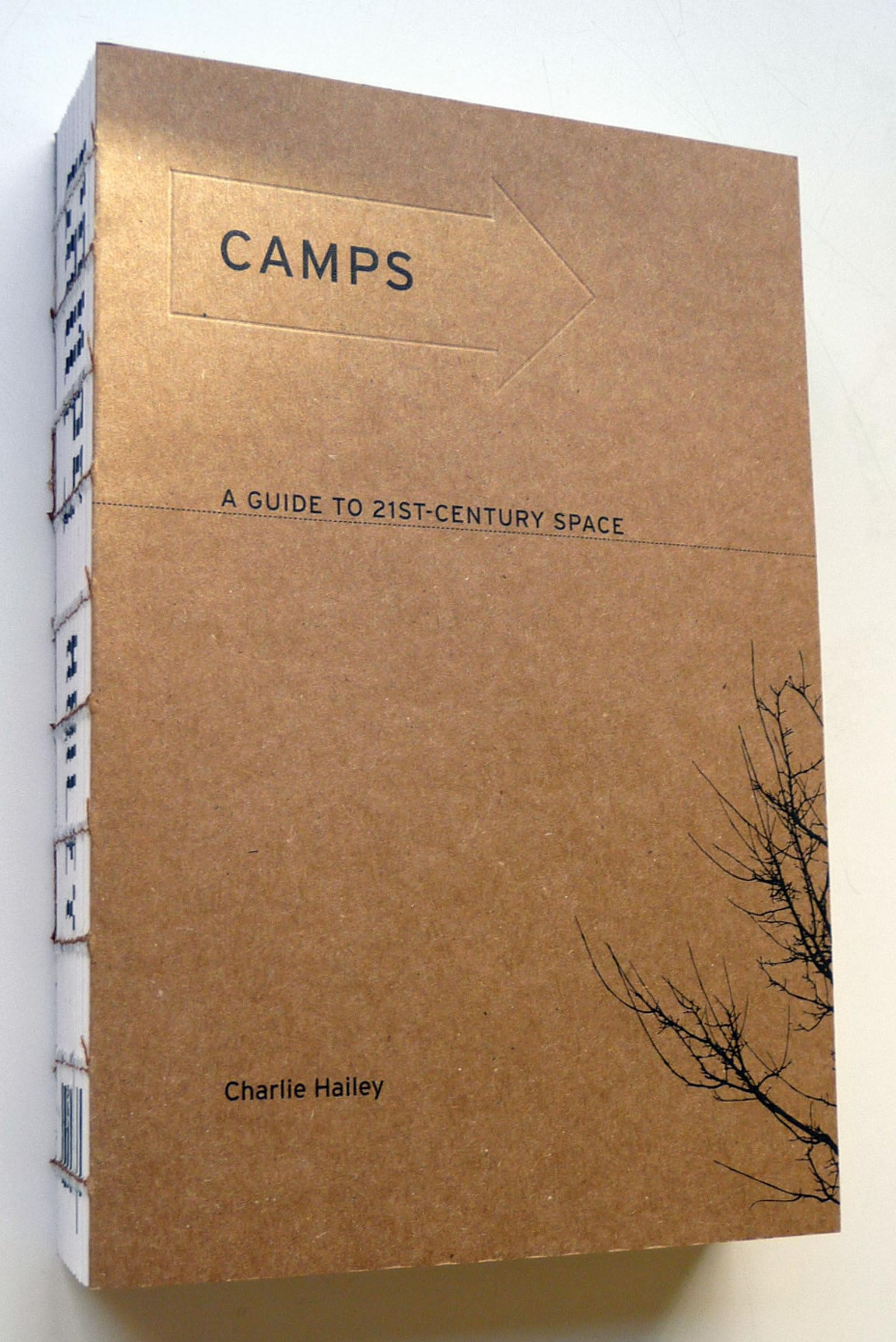



The meaning and function of camps, from Scout Jamborees and RV Clubs to FEMA trailers and GTMO. What is a camp? In August 2005, television news showed viewers an estimated 20,000 Katrina evacuees camped out in the Superdome, Cindy Sheehan protesting the Iraq War on President Bush's doorstep in "Camp Casey," Texas, and Israeli and Palestinian young people at the Seeds of Peace Camp in Maine discussing the evacuation of settlement camps in the Gaza Strip. Meanwhile, off camera, summer campers all over America packed up their gear, preparing to depart Scout camps, computer camps, and sports camps, and millions of recreational vehicles owners were on the road, permanent itinerant campers. In Camps , Charlie Hailey examines the space and idea of camp as a defining dimension of 21st-century life. The ubiquity and diversity of camps calls for a guidebook. This is what Hailey offers, but it is no ordinary one. Not only does he establish a typology of camps, but he also embeds within his narrative a key to camp ideology. Thus we see how camp spaces are informed by politics and transform the ways we think about and make built environments. Hailey describes camps of diverse regions, purposes, and forms, and navigates the inherent paradoxes of zones that are neither temporary nor permanent: camps of choice, including summer camps, protest camps, drift camps (research stations on Arctic ice floes), and LTVA (Long-Term Visitor Area) Camps; strategic camps regulated by power--boot camps, GTMO (the detention camp at Guantánamo Bay), immigrant camps, and others;--and transient spaces of relief and assistance, among them refugee camps, FEMA City, work camps, and Gypsy camps. More than 150 diagrams, sketches, building and site plans, photographs, political cartoons, video game screenshots, aerial and satellite images, and maps illustrate camp space in unprecedented complexity and variety. Today camps are at the center of emerging questions of identity, residency, safety, and mobility. Camp spaces register the struggles, emergencies, and possibilities of global existence as no other space does. "Drawing from an expansive range of sources, from anarchists to Boy Scouts, Katrina refugees to GTMO detainees, Hailey demonstrates his keen architect's eye in revealing camp as a pedagogic fulcrum that springs beyond traditional classroom experience. Cracking the multivalent lingo of camps, this book is more than a guide to hidden treasure or singular reading of our global territory. It is also a generative resource operating within today's interconnected terrain of identity and spatial politics, asking how we as individuals make camp."--Chris Taylor, Architect, Educator, and Director of Land Arts of the American West at Texas Tech University "Hailey has focused on impermanent, or seemingly impermanent, patterns in the built environment that most of us consider marginal, demonstrating how important they are, not just as components of the landscape, but also as manifestations of our ideas and experiences. In analyzing the many types of shelter associated with 'camp, ' he delineates the centrality of his subject to landscape forms. Through his organization of this material, he demonstrates the great range of human conditions related to 'camp.' Ultimately, the content transcends its important subject to offer a new and a rather profound way of looking at how we shape our environments."--Richard Longstreth, George Washington University "While camps may appear like rather simple physical environments made of prefabricated repetitive shelters that permanently seek to perform their temporariness, Hailey demonstrates how complex a set of spaces camps can actually be. With almost one thousand refugee camps in more than forty countries, and tens of thousands of the other types discussed, it is increasingly apparent that no one, not least architects, can any longer ignore this emergent type of environment."--Eyal Weizman, Director of Centre for Research Architecture, Goldsmiths, London University Charlie Hailey is Assistant Professor in the University of Florida's School of Architecture. He is the author of Campsite: Architectures of Duration and Place. Charlie Hailey, Professor in the School of Architecture at the University of Florida, is the author of Camps: A Guide to 21st Century Space (MIT Press) and other books. He was awarded a Guggenheim Fellowship in 2018.