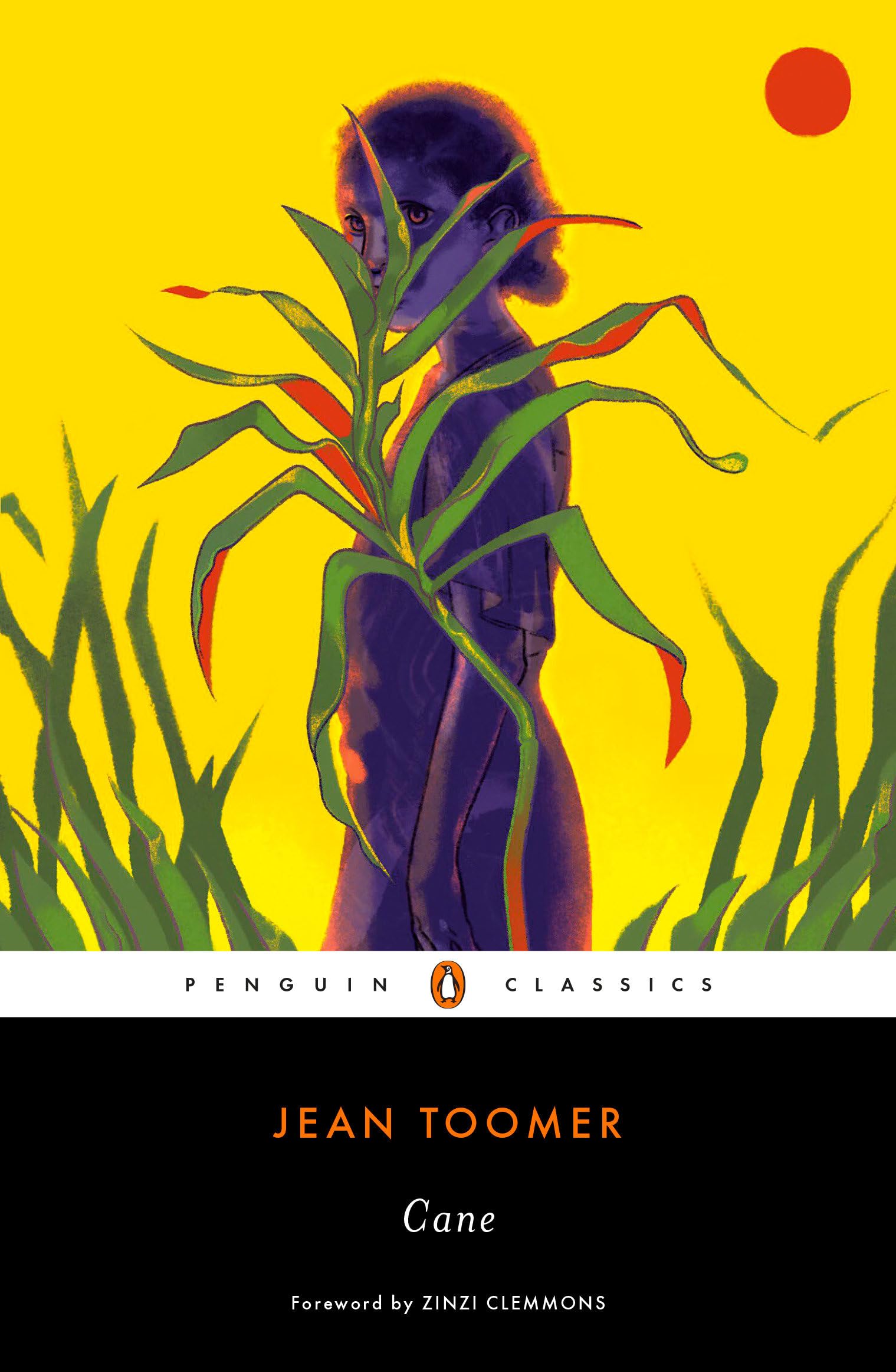



The Harlem Renaissance writer's innovative and groundbreaking novel depicting African American life in the South and North, with a foreword by National Book Foundation 5 Under 35 honoree Zinzi Clemmons Jean Toomer's Cane is one of the most significant works to come out of the Harlem Renaissance, and is considered to be a masterpiece in American modernist literature because of its distinct structure and style. First published in 1923 and told through a series of vignettes, Cane uses poetry, prose, and play-like dialogue to create a window into the varied lives of African Americans living in the rural South and urban North during a time when Jim Crow laws pervaded and racism reigned. While critically acclaimed and known today as a pioneering text of the Harlem Renaissance, the book did not gain as much popularity as other works written during the period. Fellow Harlem Renaissance writer Langston Hughes believed Cane 's lack of a wider readership was because it didn't reinforce the stereotypes often associated with African Americans during the time, but portrayed them in an accurate and entirely human way, breaking the mold and laying the groundwork for how African Americans are depicted in literature. For the first time in Penguin Classics, this edition of Cane features a new introduction, suggestions for further reading, and notes by scholar George Hutchinson, and National Book Award Foundation 5 Under 35 novelist Zinzi Clemmons contributes a foreword. “[Toomer] is American literature’s greatest, most enduring enigma. . . . But here, in this lush, bleak book, in his evocation of the world as it is instead of how it ought to be, something hardier, more useful is conveyed — of the possibilities for epiphany, the reliable consolations of love and revenge. And in his style — this pastiche of poem, autobiography and fable — there is an integration of the self that the life never afforded.” —Parul Sehgal, The New York Times “Over the past 95 years this Harlem Renaissance ‘experiment’ — a mosaic of poems, vignettes and short stories, many of these last being shocking studies of loneliness and the longing for love — has risen from relative obscurity to become what it always was, a groundbreaking work of 20th-century American literature.” —Michael Dirda, The Washington Post Jean Toomer (1894-1967) was an African American novelist and poet who wrote during the Harlem Renaissance. The son of a mixed-race freedman born into slavery who later joined ranks with the mulatto elite in Washington, D.C., Toomer's lighter skin and upbringing in all-white schools and neighborhoods caused him to not identify as black or white, but rather an American who represented a new mixed race. Despite his refusal to be bound or classified by race, Toomer is considered one of the most important African American writers to come of the Harlem Renaissance, as his non-stereotypical depiction of African Americans in Cane (which was inspired by his time teaching at a rural school in Georgia) set a groundbreaking precedent for the honest portrayal of the black experience in America. George Hutchinson is a Newton C. Farr Professor of American Culture at Cornell University. He is the author of In Search of Nella Larsen ,and The Harlem Renaissance in Black and White . Most recently he brought to light Anita Thompson Reynolds' memoir, American Cocktail: A 'Colored Girl' in the World . He also edited The Cambridge Companion to the Harlem Renaissance . Zinzi Clemmons was raised in Philadelphia by a South African mother and an American father. Her novel What We Lose earned her a spot on National Book's 5 Under 35 list in 2015 and was a NBCC John Leonard First Book Prize finalist. Clemmons lives in Los Angeles with her husband, where she teaches at the Colburn Conservatory and Occidental College. KARINTHA Her skin is like dusk on the eastern horizon, O cant you see it, O cant you see it, Her skin is like dusk on the eastern horizon . . . When the sun goes down. Men had always wanted her, this Karintha, even as a child, Karintha carrying beauty, perfect as dusk when the sun goes down. Old men rode her hobby-horse upon their knees. Young men danced with her at frolics when they should have been dancing with their grownup girls. God grant us youth, secretly prayed the old men. The young fellows counted the time to pass before she would be old enough to mate with them. This interest of the male, who wishes to ripen a growing thing too soon, could mean no good to her. Karintha, at twelve, was a wild flash that told the other folks just what it was to live. At sunset, when there was no wind, and the pine-smoke from over by the sawmill hugged the earth, and you couldnt see more than a few feet in front, her sudden darting past you was a bit of vivid color, like a black bird that flashes in light. With the other children one could hear, some distance off, their feet flopping in the two-inch dust. Karintha's running was a