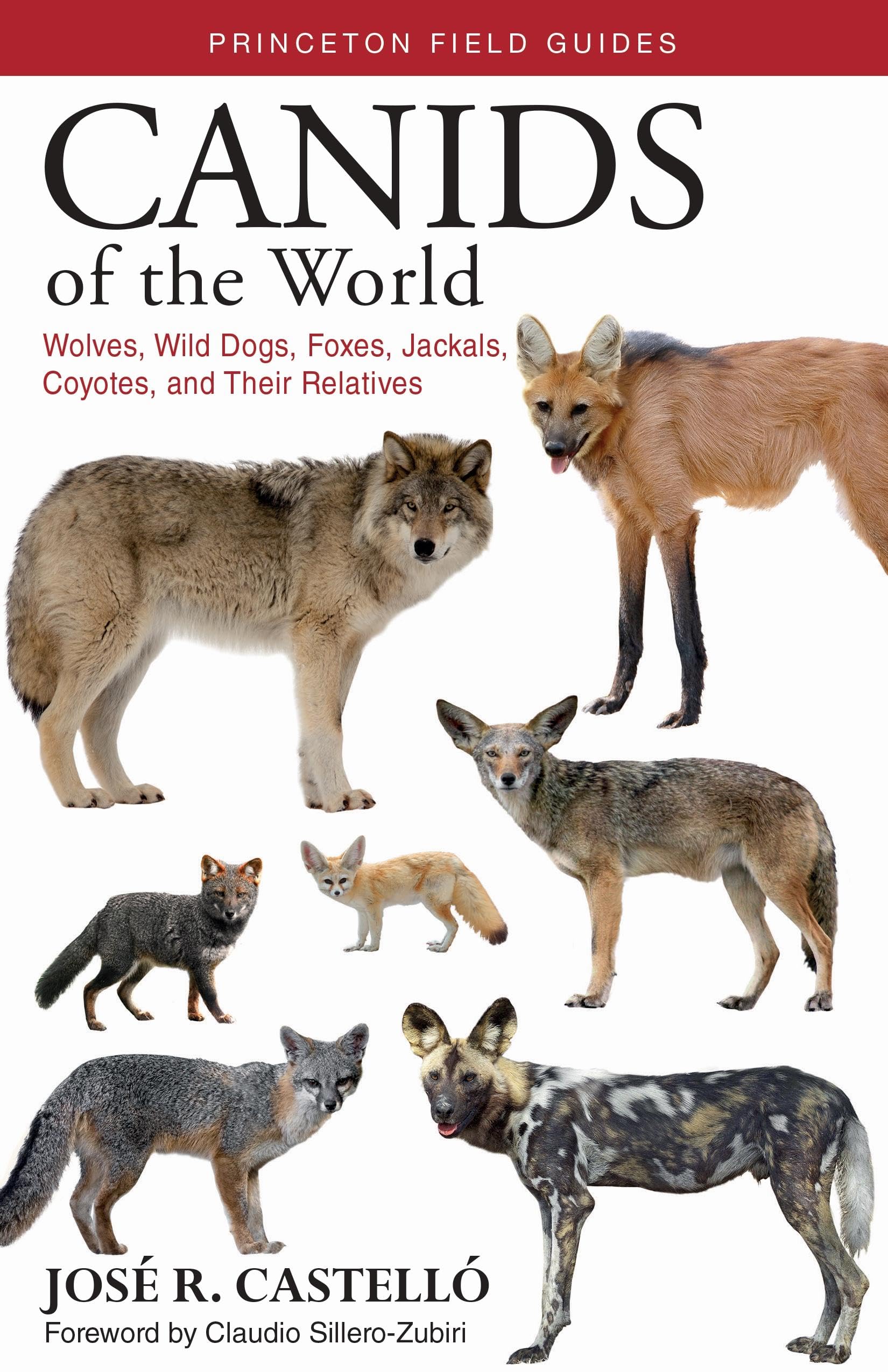
Canids of the World: Wolves, Wild Dogs, Foxes, Jackals, Coyotes, and Their Relatives (Princeton Field Guides)
$18.99
by Dr. José R. Castelló



The most complete and user-friendly photographic field guide to the world’s canids This stunningly illustrated and easy-to-use field guide covers every species of the world’s canids, from the Gray Wolf of North America to the dholes of Asia, from African jackals to the South American Bush Dog. It features more than 150 superb color plates depicting every kind of canid and detailed facing-page species accounts that describe key identification features, morphology, distribution, subspeciation, habitat, and conservation status in the wild. The book also includes distribution maps and tips on where to observe each species, making Canids of the World the most comprehensive and user-friendly guide to these intriguing and spectacular mammals. Covers every species and subspecies of canid - Features more than 150 color plates with more than 600 photos from around the globe - Depicts species in similar poses for quick and easy comparisons - Describes key identification features, habitat, behavior, reproduction, and much more - Draws on the latest taxonomic research - Includes distribution maps and tips on where to observe each species - The ideal field companion and a delight for armchair naturalists " Canids of the World is a timely resource and a fascinating survey of wolves and their canine relatives." ---Nancy Jo Tubbs, International Wolf "This is the best encyclopedia any reader or writer can hope for. I look forward to returning to it over the coming years." ― Pennsylvania Literary Journal José R. Castelló is a medical doctor, naturalist, and wildlife photographer. He is a member of the American Society of Mammalogists and the Spanish Society for Conservation and Study of Mammals. He is the author of Bovids of the World: Antelopes, Gazelles, Cattle, Goats, Sheep, and Relatives (Princeton). Canids of the World Wolves, Wild Dogs, Foxes, Jackals, Coyotes, and Their Relatives By José R. Castelló PRINCETON UNIVERSITY PRESS Copyright © 2018 José R. Castelló All rights reserved. ISBN: 978-0-691-17685-7 Contents FOREWORD, 5, ACKNOWLEDGMENTS, 7, INTRODUCTION, 8, * SOUTH AMERICAN CANIDS Maned Wolf, Bush Dog, Short-Eared Dog, and South American Foxes, 28, * WOLF-LIKE CANIDS Wolves, Jackals, Coyotes, Dhole, African Dog, and Domestic Dog, 74, * RED FOX-LIKE CANIDS True Foxes, Bat-Eared Fox, and Raccoon Dog, 172, * GRAY FOX-LIKE CANIDS Gray Fox and Island Fox, 274, SKULLS, 310, GLOSSARY, 316, REFERENCES, 319, INDEX, 329, CHAPTER 1 South American Canids MANED WOLF, BUSH DOG, SHORT-EARED DOG, SOUTH AMERICAN FOXES RECOGNITION South American endemic Canids form a phylogenetically independent group. It includes the Maned Wolf, Bush Dog, Short-Eared Dog, Crab-Eating Fox and the six species of Lycalopex (South American Foxes). This group is more closely related to Wolf-like Canids than to Foxes. Most South American Canids can be described as Fox-like, but vary considerably in size and morphology. There is little size dimorphism between males and females. Several species are morphologically atypical, compared to most Canids, such as the extremely long-legged Maned Wolf, or the short-legged Bush Dog. They exhibit the typical Canid dental formula, I 3/3, C 1/1, P 4/4, M 2/3 = 42, except Bush Dogs, which have 38 or 40 teeth and trenchant heel dentition. Chromosome number is 2n=74, except for the Maned Wolf and Short-Eared Dog (2n=76), and there are no "marker chromosomes," a generalized characteristic in the Carnivora and an ancestral character in other Canids. PHYLOGENY After being confined to North America for a period of about 30 million years, Canid lineages spread across the world, invading the Old World in the late Miocene (ca. 10 Ma) and arriving in South America much later, in the late Pliocene (ca. 42.5 Ma). This migration to South America generated a great diversity of species, represented by six living genera, mainly small to medium-sized omnivorous Canids, and several extinct species that included large hypercarnivorous forms. The large hypercarnivorous taxa were particularly well represented in the past, with two endemic genera ( Theriodictis and Protocyon ) and three species that have been included in Canis. Phylogenetic and molecular studies, as well as some fossil records, suggest that at least three or four independent lineages of the South American clade invaded South America after the rise of the Panama Bridge (ca. 4–2.5 Ma), pointing to an origin outside SouthAmerica for this group. Canids from other clades, Urocyon and Canis dirus, invaded this continent at least during the late Pleistocene, and Domestic Dogs ( Canis lupus familiaris ) were introduced by aborigines in the Holocene. BEHAVIOR Most South American Canids are solitary animals, forming pairs only during the breeding season, but the Bush Dog forms social groups. Lycalopex and the Maned Wolf are monoestrous, while the Bush Dog is polyestrous. Crab-Eating Fox females produce two l