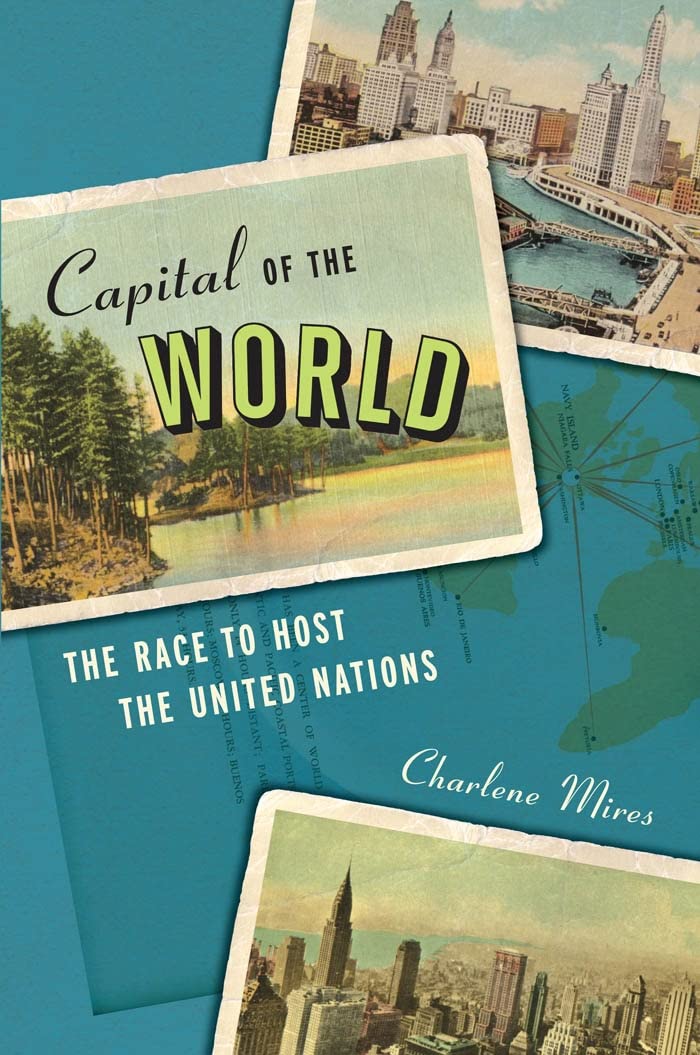



From 1944 to 1946, as the world pivoted from the Second World War to an unsteady peace, Americans in more than two hundred cities and towns mobilized to chase an implausible dream. The newly-created United Nations needed a meeting place, a central place for global diplomacy—a Capital of the World. But what would it look like, and where would it be? Without invitation, civic boosters in every region of the United States leapt at the prospect of transforming their hometowns into the Capital of the World. The idea stirred in big cities—Chicago, San Francisco, St. Louis, New Orleans, Denver, and more. It fired imaginations in the Black Hills of South Dakota and in small towns from coast to coast. Meanwhile, within the United Nations the search for a headquarters site became a debacle that threatened to undermine the organization in its earliest days. At times it seemed the world’s diplomats could agree on only one thing: under no circumstances did they want the United Nations to be based in New York. And for its part, New York worked mightily just to stay in the race it would eventually win. With a sweeping view of the United States’ place in the world at the end of World War II, Capital of the World tells the dramatic, surprising, and at times comic story of hometown promoters in pursuit of an extraordinary prize and the diplomats who struggled with the balance of power at a pivotal moment in history. Polls have repeatedly indicated that many New Yorkers wouldn’t mind if the UN left their city lock, stock, and barrel, taking its bureaucracy and parking-violating diplomats along. The irony is not lost on Mires, for, as she reveals in her surprising and often amusing work, New York “won” the privilege to host the UN after a furious, sometimes sad, and sometimes comical competition with other cities and locales. Some of the competitors were seriously considered, including San Francisco, Boston, Philadelphia, and even an Ontario island near Niagara Falls. Others, including the Black Hills of South Dakota, never had a chance. Mires shows how the competition was triggered by a combination of municipal pride, boosterism, and an eagerness to reap the financial rewards that were expected to accrue to the host city. Mires also captures the pervading sense of optimism amongst the claimants after the horrors of WWII. This is a very readable, entertaining account that is aimed at a general audience. --Jay Freeman "Capital of the Worldis a rich and fascinating book that both entertains and enlightens. Mires has an eye for the telling vignette, a skill for plumbing the archives and interrogating the documentary and visual record, and an ability to see the large in the small and vice versa. Although the book's accessibility is sure to gain it a wide nonacademic readership, scholars, particularly those with an interest in such topics as the United Nations, modern U.S. history, civic engagement, and postwar internationalism, will find it more than worth their time." -- Mary Ann Heiss ― The Journal of American History "In what promises to be the definitive account of this story, Charlene Mires, a former journalist who is now a professor of history at Rutgers-Camden, relates how the United Nations wound up in the heart of Manhattan. It is a story, she notes, that has been largely ignored by most previous historians of the United Nations. Mires does not limit herself to a bloodless account of bureaucratic maneuverings; instead, she embeds her narrative in a broader framework that traces the history of the international organization back to the early nineteenth century." -- Gary B. Ostrower ― The New England Quarterly "This fascinating and extremely detailed story covers the period from late 1944, before the UN had even been formally created, to the end of 1946, when the decision was made to locate the organization in New York City. Based on extensive research, the book is vividly written in an accessible fashion that is suitable for a wide audience." -- Andrew Johnstone ― American Historical Review "thoroughly entertaining book" -- John King ― SFGate "With meticulous research and journalistic verve, Charlene Mires tells an overlooked story about American engagement with the world. Writing in a decade when many Americans worry about their nation's place in the world, Mires reminds us about the excitement that the newly created United Nations generated not only in big eastern cities but also in the heartland of the Middle West and Great Plains. Her fast-moving and always entertaining narrative captures the optimistic spirit of the 'Greatest Generation.'" -- Carl Abbott,author of How Cities Won the West: Four Centuries of Urban Change in Western North America "Capital of the World is an exceptionally imaginative book that warrants an exceptionally diverse readership. Charlene Mires, a former journalist who recognizes the extraordinary in the ordinary, leverages her skill as a public historian and expertise in