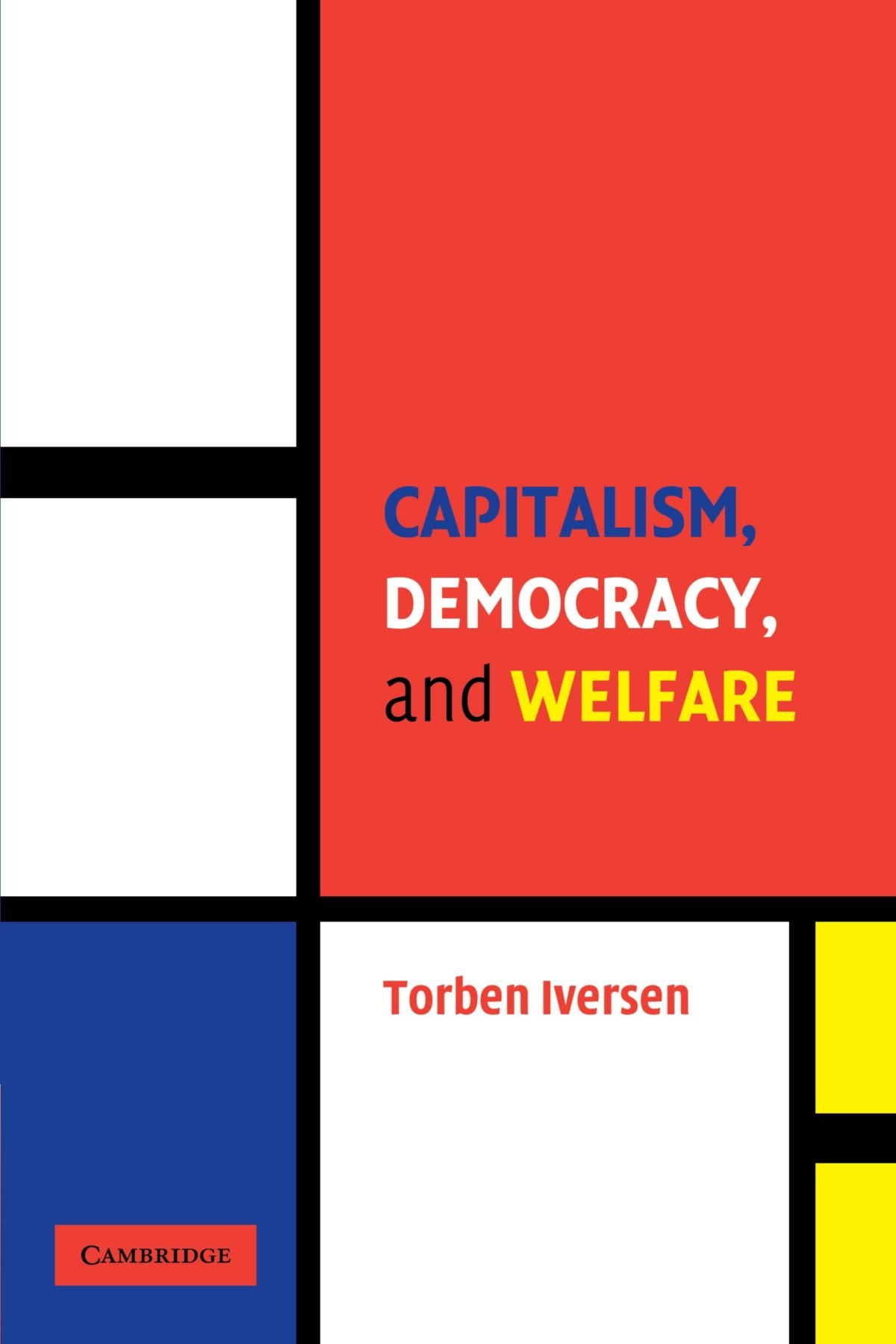
Capitalism, Democracy, and Welfare (Cambridge Studies in Comparative Politics)
$25.51
by Torben Iversen



Based on the key idea that social protection in a modern economy, both inside and outside the state, can be understood as protection of specific investments in human capital, Torben Iversen offers a systematic explanation of popular preferences for redistributive spending, the economic role of political parties and electoral systems, and labor market stratification (including gender inequality). Contrary to the popular idea that competition in the global economy undermines international differences in the level of social protection, Iversen argues that these differences are actually made possible by a high international division of labor. "Iversenas analysis of the political economy of the welfare state and redistribution is highly original and provocative. His theoretical approach, which focuses on risks, social insurance, and the development of human capital, manages to combine the strengths of power resources theory and its recent employer centered critics and thus to transcend that debate. The book is a real tour de force and is must reading for all scholars interested in the political economy of the welfare state." John Stephens, University of North Carolina "This is an excellent book, at the highest level of quality in its combination of innovative and important theory and argument, and sophisticated and well developed supporting empirical analysis. It brings to light how much we still don't know about the welfare state and its effects and underpinnings despite its now lengthy history and the innumerable works devoted to understanding its nature. The book is also substantially interdisciplinary, truly a work of political economy in the fullest sense of that term. Iversen's research will make a major mark on the field and become the source of much debate and further scholarship." Peter Lange, Duke University "This book provides a well informed, historically situated and comparative analysis of the evolution, divergence and current problems of employment and social protection in the political economies of highly industrialized democracies. It is lucid and highly accessible, not only to undergraduates but also to an interested public. It also combines the ambitious claim of theoretical integration between separate literatures with a series of sophisticated and sometimes highly innovative exercises in analytical modeling and statistical testing that should be of interest to graduate students specializing in institutional economics and comparative political institutions." Fritz Scharpf, Max Planck Institute for the Studies of Societies This book, first published in 2005, offers a comprehensive political economy approach to the study of the welfare state and inequality. Torben Iversen is Professor of Government at Harvard University. He is the author of Contested Economic Institutions: The Politics of Macroeconomics and Wage Bargaining (Cambridge University Press, 1999), and co-editor of Unions, Employers and Central Bankers: Macroeconomic Coordination and Institutional Change in Social Market Economies (Cambridge University Press, 1999). He is also the author or co-author of articles in such journals as the American Journal of Political Science, the American Political Science Review, the British Journal of Political Science, Comparative Politics, Comparative Political Studies, International Organization, the Oxford Review of Economic Policy, Public Choice, the Quarterly Journal of Economics, and World Politics, as well as numerous edited volumes.