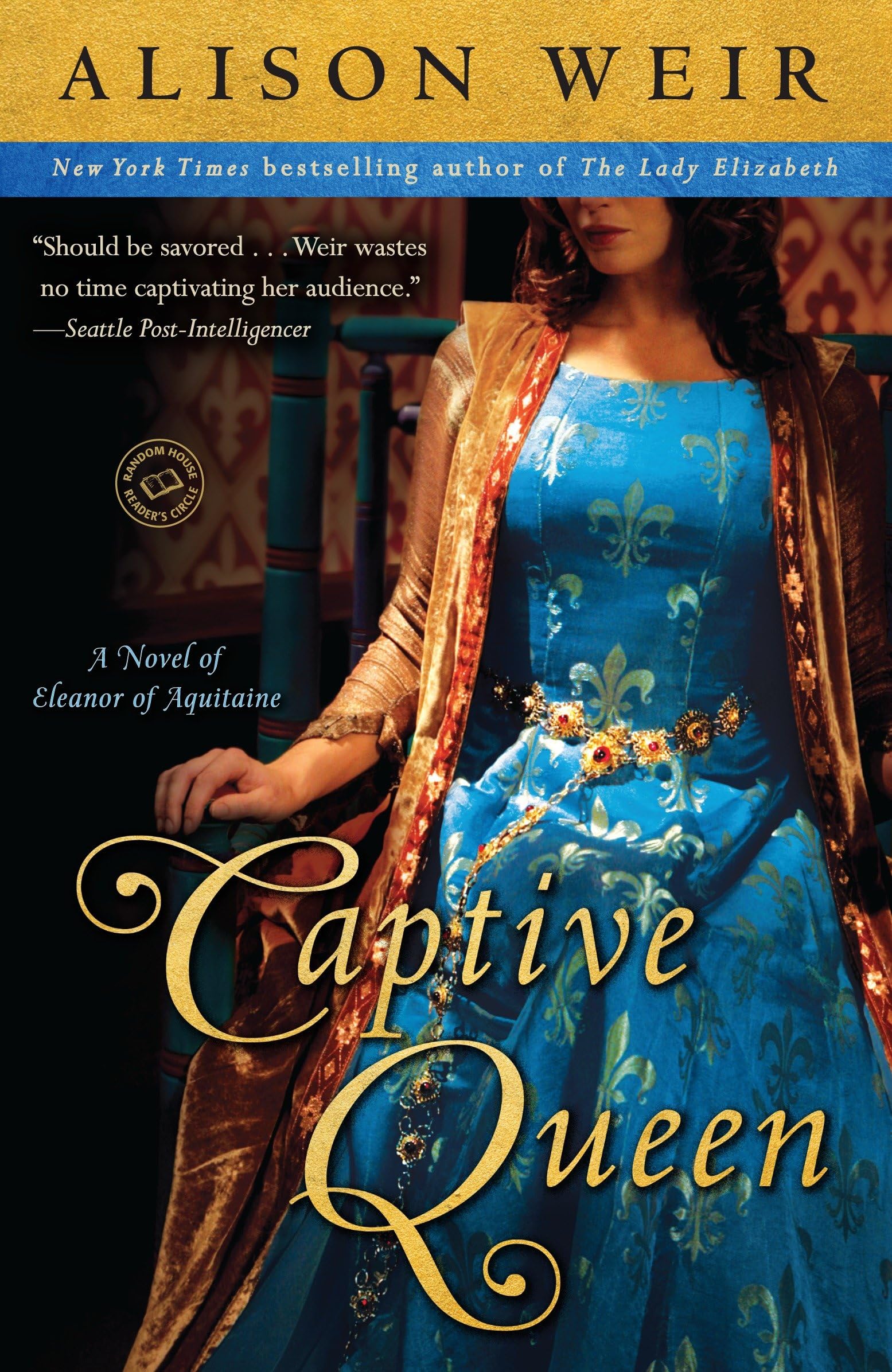
Captive Queen: A Novel of Eleanor of Aquitaine (Random House Reader's Circle)
$13.51
by Alison Weir



A “vibrant historical novel” ( Marie Claire ) that brings vividly to life England’s most passionate—and destructive—royal couple: Eleanor of Aquitaine and King Henry II, from the New York Times bestselling author hailed as “the finest historian of English monarchical succession writing” ( The Boston Globe ) “Stunning . . . Weir renders the bona fide plot twists of her heroine’s life with all the mastery of a thriller author, marrying historical fact with licentious fiction.”— The Star Tribune Nearing her thirtieth birthday, Eleanor of Aquitaine has spent the past dozen frustrating years as wife to the pious King Louis VII of France. But when Henry of Anjou, the young and dynamic future king of England, arrives at the French court, he and the seductive Eleanor experience a mutual passion powerful enough to ignite the world. Indeed, after the annulment of Eleanor’s marriage to Louis and her remarriage to Henry, the union of this royal couple creates a vast empire that stretches from the Scottish border to the Pyrenees—and marks the beginning of the celebrated Plantagenet dynasty. But Henry and Eleanor’s marriage, charged with physical heat, begins a fiery downward spiral marred by power struggles and bitter betrayals. Amid the rivalries and infidelities, the couple’s rebellious sons grow impatient for power, and the scene is set for a vicious and tragic conflict that will threaten to engulf them all. Vivid in detail, epic in scope, Captive Queen is a sensuous and tempestuous tale that encompasses the building of an empire and the monumental story of a royal marriage. “Should be savored . . . Weir wastes no time captivating her audience.” — Seattle Post-Intelligencer “Stunning . . . As always, [Alison] Weir renders the bona fide plot twists of her heroine’s life with all the mastery of a thriller author, marrying historical fact with licentious fiction.” — The Star Tribune “Engaging and dramatic . . . [Weir] laudably sticks to the historic facts while simultaneously using her imaginative gifts.” — The Star-Ledger “The history itself is inherently dramatic, augmented here by Weir’s usual lush detail, which stimulates.” — Booklist “A vibrant historical novel.” — Marie Claire “[An] epic novel . . . with its drama and rich, authentic historical detail.” — Historical Novels Review “Exceedingly well written and researched, this will more than satisfy and enchant historical novel fanatics. Weir’s attention to detail, engaging dialog and engrossing depiction of Eleanor’s life make the novel an invaluable addition to the genre.” — Library Journal “[Weir’s] weaving of personal and political narratives with minor details, social trends, and history-defining events creates a surprisingly modern-feeling romance.” — Publishers Weekly “As always, Weir’s writing is captivating and vivid.” — January Magazine Alison Weir is the New York Times bestselling author of the novels Innocent Traitor and The Lady Elizabeth and several historical biographies, including Mistress of the Monarchy, Queen Isabella, Henry VIII, Eleanor of Aquitaine, The Life of Elizabeth I , and The Six Wives of Henry VIII . She lives in Surrey, England with her husband and two children. Chapter One Paris, August 1151 Please God, let me not betray myself, Queen Eleanor prayed inwardly as she seated herself gracefully on the carved wooden throne next to her husband, King Louis. The royal court of France had assembled in the gloomy, cavernous hall in the Palace of the Cité, which commanded one half of the Île de la Cité on the River Seine, facing the great cathedral of Notre Dame. Eleanor had always hated this palace, with its grim, crumbling stone tower and dark, chilly rooms. She had tried to lighten the oppressive hall with expensive tapestries from Bourges, but it still had a stark, somber aspect, for all the summer sunshine piercing the narrow windows. Oh, how she longed for the graceful castles of her native Aquitaine, built of light mellow stone on lushly wooded hilltops! How she longed to be in Aquitaine itself, and that other world in the sun- baked south that she had been obliged to leave behind all those years ago. But she had schooled her thoughts not to stray in that direction. If they did, she feared, she might go mad. Instead, she must fix her attention on the ceremony that was about to begin, and play her queenly role as best she could. She had failed Louis, and France, in so many ways—more than anyone could know—so she could at least contrive to look suitably decorative. Before the King and Queen were gathered the chief lords and vassals of France, a motley band in their scarlets, russets, and furs, and a bevy of tonsured churchmen, all—save for one—resplendent in voluminous, rustling robes. They were waiting to witness the ending of a war. Louis looked drawn and tired, his cheeks still flushed with the fever that had laid him low for some weeks now, but at least, thought Eleanor, he