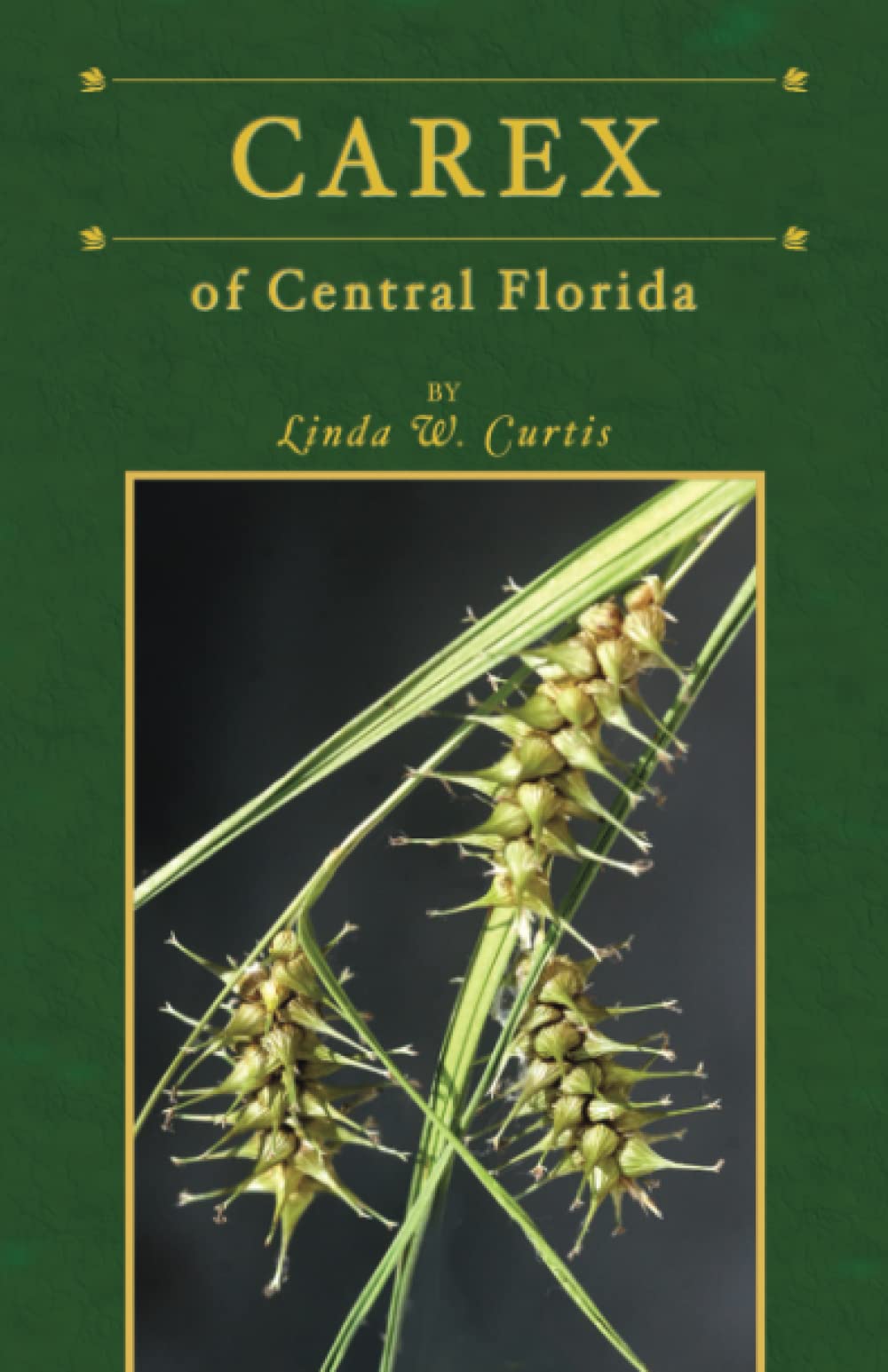



Worldwide, more than 2,100 species of Carex grow on all continents, except Antarctica. Of those, 71 Carex species grow in Florida. I found 45 species in Central Florida and sent specimens to these Florida and international herbaria. FSU–Florida State University–Tallahassee USF–University of Southern Florida–Tampa FLAS-University Florida–Gainesville Museum of Natural History Herbarium-Gainesville, FL MOR–Morton Arboretum–Lisle, Illinois NYBG–New York Botanical Garden–Bronx, N.Y. HUH–Harvard University Herbarium-Cambridge, MA Life mate Jim was the GPS photographer and navigator as we traveled forests and swamps accessible by 4-wheel drive vehicles on old logging roads, some barely ruts. Our volunteer research was welcomed by various agencies of county, state and national forests, parks and preserves since Carex were under-reported on their plant inventory lists. Permits to collect Carex culms, not rooted plants, were granted by the Florida Department on Environmental Protection (FDEP) and U.S. Fish and Wildlife Service (USFWS) in return for an annual report of the results. My first Florida Carex was C. vexans , found in 2005 in Marion County along the Withlacoochee River. New to me, I researched Carex in Flora of North America vol. 23 , and also Guide to Vascular Plants of Florida, 3rd ed. The Florida Natural Areas Inventory gave county records and website Florida Atlas has county distribution maps. Many of the Florida Panhandle Carex species did not grow in Central Florida and were at their southernmost range, although I did find C. corrugata and C. kraliana. This book describes 45 species in Central Florida and also compares some to similar Panhandle and more northern species. The Addendum has all Florida Carex . Field research collection sites included northern counties of Gilchrist, Suwannee, LaFayette and Alachua. Easternmost was Lake County. West to the Gulf Coast were Marion, Dixie, Levy, Citrus, and Hernando Counties that had 35 of the 45 species. Carex are grass-like, so my first task was to see differences starting with feeling the triangular culm. Next, the leaf junction to culm was inspected for a tube sheath instead of a cross-over sheath on a round grass culm. This book documented sheaths as well as perigynia with macro-lens camera photos and digital microscope images. The text also describes subspecies and some Carex varieties. The purpose of this book is to help others recognize and identify species of the genus Carex , using the author's unique plan to begin identification based on perigynia patterns with similar ones grouped into sections. Each section has a dichotomous key using clue-choices of traits and by process of elimination, the reader should arrive at the scientific name. A stepwise process, this begins with recognizing a Carex , then observing its perigynia taken from midway on a spike. With magnification, perigynia or “seed sacs” are compared to the Table of Content’s nine sections. Section One includes species with large perigynia that can be finger pinched and the achene rolled out. The other Carex in Sections 2–9 have smaller perigynia that require magnification to see the tip or beak, base and nerves.