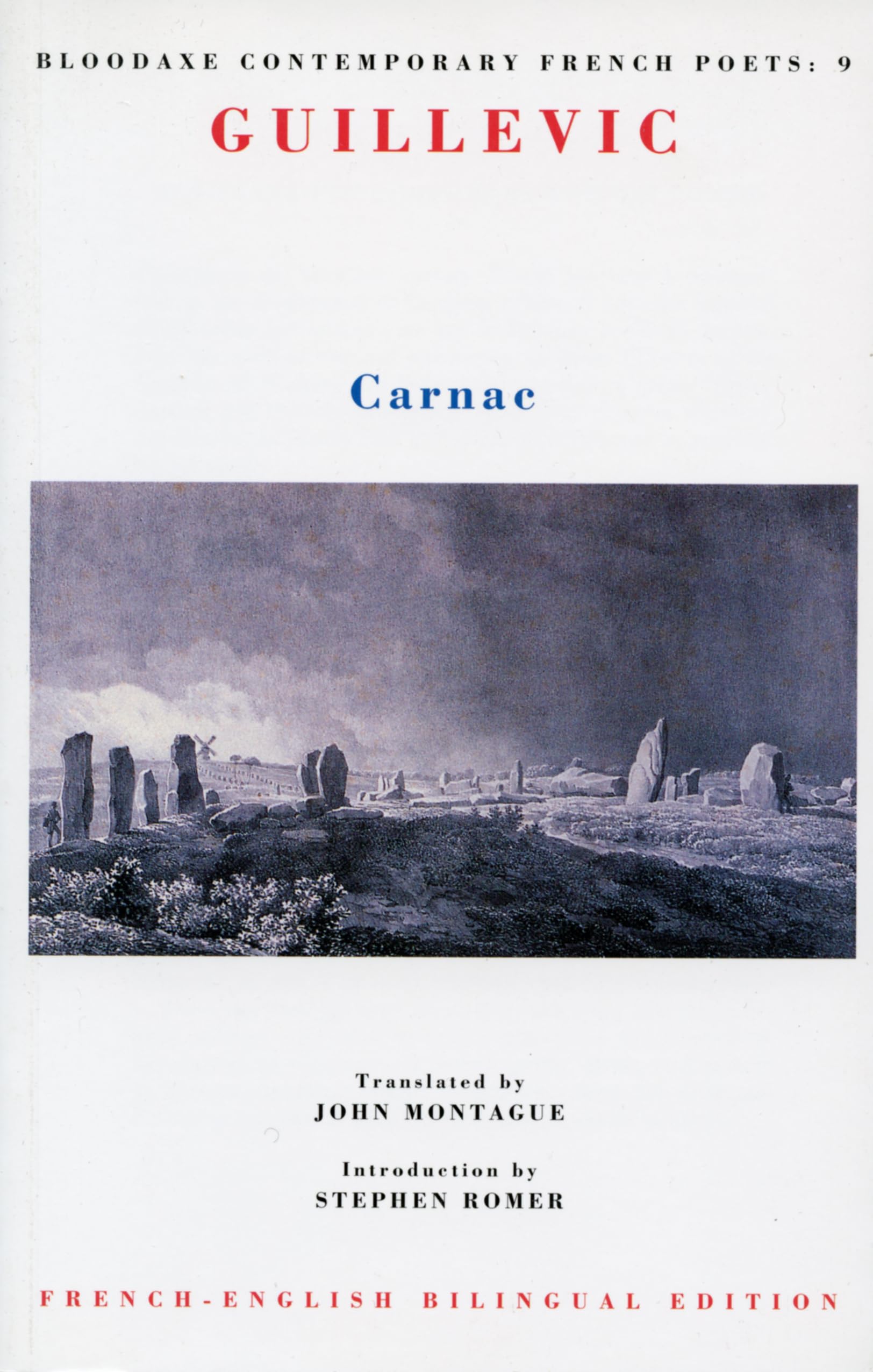



One of France’s most important modern poets, Eugène Guillevic (1907-97) was born in Carnac in Brittany, and although he never learned the Breton language, his personality is deeply marked by his feeling of oneness with his homeland. His poetry has a remarkable unity, driven by his desire to use words to bridge a tragic gulf between man and a harsh and often apparently hostile natural environment. For Guillevic, the purpose of poetry is to arouse the sense of Being. In this poetry of description – where entire landscapes are built up from short, intense texts – language is reduced to its essentials, as words are placed on the page ‘like a dam against time’. When reading these poems, it is as if time is being stopped for man to find himself again. Carnac (1961) marks the beginning of Guillevic’s mature life as a poet. A single poem in several parts, it evokes the rocky, sea-bound, unfinished landscape of Brittany with its sacred objects and its great silent sense of waiting. The texts are brief but have a grave, meditative serenity, as the poet seeks to effect balance and to help us ‘to make friends with nature’ and to live in a universe which is chaotic and often frightening. Introduction by Stephen Romer. French-English bilingual edition. Bloodaxe Contemporary French Poets: 9 Another sterling bilingual entry in Bloodaxe's contemporary French poetry series, this translation by distinguished Irish poet John Montague of Guillevic, a Breton who used his Celtic surname, contains a rich, long sequence of stark, short lyrics set in Brittany's megalith-strewn coastal landscape. Sea and stone are the central images, with their flux and stability, abundance and sterility, vastness and concision. Many poems seem to be oracles hewn from the stone of a menhir: "Have you implored the rocks some times to guard your nights?" Guillivec asks. Others are as fluid as the ocean: "Woman dressed in skin / You, who mould our hands / Without the sea in your eyes / Without that sea-taste we seize in you." Flinty and sparse and full of tensile strength, Guillevic's French is well matched by Montague's strong and sensuous English. Patricia Monaghan Copyright © American Library Association. All rights reserved The ninth in the Contemporary French Poets series, continues the recent trend of enlisting working poets as translators, with parallel translation rendered by Irish poet Montague (who began and completed the project in a fit of passion and then polished it for 20 years). Guillevic was born in the town of Carnac, in southern Brittany, and grew up at a time when standard French, not local dialects, was taught in the public schools. The few words of Breton he uses-"dolmen" (table stone) and "menhir" (long stone)-deal with the prehistoric site at Carnac. Though an intellectual heir to French Surrealism and the postwar movements of film noir, Theater of the Absurd, and Structuralism (not to mention the dogmatism of the French Communist Party), Guillevic sets forth on his own tack, avoiding what are essentially urban artistic and ideological sensibilities in favor of the toughness and self-reliance which comprise the rural Breton attitude and which form the backbone of this work. Guillevic is a pantheistic Romantic, declaring that there can be "no poetry without sacredness." But the homage he pays is not to the megaliths and their human architects; it is to the monolithic sea that he addresses his verse. "Without you, ocean, they would have done nothing at Carnac." At times humorous, at others solemn, the poet weaves his leitmotifs into language wholly appropriate to the task, in words both primitive and powerful.A fine translation of a beguilingly simple work. The effects Guillevic achieves are cumulative-geologically slow, but also imposing. -- Copyright © 2000 Kirkus Associates, LP. All rights reserved. Carnac -- Table of Poems from Poem Finder® One of France’s most important modern poets, Eugène Guillevic (1907-1997) was born in Carnac in Brittany, and although he never learned the Breton language, his personality is deeply marked by his feeling of oneness with his homeland. His poetry has a remarkable unity, driven by his desire to use words to bridge a tragic gulf between man and a harsh and often apparently hostile natural environment. For Guillevic, the purpose of poetry is to arouse the sense of Being. In this poetry of description - where entire landscapes are built up from short, intense texts - language is reduced to its essentials, as words are placed on the page ‘like a dam against time’. When reading these poems, it is as if time is being stopped for man to find himself again. Used Book in Good Condition