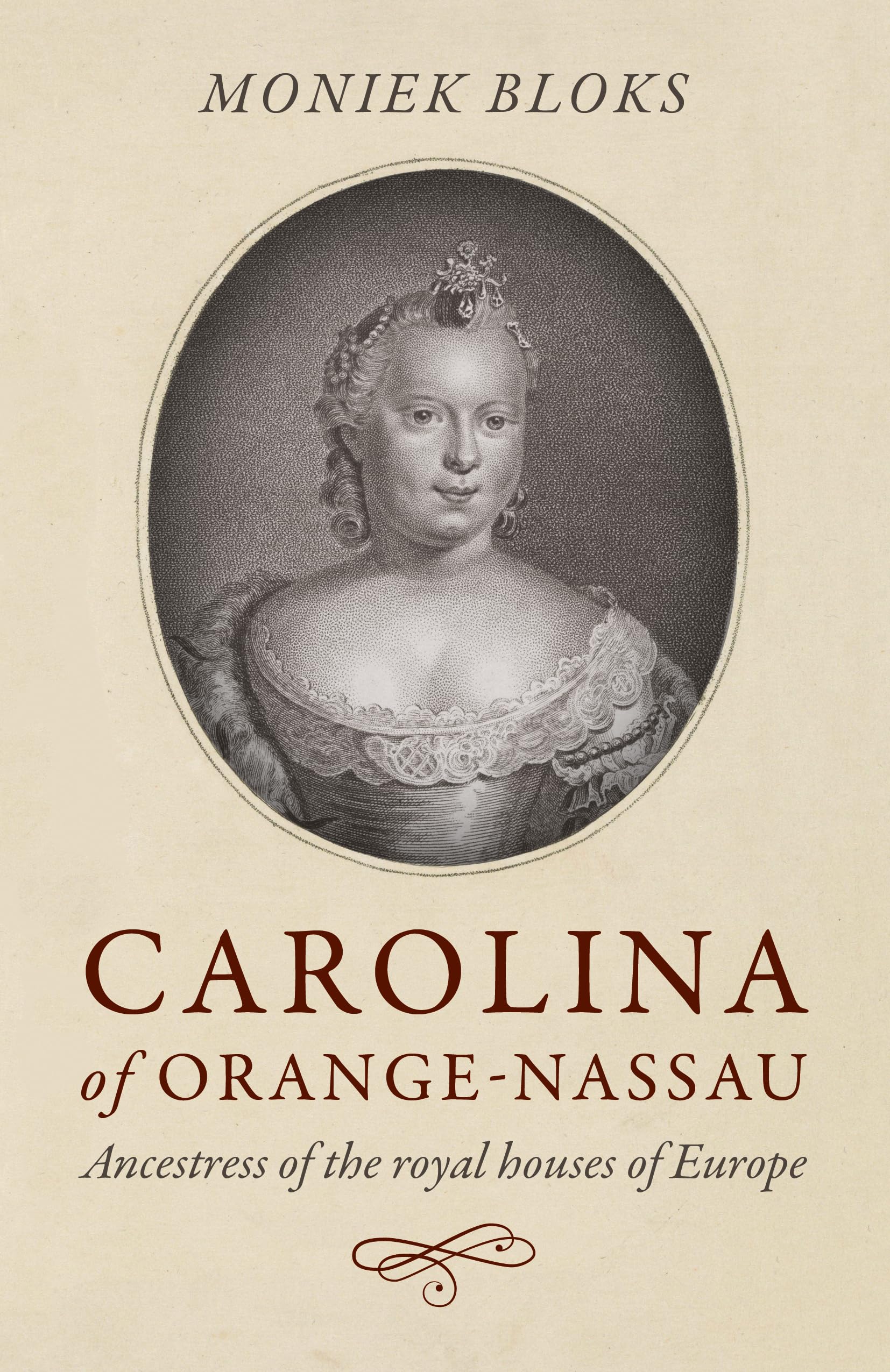



Carolina of Orange-Nassau (1743 – 1787) was born the daughter of William IV, Prince of Orange, and Anne, Princess Royal and was thus the granddaughter of King George II. It was upon the King's orders that she was named after his wife, Caroline of Ansbach. She was the first of Anne and William's children to survive to adulthood. When her father was at last made stadtholder of all seven united provinces, Carolina was included in the line of succession, in the event she had no brothers. A brother was eventually born, but due to his weak health, she remained an important figure. Carolina married Charles Christian of Nassau-Weilburg and suffered the loss of half her children, either in childbirth or infancy. Despite this, she acted as regent for her minor brother while heavily pregnant and remained devoted to him and the Dutch republic. Her children married well and her descendants sit upon the royal thrones of Europe, truly making her a grandmother of Europe. Moniek Bloks is the editor of the successful blog History of Royal Women. She lives in the Netherlands and has a background in law. Her interest in historical royal women and writing began at an early age, and she has been glad to share the stories of often little-known royal women. When she isn't writing, she is visiting castles and palaces around Europe with her trusty camera. Carolina of Orange-Nassau Ancestress of the royal houses of Europe By Moniek Bloks John Hunt Publishing Ltd. Copyright © 2018 Moniek Bloks All rights reserved. ISBN: 978-1-78535-914-9 Contents Acknowledgements, vi, Introduction, 1, Chapter 1: Birth and Youth, 3, Chapter 2: The Early Years of Marriage and the Regency, 19, Chapter 3: Life as the Princess of Nassau-Weilburg, 35, Chapter 4: Her Legacy and Descendants, 50, Chapter 5: Walking in Carolina's Footsteps, 59, References, 74, Bibliography, 83, Selected Index, 86, CHAPTER 1 Birth and Youth Princess Wilhelmine Carolina of Orange-Nassau was born on 28 February 1743 at the Princely Court of Leeuwarden as the eldest surviving child of the Stadtholder of Friesland, Groningen, Drenthe and Gelderland, William IV, Prince of Orange and Anne of Hanover, also known as Anne, Princess Royal. Her father was the de facto head of state as the Stadtholder of Friesland, Groningen, Drenthe and Gelderland, which were all provinces in the Dutch Republic. This was a largely hereditary role, which he had been born to fulfil as he was born six weeks after his father's death. His father, Johan William Friso, head of the Frisian branch of the House of Orange-Nassau, had drowned in the Hollands Diep as he was travelling to The Hague on 22 October 1751. He was just 23-years-old. The title itself originated from the middle ages and became closely associated with the Republic of the Seven United Netherlands. Some provinces refused to appoint a stadtholder during two occasions, which became known as the First and Second Stadtholderless Period. Previous stadtholders include William the Silent, leader of the Dutch revolt against Spanish rule, his sons Philip William, Maurice and Frederick Henry, William II and William III, who also became King William III of England, Scotland and Ireland. In addition, her father was Prince of Orange, a title associated with the Principality of Orange in Southern France. Although the Principality itself was ceded to King Louis XIV of France in 1713, the title continued to be used. Her mother was the eldest daughter of King George II of Great Britain and Caroline of Ansbach and she was thus known as the Princess Royal, an honorific title for the eldest daughter of the King. She was born on 2 November 1709 in Herrenhausen Palace in Hanover, five years before her paternal grandfather would succeeded as King George I of Great Britain. She was named for the Queen her grandfather would succeed, Anne, Queen of Great Britain, the last of the Protestant Stuarts. Anne had been pregnant many times but only one child survived past infancy, Prince William, Duke of Gloucester. He tragically died at the age of 11 in 1700. As Parliament did not wish the throne to revert to a Catholic, most notably Anne's half-brother James Francis Edward Stuart, also known as the Old Pretender, the Act of Settlement 1701 settled the succession on Sophia of Hanover, a granddaughter of James VI and I, and her Protestant heirs. Sophia died shortly before Queen Anne did and so her son succeeded as King George I. The marriage between the Prince of Orange and the daughter of the British King was perhaps not one many would expect. However, the Hanoverians were relatively unpopular and a marriage with a Protestant Prince would be popular and perhaps one day, the Prince of Orange would play a large role in the Dutch Republic. The marriage was also meant to improve the relationship between the Dutch Republic and England, which had been bad since the War of the Spanish Succession. Her parents had married on 7 March 1734 in St. Ja